Across the United States, a growing backlash against enormous data centres is emerging as an unexpected bipartisan political issue ahead of the 3 November midterm elections. From the dry communities of New Mexico to Pennsylvania’s industrial towns and the technology corridors of Virginia, residents are challenging projects they believe threaten water supplies, drive up electricity costs, worsen pollution and transform their neighbourhoods without adequate public consultation.
The protests have become an increasingly visible expression of public unease about the infrastructure powering artificial intelligence. As reported by El País, opposition has spread across party lines, creating a political complication for President Donald Trump, whose administration has strongly supported data centre expansion as essential to economic growth and competition with China.
In Santa Teresa, New Mexico, residents have confronted local officials with signs declaring that water should be reserved for human needs rather than data centres. In Harrisburg, Pennsylvania, protesters have warned against their city becoming dominated by such facilities. In Memphis, Tennessee, a public meeting over proposals to slow new construction reportedly descended into physical confrontations between supporters and opponents.
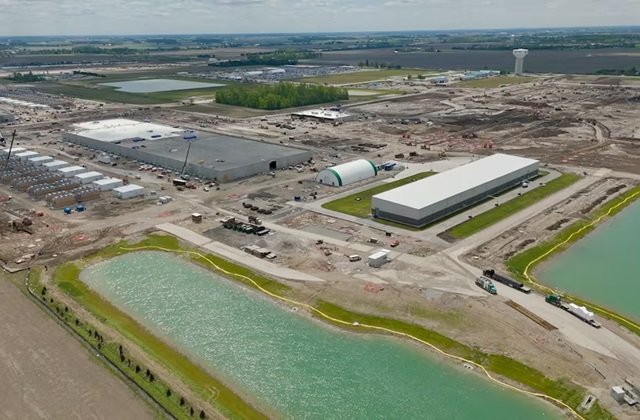
The disputes reflect a growing divide between the economic ambitions of technology companies and the concerns of communities expected to accommodate their infrastructure. Once relatively modest facilities, data centres have expanded into vast industrial complexes housing the servers and equipment required to operate internet services, cloud computing and increasingly sophisticated AI systems.
The political consequences are becoming difficult to ignore. According to the report, 20 states have approved measures to pause or prohibit data centre construction, while seven others are considering similar action. Texas, despite Republican Governor Greg Abbott’s ambition to establish the state as a centre of AI development, has also seen a halt to projects amid growing public resistance.
In Ohio, opposition to data centres has become an issue in a closely contested Senate race between former Democratic senator Sherrod Brown and Republican incumbent John Husted. A reported 63% of Ohio voters oppose the facilities, giving Brown an opportunity to challenge his opponent over his support for the industry. Campaigns and allied political groups have spent more than $53 million on advertisements mentioning data centres during the midterm election cycle.
The issue has also entered congressional contests in Pennsylvania. Democratic candidate Paige Cognetti has warned voters that large corporations have historically extracted resources from communities while leaving residents to deal with the consequences. Republican candidate Rob Bresnahan has similarly criticised the sector, arguing that companies view local communities primarily as land and potential profits.
Trump, however, has continued to defend the expansion. Speaking at a rally in Ohio, he argued that data centres would generate wealth and employment and that restricting them would risk allowing China to gain an advantage in AI. He has also suggested that communities rejecting the projects could become economically disadvantaged.
The scale of the proposed developments helps explain the intensity of the resistance. Meta’s planned Hyperion complex in rural Louisiana covers approximately nine square kilometres, equivalent to more than 1,260 football fields. Utah’s proposed Stratos Project was initially envisioned on a scale comparable to Manhattan before opposition forced a reassessment of its plans.
The United States already has 1,333 operating data centres, with another 2,359 in planning or under construction, according to market analysis firm Cleanview. Their economic footprint is expected to be substantial. Stijn Van Nieuwerburgh of Columbia University estimates that spending on data centres and the infrastructure required to support them could reach $10.3 trillion between 2025 and 2032, representing an average of 3.63% of annual US gross domestic product.
Technology companies argue that these facilities are indispensable to modern life. Without them, services ranging from online shopping and social media to streaming platforms and transport payment systems would struggle to function. Industry representatives also maintain that newer facilities have improved their efficiency, reducing water consumption and noise compared with earlier generations.
Yet public opinion suggests that enthusiasm for AI does not necessarily translate into support for the infrastructure behind it. An Annenberg Public Policy Center study at the University of Pennsylvania found that 61% of American adults opposed building data centres in their neighbourhoods in August, up 12 percentage points from a survey conducted in February and March. Only 14% expressed support. Even among people who regularly use AI, 60% opposed nearby data centre construction.
The resistance is not confined to Democrats. According to polling cited by El País from political analysis firm The Cook Political Report, 45% of Trump’s strongest supporters oppose data centres. Matthew Levendusky, a professor at the Annenberg centre, says public optimism about AI diminishes when questions arise about privacy, employment and the effects of local development.
Environmental pressures are central to the dispute. A Bloom Energy estimate cited in the report projected that US data centre electricity demand could rise from 80 gigawatts in 2025 to 150 gigawatts in 2028. Virginia, home to nearly 600 facilities, saw data centres account for 40% of electricity consumption in 2024, according to Bloomberg News analysis. Three-quarters of the state’s voters reportedly blame the facilities for rising electricity bills.
Water use presents another challenge, particularly in arid states. A single data centre may consume nearly 19 million litres of water a day for cooling, enough to supply approximately 16,000 average households. Backup generators powered by fossil fuels can also contribute to air pollution, while critics question whether facilities that employ substantial construction workforces will create many permanent jobs once completed.
Local accountability has become an equally contentious issue. Some municipalities have signed confidentiality agreements that prevent them from disclosing project details, leaving residents uncertain about what has been approved in their communities. At a recent meeting in Virginia’s Loudoun County, resident Patricia Gallardo complained that neighbours did not know whether the project under consideration matched the original plans.
The conflict exposes a broader question facing the AI industry: who should bear the environmental and economic costs of technological expansion, and how much influence should local communities have over decisions made in the name of national competitiveness? As the midterm elections approach, data centres have become a test of whether the promise of AI-driven prosperity can overcome growing concerns about the resources, transparency and public consent required to sustain it.