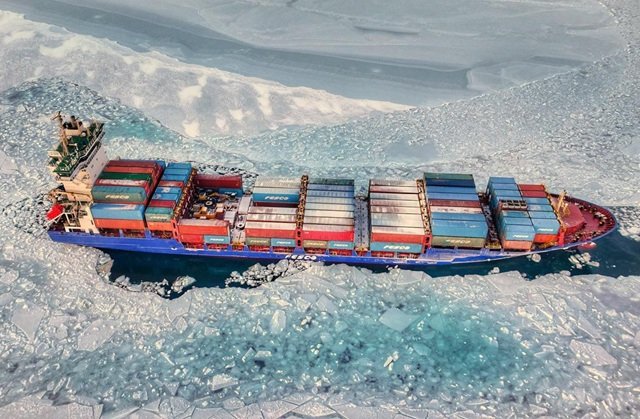
A South Korean container ship has completed the country’s first commercial round trip to Europe through the Arctic, arriving at the southeastern port of Busan on Sunday after a 50-day voyage that began on 22 August.
The voyage by the PanStar Acro marks a step towards South Korea’s plans to develop Arctic shipping as an alternative to conventional maritime routes. Authorities believe the passage could reduce typical voyage times by around a third and help transform Busan into a global maritime hub.
President Lee Jae Myung has made Arctic shipping a priority, and South Korean officials hope to establish regular services by 2030. The completed voyage provides an initial commercial test of the route, although questions remain over cargo demand, operating costs and the reliability of shipping schedules in Arctic conditions.
The PanStar Acro travelled through Arctic waters on its outbound journey before reaching Felixstowe in Britain, its first European port of call. It subsequently visited Rotterdam in the Netherlands and Gdansk in Poland before returning to South Korea via the Arctic. The vessel docked in Busan 50 days after its departure.
The route follows Russia’s Arctic coastline, creating potential diplomatic complications for Seoul as Western allies seek to maintain Russia’s isolation over its war in Ukraine. South Korea consulted Moscow about the voyage, including whether the vessel would require assistance if it encountered difficulties such as becoming trapped in ice.
The consultations reflect the practical considerations involved in operating a commercial shipping service through Arctic waters, where vessels may face conditions requiring additional support. The voyage also places South Korea’s maritime ambitions in a sensitive geopolitical context, given the route’s reliance on passage along the Russian coast.
Commercial demand emerged as one of the immediate challenges. Before the ship departed, PanStar told Reuters that it was seeking approximately 1,300 twenty-foot equivalent units (TEU) of cargo for the voyage. The vessel ultimately left with 737 TEU of cargo, alongside empty containers.
The difference between the targeted and actual cargo volumes provides an early indication of the difficulties in securing sufficient freight for the route. While the voyage demonstrated that a commercial round trip could be completed, the cargo figures leave questions about the level of demand that future services might attract.
Industry experts have identified several factors that will determine whether Arctic shipping can become commercially competitive. These include the reliability of sailing schedules, the costs associated with reducing speed to avoid ice, additional insurance premiums and increased fuel consumption.
Such expenses could affect the financial advantages of a route that authorities expect to shorten journey times by roughly one-third. The overall commercial value will therefore depend not only on the distance saved but also on the additional costs and operational requirements associated with navigating Arctic waters.
South Korea’s proposed timetable envisages regular Arctic shipping services by 2030, with Busan positioned as a central hub. The PanStar Acro’s return establishes a first commercial round-trip milestone for the country, while the cargo carried and the operational considerations identified during the voyage highlight the practical tests facing the planned service.