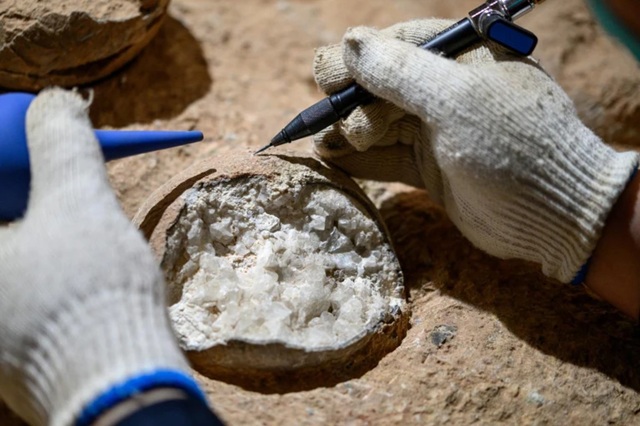
In a landmark achievement for paleontology, scientists in China have directly dated a fossilized dinosaur egg for the first time, determining it to be 85.9 million years old. The breakthrough, detailed today in Frontiers in Earth Science, was made possible by analyzing eggshell fragments from a nesting site in Shiyan, China, where a cluster of 28 fossil eggs had been discovered.
Traditionally, the age of fossilized dinosaur eggs has been estimated indirectly by dating volcanic ash or surrounding rock layers. However, this method can be imprecise, as the geological material might not have formed at the same time the eggs were laid. The new approach offers a more accurate timeline.
The research team employed laser ablation to vaporize minerals deposited on the eggshell’s surface during fossilization. By analyzing the proportions of uranium and lead isotopes within the mineral residue, the scientists were able to calculate the age of the fossil based on the known rate of uranium’s decay into lead.
“This is the first time that in situ isotopic ages have been reported for dinosaur eggshells both in China and, very likely, worldwide,” said Xing Cheng, a geologist at the Chinese Academy of Sciences in Xi’an and co-author of the study. The method has previously been used to date fossilized bones, teeth, rocks, and minerals but had never before been applied directly to dinosaur eggshells.
Implications for Paleontology
Experts believe this direct dating method could revolutionize the field by eliminating uncertainties around fossil ages. Guntupalli Prasad, a paleontologist at the University of Delhi, commented, “This will remove the uncertainties associated with the ages of many fossils,” underscoring the broader significance of the technique.
However, some researchers urge caution. Susannah Maidment, a paleontologist at the Natural History Museum in London, warned that geological processes such as diagenesis—which can alter the composition of materials between burial and fossilization—might affect dating accuracy. “Any attempt to directly date fossils must demonstrate that the mineralogy has not been altered by diagenetic processes, as this would result in an incorrect age estimation,” she said.
The authors acknowledged this concern but noted that prior research indicated minimal volcanic activity in the area and that the sampled eggshells were exceptionally well-preserved with no deformation, suggesting little to no post-burial alteration. They plan further studies to confirm their findings.
A Treasure Trove of Fossil Eggs
The Shiyan nesting site is part of the broader Qinling region, where dinosaur eggs have been uncovered since the late 20th century. These fossils have been widely exhibited in museums around the world and have drawn significant scientific and public interest.
Despite extensive excavations, paleontologists have not yet identified the species that laid the eggs. The newly confirmed age places the fossils in the Late Cretaceous epoch, a period spanning from roughly 100 million to 65 million years ago—a time when Earth was undergoing substantial global cooling.
Bi Zhao, a paleontologist at the Hubei Institute of Geosciences in Wuhan and co-author of the study, said, “The exact age of these fossilized eggs had remained unclear until now. Our findings mark a major step toward understanding the evolutionary history of dinosaurs.”