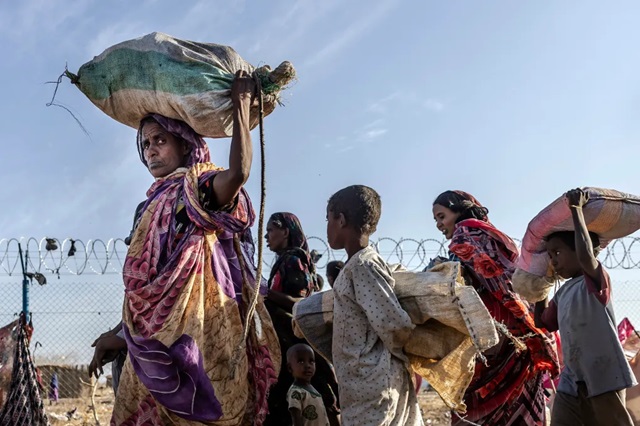
BNP Paribas, one of the world’s largest banks, is facing a high-profile trial in a Manhattan courtroom this week over allegations that it enabled human rights abuses in Sudan by providing financial services to the regime of former dictator Omar al-Bashir.
During opening arguments on Thursday, Bobby DiCello, the attorney representing a class of Sudanese refugees now living in the United States, accused the French bank of prioritizing profits over human suffering. “BNP Paribas never thought twice about the people of Sudan as it ran a profitable business in the country at a time of destruction and displacement,” DiCello told the jury.
The civil case, which was first filed nearly a decade ago, claims the bank’s financial support directly contributed to a campaign of violence and atrocities committed by Bashir’s government in the late 1990s and 2000s. “They knew what he was doing as they were giving him money and their services, their visits, their courtesies, their kindness and their professionalism,” DiCello asserted.
The lawsuit alleges that BNP Paribas facilitated Sudan’s access to US financial markets and petrodollars, enabling the regime to expand military spending. “More oil meant more dollars, more dollars meant more weapons and more weapons meant more killing and destruction,” DiCello added.
Omar al-Bashir, who led Sudan from 1989 until his ouster in 2019, was charged by the International Criminal Court with crimes against humanity, including war crimes, murder, torture, and genocide, for orchestrating military campaigns against civilians during internal conflicts such as the Darfur war and the second civil war.
BNP Paribas, however, denies any wrongdoing. Bank lawyer Dani James told the jury that “there’s just no connection between the bank’s conduct and what happened” to the plaintiffs. While expressing sympathy for the victims, James argued that the bank’s involvement was limited to issuing letters of credit and facilitating global trade, rather than directly funding violence. “The bank didn’t provide the regime with a bag of cash,” she stated. “It issued letters of credit which facilitated global trade and processed payments. These were just ordinary banking services.”
James also presented a historical timeline, arguing that the violence in Sudan predated the bank’s involvement and continued even after it withdrew from the country. BNP Paribas had previously pleaded guilty in 2014 to violating US sanctions by processing transactions for Sudanese, Iranian, and Cuban entities, agreeing to pay $9 billion in penalties. At the time, then-US Attorney Preet Bharara described the bank’s actions as “criminal support of countries and entities engaged in acts of terrorism and other atrocities.”
DiCello emphasized that BNP Paribas had, for a period, been “the single most important bank” in Sudan, and that its financial services were intricately linked to the dictator’s ability to wage war.
The trial is expected to last for 10 weeks and is one of the rare instances in which a global financial institution is being held accountable before a US jury for its alleged role in human rights violations abroad.