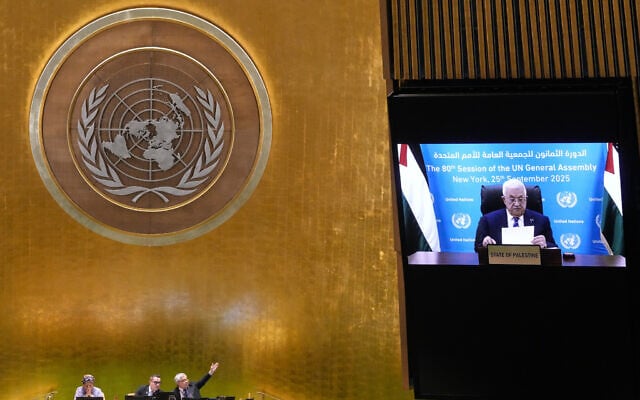
Palestinian President Mahmoud Abbas delivered a poignant speech before the United Nations General Assembly on Friday, strongly condemning the ongoing violence in Gaza and calling for Hamas to disarm as part of efforts to secure peace and build a unified Palestinian state.
In his speech, Abbas highlighted the devastating toll the war in Gaza has taken on the Palestinian people, denouncing what he described as “genocidal” acts by the Israeli forces that have led to the deaths of over 220,000 Palestinians, many of them women, children, and the elderly. The president also condemned Israel’s expansion of settlements in the West Bank and the ongoing human rights violations, stressing that such actions undermine international law and the potential for peace.
However, Abbas’s speech took a significant turn when he directly addressed Hamas, calling for the militant group to disarm and cease its role in governing Gaza. He declared, “We reject what Hamas carried out on October 7th—acts that targeted Israeli civilians and took them as hostages—because such actions do not represent the Palestinian people nor their just struggle for freedom and independence.”
Abbas stressed that the State of Palestine would be ready to assume full governance of Gaza, but only if Hamas and other factions agreed to disarm and place their weapons under the control of the Palestinian National Authority (PNA). “Hamas will have no role in governance,” he asserted, emphasizing that the aim is to build a unified state governed by a single law, under a legitimate security force. “We do not want an armed state.”
This bold call to disarm Hamas was a clear indication of Abbas’s long-standing position on the need for a peaceful, democratic Palestine, free from armed groups and violence. He reiterated that the Palestinian goal is not to have an armed state but to create a modern, civil society grounded in the rule of law and human rights.
The speech also highlighted the immense challenges faced by Palestinians, particularly those who continue to live in exile or under Israeli occupation. Abbas made an impassioned plea for international support for a two-state solution based on the 1967 borders, with East Jerusalem as the capital of Palestine. He urged the international community to end Israel’s occupation and to support Palestine’s bid for full UN membership.
He underscored that peace could only be achieved if Israel honored its commitments under international law and the numerous UN resolutions that have long gone unimplemented. His remarks served as a reminder of the decades of suffering endured by Palestinians since the Nakba in 1948, as well as the continuing trauma caused by displacement and occupation.
In closing, Abbas spoke directly to the Palestinian people, emphasizing their resilience and determination. “However deep our wounds, however long our suffering, they will not break our will to live and endure,” he said, drawing attention to the ongoing struggle for a free and independent Palestine.