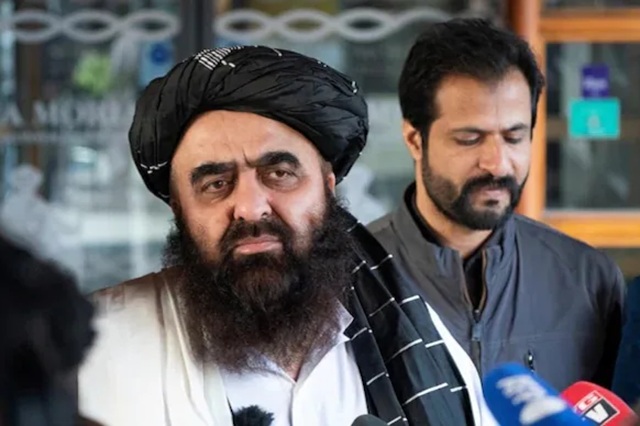
The anticipated visit of Amir Khan Muttaqi, the Foreign Minister of the Taliban government in Kabul, to New Delhi on October 9-10, 2025, represents a watershed moment in Afghanistan-India relations since the Taliban’s return to power in 2021. Having secured a temporary travel exemption from the United Nations Security Council (UNSC), Muttaqi will engage in talks with India’s External Affairs Minister S. Jaishankar in what is set to be the first high-level Taliban presence in New Delhi since the regime’s takeover. The meeting is not merely symbolic: it reflects a recalibration of India’s regional policy and underscores the evolving triangular dynamics between Afghanistan, India, and Pakistan.
India’s approach to the Taliban has been marked by cautious pragmatism. While New Delhi has refrained from formally recognising the regime, it has kept channels of communication open through humanitarian assistance, limited diplomatic outreach, and its “technical mission” in Kabul reopened in 2022 to oversee aid distribution. Multiple rounds of dialogue have already occurred, including meetings between Indian officials and Muttaqi in Dubai. This incremental engagement signals India’s recognition that complete isolation of the Taliban may undermine its ability to safeguard long-standing investments and influence in Afghanistan, while also limiting its leverage on pressing security concerns.
At the heart of India’s rationale is a complex web of strategic, humanitarian, and security considerations. For decades, Afghanistan has been central to India’s regional calculus, serving both as a potential partner for trade corridors-such as those linked to Iran’s Chabahar port – and as a buffer against the spread of terrorism. With the Taliban back in power, India fears Afghan soil could once again become a platform for anti-India terrorist groups. Engagement, therefore, becomes less a matter of choice than necessity: it offers the prospect of extracting commitments on counter-terrorism, while also sustaining humanitarian assistance for a population facing acute poverty, displacement, and infrastructural collapse.
Another compelling factor behind New Delhi’s diplomatic overture may lie in the Taliban’s alleged expression of support for India in the wake of Operation Sindoor, a military action that elicited negative reactions from many quarters of the international community. While there was no official statement endorsing the operation from Kabul, Pakistan’s Defence Minister claimed that the Taliban and Israel were the only regimes to back India’s position – a notion attributed to Indian defence analyst Pravin Sawhney. Although unconfirmed, this perception may influence India’s diplomatic calculus, framing the Taliban as a potential ally in South Asia’s fractious strategic orbit, signalling an unexpected alignment of interests.
For the Taliban, this visit offers both legitimacy and tangible opportunities. Direct dialogue with India provides Kabul with access to one of the region’s major powers, which could translate into humanitarian aid, technical cooperation, and trade facilitation. While India has hesitated to resume its large-scale development projects, it has signalled willingness to consider limited reconstruction initiatives and targeted humanitarian efforts. For a regime grappling with pariah status in much of the international community, the optics of being hosted in New Delhi strengthen its claim to diplomatic relevance.
The implications for Pakistan, however, are deeply unsettling. Historically, Islamabad has viewed Afghanistan as a strategic backyard that secures its western flank and provides leverage against India. While Pakistan played a significant role in facilitating the Taliban’s ascent, recent years have exposed the limitations of its influence. Kabul’s refusal to acquiesce to Islamabad’s demands on border management, particularly over accepting the Durand Line as the permanent border between the two countries, and its failure to curb militant threats emanating from groups like the Tehrik-e-Taliban Pakistan (TTP), have strained relations. The prospect of India building a parallel channel of influence with the Taliban regime raises alarms in Islamabad, potentially eroding Pakistan’s purported ‘strategic depth’ and altering the regional balance of power.
Internationally, Muttaqi’s visit tests the boundaries of diplomatic engagement with a regime accused of systematic human rights violations, suppression of women’s rights, and exclusion of minorities from governance. New Delhi has to balance its pursuit of tangible gains with the reputational risks of being seen as normalising an authoritarian and inequitable order. Yet, in an increasingly multipolar regional environment – where Iran, Russia, and Central Asian states are already engaging Kabul – India’s calculus appears driven by the risk of strategic marginalisation.
Muttaqi’s visit is more than symbolic diplomacy. It signals India’s willingness to engage substantively with the Taliban, though still avoiding outright recognition. For Afghanistan, it offers avenues of international legitimacy and potential material support. For Pakistan, it underscores an unsettling shift in the regional chessboard, where its monopoly over Kabul’s orientation is no longer guaranteed. Whether this visit produces concrete assurances on counter-terrorism, humanitarian cooperation, and infrastructure support remains to be seen, but the very fact of its occurrence suggests a turning point. The uncertainty dogging Afghanistan’s future reverberates across South Asia. New Delhi’s cautious yet deliberate engagement could reshape the triangular Afghanistan-India-Pakistan equation, setting the stage for either a fragile cooperation or a renewed cycle of rivalry.