by Our Correspondent in Colombo
It was one of those rare evenings that linger gently in memory, a night when music spoke a language older and deeper than words. On the evening of 3 November 2025, the British Council auditorium in Colombo became a bridge between cultures, hosting the Anatolian Turkish Music Ensemble in a concert organised by the Embassy of the Republic of Türkiye. For me, it was a first in many ways: my first time stepping into the British Council’s elegant hall, and my first encounter with the vast, emotional landscape of Turkish classical music. I do not speak or understand Turkish, yet what unfolded on that stage proved that music needs no translation.
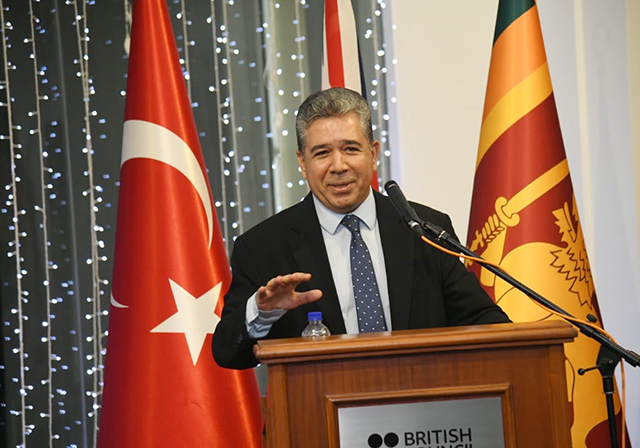
The evening began with a warm welcome from Orlando Edwards, the Country Director of the British Council, who spoke with genuine warmth about cultural exchange and the timeless power of art to connect people. His words were followed by the opening remarks of Semih Lütfü Turgut, the Ambassador of the Republic of Türkiye to Sri Lanka and the Maldives. The Ambassador spoke with quiet pride about Türkiye’s musical heritage, and about how the evening’s concert symbolised the friendship between the two nations. Behind the scenes, the embassy staff worked with discreet grace, ensuring that every detail was perfectly in place. There was an air of celebration but also of reverence, as if the walls themselves recognised that something special was about to unfold.
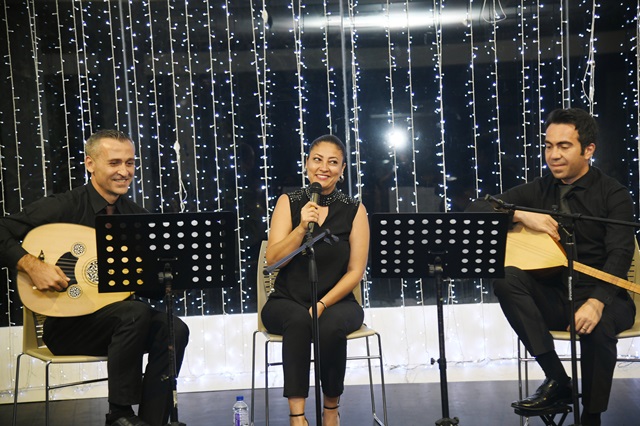
When the ensemble took their places, the stage seemed to glow with quiet anticipation. The performers—Pelin Demirçe Altıntaş, Meriç Dizbaş, and Yasin Bol—formed a trio of rare harmony. Together they carried the spirit of Anatolia into the heart of Colombo. Pelin Demirçe Altıntaş, the evening’s soloist, radiated both elegance and authority. A musician and scholar with a doctorate in music education, she has spent years teaching and directing ensembles at Anadolu University. Her presence was commanding yet gentle, her gestures flowing as naturally as breath. Seated beside her, Meriç Dizbaş played the tanbur and bağlama with calm concentration. He is not only a performer but also the Head of the Turkish Music Department at Anadolu University, and his deep understanding of the classical repertoire was clear in every note he produced. Completing the trio was Yasin Bol, a master of the oud, whose sensitive playing wove golden threads through the fabric of the music. An associate professor at the same university, he brought warmth and texture to the ensemble’s sound.
The programme was a journey through the refined world of Turkish classical music. The first pieces, Şedaraban Peşrev by Refik Fersan and Şedaraban Saz Semâisi by Tanburi Cemil Bey, opened the concert with dignity and grace. The peşrev, a form that traditionally begins a classical suite, carried an air of stateliness, setting the tone for what followed. I could not understand the technical structure or the melodic theory behind the performance, but the feeling was unmistakable—a deep, reflective beauty that reached across centuries. When the semâisi followed, the rhythm quickened and the melody seemed to move with a quiet longing. It felt both disciplined and emotional, like a conversation between heart and mind.
Next came the works in the makam Neveser, the Neveser Peşrev by Neyzen Yusuf Paşa and the Neveser Saz Semâisi by Necdet Yaşar. The shift in mood was subtle but powerful. These pieces seemed to hover between joy and sorrow, between light and shadow. Even without words, they carried an unmistakable sense of yearning, as if telling an ancient story that the listener could feel rather than understand. The ensemble played with complete unity, each musician responding intuitively to the others, creating moments of silence as expressive as the notes themselves.
The second half of the programme moved into the makam Nihavend, one of the most beloved modes in Turkish music. The Nihavend Saz Semâisi by Neyzen Tevfik and the version by Vecdi Seyhun were both graceful and tender, filled with romantic melancholy. The sound of the oud lingered like a sigh, while the tanbur’s delicate phrasing seemed to trace invisible patterns in the air. For me, it was at this point that the emotional power of the music became overwhelming. Although I could not name the intervals or the rhythmic cycles, the feelings they evoked were universal: longing, reflection, the sweetness of memory. I found myself thinking of how the essence of music transcends every border and every language, speaking directly to what we all share as human beings.
The concert concluded with two radiant pieces in the makam Sultaniyegâh, both composed by Refik Fersan: the Sultaniyegâh Peşrev and the Sultaniyegâh Şirto. After the quiet introspection of the earlier works, these pieces arrived like sunlight after dusk. The peşrev was noble and expansive, while the şirto, a lively dance form, brought an air of celebration and joy. It was as though the entire concert had been a journey through the soul—from contemplation to exaltation, from solitude to shared delight. As the final notes faded, the audience remained silent for a heartbeat before breaking into warm applause. It was not the kind of applause that comes from mere enjoyment; it was the applause of gratitude, of people moved by something beautiful and genuine.
What made the evening unforgettable was not only the mastery of the musicians but the spirit behind their art. Turkish classical music, with its makams and intricate rhythmic cycles, is centuries old, shaped by influences from Central Asia, the Middle East, and the Mediterranean. It carries traces of empires, mysticism, poetry, and devotion. Yet on that evening, none of this history felt distant or foreign. It felt alive, immediate, and deeply human. The musicians played with humility and passion, and through their music, they opened a window to a world that felt both ancient and familiar.
For me, it was extraordinary to realise how powerfully music can communicate across difference. I left the auditorium feeling that I had understood everything that mattered. The melodies, the pauses, the delicate shifts of tone—all spoke of emotions that belong to every heart. It was as if the University of Music itself had found a way to reach into each of us, reminding us that art is not about explanation but about shared inspiration.
There was a sense that something meaningful had taken place—something more than a diplomatic event, more than a concert. It was a meeting of souls, a reminder that even in a world of differences, we are united by our capacity to feel.
The sounds of the tanbur, oud, and bağlama still echoed in my mind, carrying traces of places I had never been, yet somehow recognised. It had been a wonderful evening, one that transcended the boundaries of culture and language. It was my first experience of Turkish classical music, my first time at the British Council, and my first real understanding of how music can connect people from different worlds. I may not have understood a single word, but I understood everything that mattered.