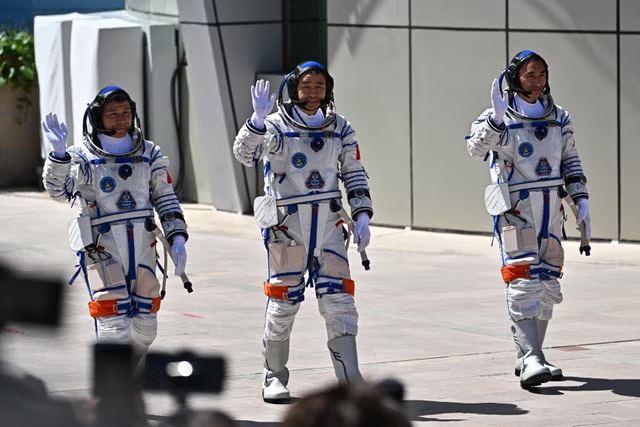
Chinese astronauts stranded aboard the Tiangong space station are set to return to Earth on Friday, after a suspected piece of space debris damaged their spacecraft and delayed their original departure. The crew, Wang Jie, Chen Zhongrui, and Chen Dong, part of the Shenzhou-20 mission, had initially planned to return on November 5, but the unexpected impact forced the China Manned Space Agency (CMSA) to postpone their trip.
The three astronauts have been living aboard the space station since April, performing maintenance and research tasks during their six-month mission. Their return will now be aboard the Shenzhou-21 spacecraft, which brought a replacement crew to Tiangong last month. Two crews are currently aboard the orbital outpost, ensuring continuity of operations while repairs and assessments are conducted.
CMSA confirmed that all three astronauts are in good health and that preparations for their landing at the Dongfeng Landing Site in Inner Mongolia are underway. The exact timing and location of the suspected debris strike remain unclear, and the agency continues to assess the risks associated with the incident. Emergency response protocols were activated following the postponement, highlighting the rigorous safety measures in place for China’s space missions.
The Shenzhou-21 crew, who arrived on November 1, will return to Earth next year aboard their own spacecraft. Meanwhile, a Shenzhou-22 spacecraft is being prepared for a future launch from the Jiuquan Satellite Launch Centre in the Gobi Desert to support ongoing missions.
This event underscores the growing threat posed by space debris. Last year, debris from a destroyed Russian satellite forced astronauts on the International Space Station to seek shelter for nearly an hour. Experts estimate there are over 200,000 pieces of space junk between 1-10 centimeters and tens of thousands of larger objects, creating a crowded and hazardous environment in Earth’s orbit.