Bangladesh now stands at the precipice of a judicial disgrace. Former Prime Minister Sheikh Hasina has denounced the so-called International Crimes Tribunal (ICT) as a politically choreographed “hatchet job,” and the evidence for such an accusation grows more compelling by the day. With a verdict due on 17 November, the trial has all the hallmarks of a process designed not to uncover truth but to dismantle a grand political legacy.
Hasina’s warning is stark: the tribunal is “neither international, nor even a tribunal.” Rather, it is an apparatus captured by political adversaries determined to engineer a preordained guilty verdict and thereby cripple the Awami League as a national political force. It is difficult to dismiss the charge when the proceedings themselves bear the unmistakable stain of political interference—from the timing of the indictment to the theatrical urgency with which the case has been pushed forward.
The prime minister, now in forceful exile in India, already faces a six-month sentence for contempt of court, and separate corruption charges have been stacked alongside the ICT case. Several senior figures from her government, including the former interior minister and police chief, face prosecution as well—signaling a sweeping purge rather than a sober pursuit of accountability. One former official has pleaded guilty under circumstances that many observers view with deep skepticism.
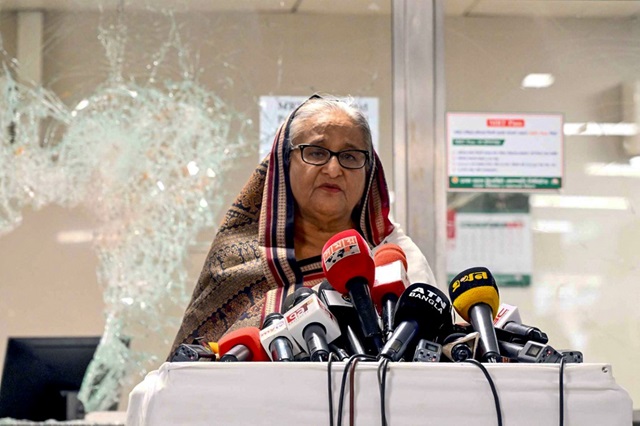
In an interview with This Week in Asia, Hasina forcefully defended her handling of last year’s student protests, insisting that what began as peaceful demonstrations devolved into violent unrest, compelling state intervention. To allege that she ordered lethal force, she argues, is a fabrication unsupported by credible evidence. “My political adversaries have alleged this but have shown no persuasive evidence,” she said. “Because there is none.”
That absence of evidence, however, appears irrelevant in a trial whose trajectory seems predetermined. Conducted largely in her absence, the proceedings have lacked transparency, procedural rigor, and the judicial restraint expected of a tribunal claiming international legitimacy. Instead, they have deepened political fissures, ignited public anger, and cast a long shadow over the rule of law in Bangladesh.
Tensions are already boiling. The Awami League has announced a nationwide “lockdown” on 13 November 2025 in protest, prompting schools in Dhaka and other major cities to shift online. Public transport has been disrupted as security forces tighten control ahead of the verdict. The interim government, meanwhile, has further inflamed the crisis by banning all Awami League activity under the Anti-Terrorism Act—a move that Hasina rightly condemns as incompatible with democratic norms.
“An election where the Awami League is banned is neither free, fair, nor inclusive,” she told SCMP. It is impossible to argue otherwise. Bangladesh cannot credibly claim to be progressing toward democratic renewal while excluding a party supported by tens of millions of citizens. To disenfranchise such a vast share of the population is not governance—it is political erasure.
As 17 November approaches, the verdict risks becoming the spark that plunges the nation into deeper turmoil. What should have been a meticulous and transparent judicial process has instead hardened perceptions that the tribunal is being wielded as a political weapon. If the ICT proceeds to deliver a verdict that appears scripted rather than adjudicated, the damage to Bangladesh’s judicial integrity will be profound—and possibly lasting.
Bangladesh deserves justice that is impartial, credible, and free from political manipulation. What it is receiving instead is a judicial spectacle—one that threatens not only Sheikh Hasina’s political fate but the nation’s democratic future itself.