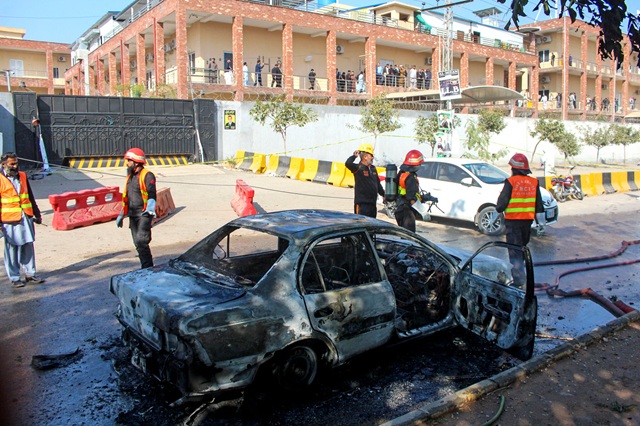
On November 11, 2025, at least 12 people were killed and 36 injured in a suicide blast outside the District and Sessions Court building in the G-11 area of the Islamabad Capital Territory (ICT). While briefing the media outside the Court, Interior Minister Mohsin Naqvi gave details of the attack: “He first attempted to go inside the Court, but then targeted the Police vehicle after he was unable to do so.” The Jamaat-ul-Ahrar (JuA), a sub-group of the Tehreek-e-Taliban Pakistan (TTP) claimed responsibility for the attack.
Before this suicide bombing, Islamabad had faced a TTP-orchestrated suicide attack in 2022, as a vehicle with a man and a woman aboard detonated when the Police stopped their vehicle in I-10/4 sector on December 23. A Policeman was killed and at least six people – including four Police officers and two civilians – were injured in this incident. A TTP statement claimed responsibility for the attack, but shortly after, Sarbakaf Mohmand, a commander from the group, sent a WhatsApp messages insisting the group had not made any such claim.
Before 2022, the last suicide attack in Islamabad was on March 3, 2014, when at least 11 people, including Additional District and Sessions Judge Rafaqat Awan, a woman lawyer, and a Policeman, were killed and 25 were injured when militants attacked the courthouse complex in Sector F-8 on. Spraying bullets and hurling hand grenades, the terrorists later exploded their suicide vests. TTP ‘spokesman’ Shahidullah Shahid, while distancing the group from the attack, stated, “We have already declared a ceasefire and we strictly adhere to our deal with the Government. Our colleagues in the organisation also cannot violate this agreement”. Meanwhile, Asad Mansoor, the ‘spokesman’ of Ahrar-ul-Hind (AuH), a TTP splinter group, claimed responsibility for the attack.
However, occasional incidents of terrorism have persisted, though no year has crossed double digits in fatalities. Of the three terrorism-related incidents in 2025, so far, the November 11-sucide blast has been the only one to inflict fatalities. The two other terrorism-related incidents were:
On May 31, an official of the Frontier Corps (FC) was injured in a shooting by unidentified assailants in the Chatha Bakhtawar area under the Shahzad Town Police Station in the Islamabad Capital Territory (ICT). According to Police, the FC official was sitting outside his house when the attackers opened fire on him, and then fled.
On January 3, a Police Station was targeted in a ‘rocket’ attack, subsequently claimed by TTP, in the I-9 area of ICT. Police later discovered a ‘mini-rocket’ on the station’s outer walls.
2024 recorded just one terrorism-related fatality in Islamabad. On January 5, 2024, the central deputy secretary general of the Sunni Ulema Council of Pakistan, and spokesman of Ahle Sunnat Wal Jama’at (ASWJ), Allama Masood-u-Rehman Usmani, was shot dead by unidentified assailants in the Ghori Town area of Islamabad. Another four incidents of terrorism – one each of recovery, extortion, arrest and abduction – were reported through the year.
However, two incidents in 2024 had created a sensation within security agencies, prompting heightened security measures in the national capital. On April 3, a newly emerged terrorist group, the Tehreek Tahaffuz Namoos-i-Pakistan (TTNP) sent threat letters to five judges of the Supreme Court. Then, on April 5, another five judges of the Supreme Court received threatening letters. All the letters had traces of arsenic powder on the envelopes to Supreme Court justices.
Nevertheless, conditions in the national capital were far better than the overall security situation in the country. The ICT Police Counter-Terrorism Department (CTD) to manage the terrorist threat in the heavily securitized capital, conducted 52 intelligence-based operations (IBOs), 141 search operations, and blocked 565 social media accounts promoting linguistic, sectarian, and religious extremist content in 2024. At least 46 accused were arrested, 1.480 kilograms of explosives, 10 detonators, and 10 feet of safety fuse wire, two meters of prima cord, eight grenades, mortar shells, IEDs, one mine, 2.64 kilograms of ball bearings, nuts, bolts, five pistols, and a Kalashnikov with ammunition were recovered in these operations. CTD sent 2,161 social media reports to the Pakistan Telecommunication Authority (PTA) and Federal Investigation Agency (FIA) for legal action against accounts involved in promoting linguistic, sectarian and religious extremist content. In 2024, CTD compiled a record of more than 12,400 Afghan citizens living in the Federal capital, while 92 illegal Afghan citizens were deported.
The identification of the Islamabad District Court suicide bomber as an Afghan national underlines the vulnerability of the National Capital as, according to a 2025 UNHCR report, approximately 41,520 Afghan refugees reside there. An entire Afghan-based cell involved in the Islamabad suicide blast, including its ‘commander’ and three cadres, was arrested by security agencies on November 13. The Federal Government, in an official statement, disclosed, on November 14, that a joint Intelligence Bureau-CTD operation arrested four cadres of a TTP cell linked to the suicide attack. The official statement, shared on X, added,
During interrogation, Sajidullah alias Sheena, the handler of the suicide bomber, confessed that TTP/FAK (Fitna al-Khawarij) Commander Saeed-ur-Rehman alias Daadullah (resident of Charmang, Bajaur, currently in Afghanistan, and serving as TTP’s Intelligence Chief for Nawagai, Bajaur) contacted him through the Telegram application to carry out a suicide attack in Islamabad to cause maximum casualties of LEAs (law enforcement agencies)… Daadullah sent pictures of the suicide bomber (SB) Usman alias Qari to Sajidullah alias Sheena for receiving him. SB (suicide bomber) Usman Qari belonged to the Shinwari tribe and was a resident of Achin, Nangarhar, Afghanistan. When he reached Pakistan from Afghanistan, Sajidullah alias Sheena arranged his stay in a residence near Islamabad… On the directions of Afghanistan-based TTP/FAK (Fitna al-Khawarij) Commander Daadullah, Sajidullah alias Sheena collected a suicide jacket from Akhun Baba graveyard in Peshawar and brought it to Islamabad. On the day of the blast at Judicial Complex G-11, Sajidullah Sheena set the suicide jacket on SB Usman alias Qari. The network was handled and guided at every step by the Fitna al-Khawarij/TTP high command based in Afghanistan.
Prime Minister Shehbaz Sharif on November 11 accused India of orchestrating the suicide bombing in Islamabad. In an official statement, Sharif called on the international community to “condemn India’s conspiracies,” saying that “the real face of India has been exposed.” He vowed that Pakistan would not allow “the blood of its citizens to go in vain” and promised to intensify efforts to eliminate terrorism from the country.
Meanwhile, Defence Minister Khawaja Asif attributed the attack to the Taliban regime in Afghanistan, claiming that terrorist networks operating from Afghan territory continued to infiltrate Pakistan. Asif warned that Pakistan might conduct strikes against ‘terrorist sanctuaries’ inside Afghanistan, declaring, in an X post, “We are in a state of war. Anyone who thinks that the Pakistan Army is fighting this war only in the border areas along Afghanistan or in the remote regions of Balochistan should take the suicide attack in Islamabad as a wake-up call.” Further, speaking on the Geo News programme ‘Aaj Shahzeb Khanzada Kay Sath‘, Defence Minister Asif insisted that cross-border action inside Afghanistan could not be “ruled out”.
The Taliban regime denied all involvement, and expressed regret for the tragedy, but Asif rejected these statements, claiming that such expressions of regret could not “be taken as proof of sincerity.” Further, he asserted that “Those sheltered by the Afghan Taliban are repeatedly attacking us”, and “Pakistan will never initiate any military adventure,” but “We will not let any act of aggression go unanswered; we will respond forcefully.”
India unequivocally rejected as baseless Pakistan Prime Minister Shehbaz Sharif’s allegations linking the terrorist attack in Islamabad to New Delhi, dismissing the statement as a predictable tactic by the “delirious” leadership of that country to “concoct” false narratives. External Affairs Ministry spokesperson Randhir Jaiswal added that the international community was well aware of the reality and would not be misled by Pakistan’s “desperate” ploys.
Despite the internal contradictions in Pakistan’s allegations, the court suicide blast can only further worsen the already fraught relations between Pakistan and Afghanistan, as the 3rd round of peace talks between the two nations ended in deadlock at Istanbul on November 6-7, 2025. Pakistan’s primary demand was that the Afghan Government take action against the TTP and prevent the use of Afghan soil for attacks against Pakistan. Afghanistan accused Pakistan of making “unreasonable and impractical” demands and of attempting to shift the entire responsibility for its internal security problems on to the Afghan Government. Pakistani Defence Minister Asif declared that the talks were “over” and there was “no plan for any future meetings,” indicating an indefinite pause in the dialogue process. Meanwhile, Afghan Taliban spokesperson Zabihullah Mujahid claimed that specific elements in the Pakistani military were “deliberately sabotaging” the Pakistan-Afghanistan peace process.
The Islamabad court attack underscores the resurgence and increased operational capabilities of the TTP and highlights failures in Pakistan’s counter-terrorism strategy and intelligence apparatus, which struggles to penetrate TTP networks operating from Afghan territory. It reiterates, moreover, the persistent contradictions of Pakistan’s foreign policy, long focused on creating terrorist mischief for its neighbours, and the blowback that has now resulted.