Leif Erikson and his Norse crew reached North America around the year 1000, establishing an outpost in present-day Newfoundland nearly five centuries before Christopher Columbus crossed the Atlantic in 1492. Yet while the United States continues to observe Columbus Day as a federal holiday, Erikson’s achievement receives comparatively limited public recognition. A Washington Post report examining the historical evidence and politics behind the two commemorations traces how archaeology, medieval Icelandic sagas and campaigns by immigrant communities helped determine which explorer became the better-known figure.
The Norse settlement, known in the sagas as Vinland, was discovered in 1960 at L’Anse aux Meadows on Newfoundland’s northern coast by Norwegian explorer Helge Ingstad and his wife, archaeologist Anne Stine Ingstad. The site contained the remains of eight structures built from wood and turf, including three longhouses, an iron forge and several workshops. Archaeologists also recovered iron nails, ship rivets, bone needles and a bronze ring-headed cloak pin. The buildings resembled those constructed by Norse communities in Iceland and Greenland, providing the first archaeological evidence of European contact with the Americas before Columbus.
Radiocarbon dating initially placed the settlement’s use between 990 and 1050. In 2021, researchers at the University of Groningen in the Netherlands established a more precise date for three pieces of wood cut at the site. By counting tree rings and identifying the radiocarbon signature of a solar disturbance known to have occurred in 993, the scientists dated the wood to 1021. The finding provided a specific year for Norse activity in North America.
The settlement’s purpose remains uncertain, although its physical characteristics suggest that it was not intended to support a large, permanent population. Its relatively modest accommodation, absence of burial sites and comparatively shallow waste deposits point towards a temporary base. Archaeologist John Steinberg of the University of Massachusetts Boston suggests that Norse communities may have operated a network of seasonal stations, including sites for fishing, dairy production and other activities.
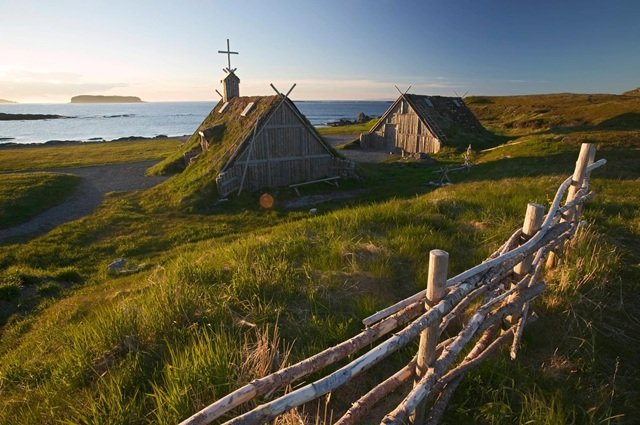
Historian Eleanor Barraclough, author of “Beyond the Northlands: Viking Voyages and the Old Norse Sagas”, describes L’Anse aux Meadows as an outpost used to support further journeys. The site may have allowed Norse crews to repair ships during winter before travelling farther inland or southwards. Butternut shells discovered there offer evidence that the visitors reached regions beyond Newfoundland or exchanged goods with people who had travelled from those areas. Butternut trees do not grow naturally on the island, and their presence suggests connections with places such as New Brunswick or the Saint Lawrence River Valley.
The account of these voyages comes principally from the Saga of the Greenlanders and the Saga of Erik the Red, Icelandic works written in the 13th century, roughly 250 years after the events they describe. Their narratives contain genealogies, geographical information and accounts of Norse encounters with Indigenous peoples, but also supernatural episodes and contradictions that complicate their use as historical records.
Barraclough argues that the sagas remain valuable navigational sources because they preserve practical information about travelling across the North Atlantic. “Part of it is the stuff you need to know to survive out in the world, which is directions and how to get across seas,” she says. “And so that material is really quite neatly mapped.” The Norwegian explorers who found L’Anse aux Meadows used these descriptions to identify the likely location of the settlement.
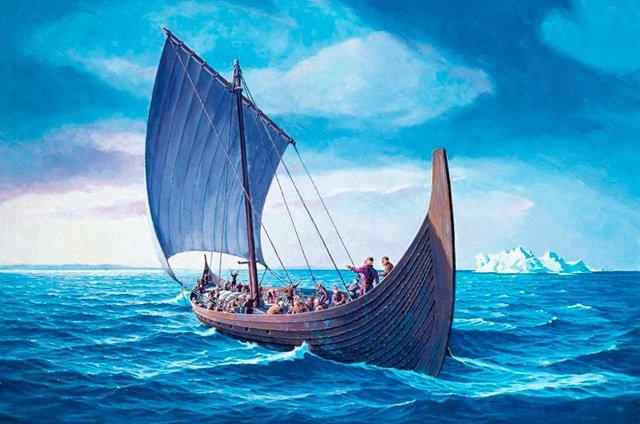
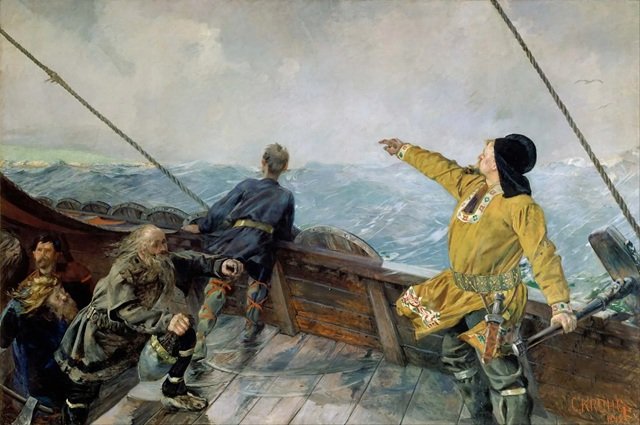
According to the sagas, Leif Erikson was inspired to explore westwards by the Icelandic merchant Bjarni Herjólfsson, who had sighted land after being blown off course while travelling towards Greenland. Leif acquired Herjólfsson’s ship and retraced the route with a crew of 35. He encountered territories he called Helluland, believed to be present-day Baffin Island in Nunavut; Markland, identified with Labrador; and Vinland, associated with the Newfoundland settlement.
The sagas describe both friendly and violent encounters between the Norse and Indigenous inhabitants. They also recount the experiences of Gudrid Thorbjarnardóttir, the widow of Leif’s brother Thorstein Erikson. Gudrid is said to have remarried and given birth to Snorri, believed to have been the first child of European descent born on the North American mainland. The duration of Norse contact with Vinland is uncertain, although researchers consider sporadic visits over several decades plausible. A 14th-century report of a ship blown off course from Markland and arriving in Iceland suggests that journeys to the region may have continued long after the initial settlement.
Columbus, by contrast, left a more extensive documentary record. His 1492 voyage to the Caribbean was described by the contemporary writer Bartolomé de las Casas, a lawyer and Dominican friar who drew partly on Columbus’s own logs. Columbus never reached the North American continent, although his voyage initiated sustained European expansion into the Americas. Steinberg attributes the difference in public recognition partly to the historical records available for each explorer. “Columbus had better PR,” he says. “The Vinland Sagas are stories told around a campfire. We have legends and archeology but no real history. … With Columbus, someone writes the story from his point of view.”
Columbus Day also developed through political campaigns that connected his legacy with Italian American identity. The first known celebration took place in New York on 12 October 1792, marking 300 years since his landfall. An explicitly Italian American observance followed in 1866, when Italian immigrants faced discrimination in the United States. After a mob lynched 11 Italian immigrants in New Orleans in 1891, Italy severed diplomatic relations with the United States. President Benjamin Harrison proclaimed 12 October a national holiday the following year. Lobbying by the Knights of Columbus and prominent Italian Americans eventually helped secure federal holiday status in 1937 under President Franklin D. Roosevelt.
The commemoration has since become contested because Columbus and subsequent European colonisation brought enslavement, disease and death to Indigenous populations. South Dakota replaced Columbus Day with Indigenous Peoples Day in 1989, and more than a dozen states and the District of Columbia subsequently adopted the alternative observance. President Joe Biden became the first US president to proclaim Indigenous Peoples’ Day in 2021, alongside Columbus Day. President Donald Trump, meanwhile, proclaimed Columbus “the original American hero” in 2025 and said he was “bringing Columbus Day back from the ashes”.
Leif Erikson has also received official recognition, following a separate campaign led by Scandinavian Americans. Rasmus B. Anderson’s 1874 book, “America Not Discovered by Columbus”, helped popularise the Norse claim, although it included unsupported assertions that Erikson travelled to present-day New England. President Calvin Coolidge called Erikson the discoverer of America in 1925, and President Lyndon B. Johnson proclaimed Leif Erikson Day a national observance in 1964. Celebrated annually on 9 October, the date commemorates the arrival of Norwegian immigrants in New York Harbor in 1825 rather than an event in Erikson’s life.