Hundreds of major cities around the world are sinking by several millimetres a year, with the fastest rates recorded in parts of Mexico, Iran and South-east Asia, according to a study published in the scientific journal Nature Cities. Researchers used satellite measurements to track changes in the elevation of 465 cities with populations exceeding one million across 107 countries since 2014.
The study found that Asian cities had the highest median rates of subsidence, reaching 33 millimetres a year. At that rate, the ground would sink by about one-third of a metre over a decade. The researchers identified groundwater extraction and urban development among the factors contributing to the problem, alongside natural processes affecting the ground beneath cities.
The research used data from the European Space Agency’s Sentinel-1 satellite, which employs interferometric synthetic aperture radar (InSAR) to detect changes in the Earth’s surface with millimetre-level precision. The technique sends microwave pulses towards the ground and records changes in the phase of the returning signals as the satellite repeatedly passes over the same location, allowing researchers to measure whether the surface has risen or fallen.
Although Asian cities recorded the highest median subsidence rates, the extent of sinking varied considerably between regions. European cities had the lowest median rate, at about three millimetres annually, followed by Oceania at four millimetres and Africa at six millimetres. Cities in the Americas recorded rates of up to 17 millimetres a year.
In Spain, Madrid was found to be sinking by just 0.2 millimetres annually, while Barcelona was subsiding by 0.9 millimetres. The study noted that subsidence generally tended to be greater in coastal settlements, where interactions with seawater could influence ground conditions.
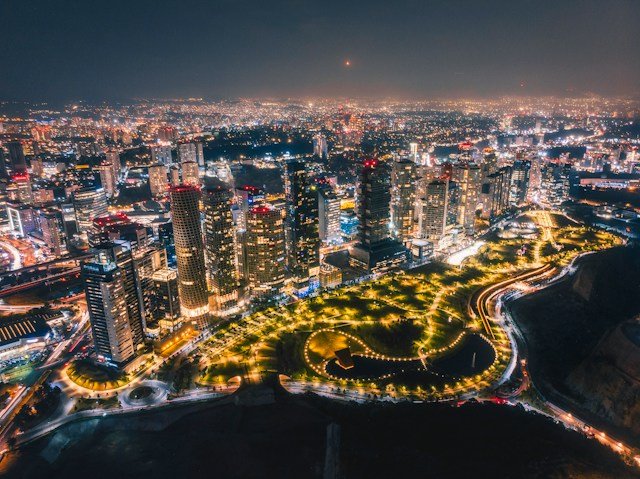
The most extreme measurements revealed much faster declines in particular areas. Mexico City had sections of land sinking at 216.5 millimetres a year, equivalent to almost a metre every four years. The Indonesian cities of Bandung and Medan followed, with some areas sinking by around 100 millimetres annually.
The researchers also measured the proportion of urban land sinking at more than 10 millimetres a year to assess how widely the problem affected each city. Medan and Bandung ranked prominently on this measure, followed by cities including Bogotá in Colombia, Florianópolis in Brazil and Mexico City.
Indonesia illustrates the range of processes that can contribute to subsidence. These include the compaction of sediments, mining, groundwater extraction, the accumulated weight of buildings and coastal geography. Jakarta, the Indonesian capital, has also faced severe subsidence, contributing to plans to relocate the seat of government.
Robert J. Nicholls, director of the Tyndall Centre for Climate Change Research at the University of East Anglia in Britain, said there was no universal rate at which subsidence became dangerous because the consequences depended on local conditions.
“Differential subsidence — that is, spatial variations in the rate of subsidence over short distances — can cause buildings to collapse; the Leaning Tower of Pisa is due to this process,” Nicholls wrote. He said a rate of 10 millimetres a year, or one metre a century, could serve as a rough threshold for concern, although the figure was somewhat arbitrary.
The study also identified cities where the ground was rising rather than sinking, including several in Europe and Japan. Osaka provides an example of how restrictions on groundwater extraction can reverse subsidence. Pumping to supply the city, which now has 15 million residents, had lowered the water table by about 30 metres and caused subsidence of two metres in some locations. Restrictions on extraction and the use of alternative water sources have since helped reverse the trend, with Osaka now rising by about four millimetres a year.
Parts of north-eastern China, including Beijing, have also begun recovering after years of subsidence. Roberto Tomás Jover, a civil engineering researcher at the University of Alicante and co-author of a global subsidence map, said a water-transfer project launched in 2002 had helped reduce dependence on groundwater extraction. Since 2016, the Beijing-Tianjin corridor, home to about 50 million people, has been rising.
Tomás Jover cautioned, however, that the damage caused by groundwater depletion was not always reversible. As water is removed from the spaces between soil particles, the ground becomes more compact and loses volume. A substantial proportion of that volume loss, he said, is permanent and irreversible.