by Durga Velayudham
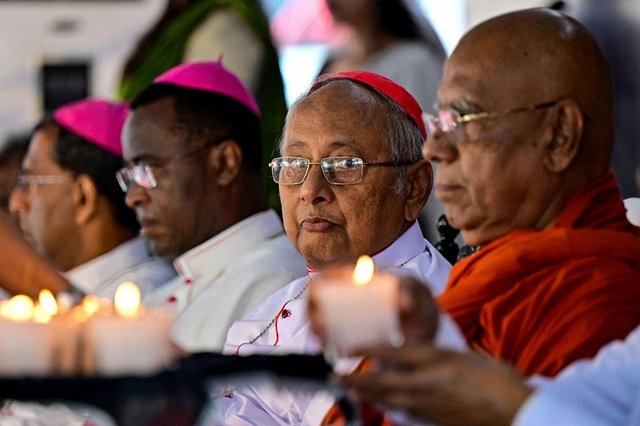
Soon after the landmark judgment in the Easter Sunday attacks case, in which 15 defendants were convicted and sentenced to lengthy prison terms, including sentences ranging from 200 to 260 years, Cardinal Malcolm Ranjith has remained a conspicuously restrained public voice on the wider political questions now unfolding around religion, national identity and the authority of the clergy. The verdict delivered in September 2026 was a significant moment in the long struggle for accountability following the massacre of worshippers at churches and visitors at hotels on 21 April 2019. Yet, as Buddhist monks march from Kandy towards Colombo demanding the release of Galagoda Aththe Gnanasara Thera, and as sections of the Sangha warn that Buddhism is under threat, a troubling question arises. Where does the Cardinal stand when the religious identity of the country becomes the subject of political mobilisation, and where does his earlier defence of Buddhism lead us now?
The question is not whether Ranjith has literally said nothing. He issued a statement on 10 August opposing capital punishment while demanding that those who planned and masterminded the Easter attacks be identified and held accountable. In February, he also criticised government ministers whom he accused of insulting Buddhist monks. The question, therefore, is more exacting. Why has his public language on Buddhism been so emphatic at certain moments, while the present confrontation between sections of the Sangha and the state raises difficult questions about the relationship between religious authority, the law and democratic citizenship? Has he offered a consistent moral principle, or has his interventions been shaped by the political circumstances in which they were made?
Ranjith’s words have been remarkably unambiguous. In May 2019, when anti-Muslim violence followed the Easter attacks, he declared, “This is a Buddhist country and Buddhism is the spinal cord of the country’s culture.” He also urged Muslims to participate in the country’s shared culture, while warning those involved in attacks on Muslim communities to stop. He called for a new Sri Lanka in which Sinhalese, Tamils, Muslims, Christians, Buddhists and Hindus could live together in unity. The tension within these remarks deserves attention. On one hand, he recognised the cultural centrality of Buddhism. On the other, he acknowledged the country’s plurality and condemned violence against a vulnerable minority. These positions need not contradict each other. But they require a clear principle explaining how a Buddhist cultural inheritance can be respected without becoming a licence for religious hierarchy, exclusion or political coercion.
In December 2020, Ranjith went further. Speaking at Malegoda Sri Pushparamaya Temple in Payagala, he described Buddhism as “a great blessing” and “a great gift” received by Sri Lanka. He cited the country’s stupas as evidence of the devotion of its ancient kings and declared that Sri Lanka was a Buddhist nation. “No one can deny this fact,” he said, adding that it was foolish to say otherwise. He also warned national leaders against making decisions that would harm Buddhism. These were not incidental remarks by a religious figure speaking privately. They were public interventions by the head of the Catholic Church in Colombo, lending the authority of a major Christian institution to a particular account of Sri Lanka’s historical and cultural identity.
There is a legitimate historical argument behind recognising Buddhism’s extraordinary influence on Sri Lankan civilisation. Its monasteries, literature, art, education and political traditions have shaped the island for centuries. Acknowledging that history does not require anyone to deny the existence or contributions of other communities. But the language of a “Buddhist nation” becomes politically consequential when it is used to settle questions about who belongs, whose historical claims receive state recognition, whose religious sites are protected and whose criticism is considered acceptable. A cultural description can become a political instrument. The crucial question is not whether Buddhism has shaped Sri Lanka, but whether that historical truth should determine the rights and standing of citizens who do not belong to the Buddhist majority.
Ranjith’s own comments in 2021 contained a qualification that deserves to be remembered. In an interview with Milinda Moragoda, he acknowledged Buddhism’s deep influence on Sri Lankan culture but rejected the idea that this required a monocultural social arrangement. He compared the different communities to branches contributing to the wellbeing of a single tree. That image offers a more generous understanding of national belonging than the blunt assertion that Sri Lanka is a Buddhist nation. It recognises historical inheritance without reducing citizenship to religious identity. If this remains his position, the present controversy provides an opportunity to restate it with clarity, particularly when some demands made in the name of Buddhism touch upon the rights of non-Buddhists and the limits of political power.
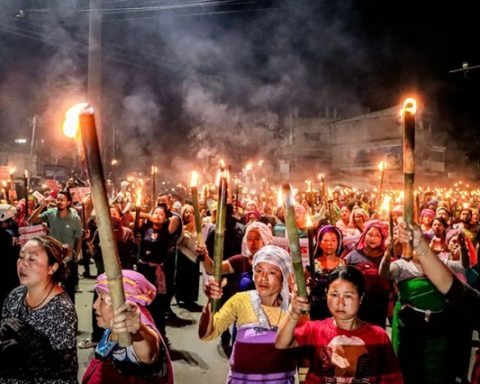
The current march from Kandy to Colombo, organised under the banner of “Justice for the Robe”, is centred on Gnanasara Thera’s imprisonment and the decision to produce him in court without his monastic robes. Organisers demand his release and describe the treatment of the monk as an affront to the dignity of the Sangha. Yet the legal background cannot be erased from the debate. The Supreme Court ruled in September 2026 that the presidential pardon granted to Gnanasara in 2019 was unlawful, and he was returned to prison to serve the remainder of his sentence for contempt of court. A demand for fair treatment of an imprisoned monk is one matter. A demand that a judicial decision be set aside because the convicted person is a monk is quite another. The robe may carry spiritual significance, but it cannot automatically place its wearer beyond the law.
This is where Ranjith’s earlier interventions acquire a new significance. In February 2026, he accused ministers of insulting Buddhist monks and argued that disrespect towards religious leaders would not help the country prosper. He stated that Sri Lankan culture was deeply rooted in Buddhism, introduced to the island by Arahat Mahinda. The concern for respect is understandable. But respect cannot be defined as immunity from criticism, just as criticism cannot automatically be classified as hostility towards Buddhism. Monks, like politicians, public officials and leaders of other religions, exercise influence in society. Their conduct, statements and political demands must remain open to scrutiny. If the dignity of the Sangha is to be protected, it must also be protected from the damage caused when religious authority becomes entangled with partisan politics or when the robe is used to discourage legitimate questions.
The irony is difficult to ignore. Ranjith has repeatedly insisted on Buddhism’s cultural primacy, yet the present controversy demands more than recognition of that primacy. It demands a judgement about what follows from it. Does protecting Buddhism mean protecting every monk from public criticism? Does it mean accepting political demands made in the name of the Buddha Sasana without examining their constitutional implications? Or does it mean defending the ethical principles associated with the Buddha, including restraint, compassion and a refusal to confuse personal authority with moral truth? The Cardinal need not agree with every government decision to insist that religious leaders remain accountable, that court orders be respected and that the rights of other communities be protected.
The Easter Sunday judgment makes this question even more urgent. Ranjith has spent years demanding answers about the attacks, insisting that the full truth must emerge and that those responsible for planning the massacre must be held accountable. In August, he reaffirmed that pursuit while rejecting the death penalty on grounds of human dignity. His statement demonstrated that justice and vengeance are not the same thing. That principle should apply beyond the Easter case. It should guide the treatment of Buddhist monks, Muslim citizens, Christian institutions and everyone else who comes into conflict with state power. A society cannot demand accountability for one set of actors while treating the religious identity of another as a reason to suspend scrutiny.
Was Ranjith’s defence of Buddhism a genuine assessment of Sri Lanka’s history, or was it also an attempt to find common ground with the Buddhist majority and the influential clergy? It would be unfair to declare his motives without evidence. His condemnation of anti-Muslim violence and his calls for interreligious harmony suggest that his position cannot simply be dismissed as religious opportunism. But sincerity does not remove the need for consistency. A statement that Buddhism is a blessing becomes politically meaningful only when its implications for justice, equality and coexistence are made clear.
The essential question is therefore not whether Cardinal Ranjith should speak for Buddhism or against the monks marching to Colombo. It is whether he is prepared to articulate a principle that applies equally to all. If Sri Lanka’s Buddhist inheritance is a blessing, it cannot be reduced to the protection of clerical privilege. If religious leaders deserve respect, they must also accept responsibility. And if the law is essential to securing justice for the victims of Easter Sunday, it cannot become negotiable when the person before the court wears a robe.
Perhaps the Cardinal’s most consequential statement now would not be another declaration that Sri Lanka is a Buddhist country. It would be an explanation of what that assertion demands of a country whose citizens belong to several faiths, whose institutions are bound by law and whose history contains both extraordinary religious achievements and painful episodes of communal exclusion. Without that explanation, the language of cultural inheritance risks becoming a convenient shield for political interests. With it, the Cardinal could help distinguish the preservation of Buddhism from the preservation of power exercised in its name.