by Our Correspondent in Colombo
Prime Minister and Minister of Education Harini Amarasuriya triggered intense political shockwaves today after declaring in Parliament that there “was never a demand” to allocate 6% of GDP for education — a statement that contradicts one of the most widely recognized demands in Sri Lanka’s modern education-rights discourse.
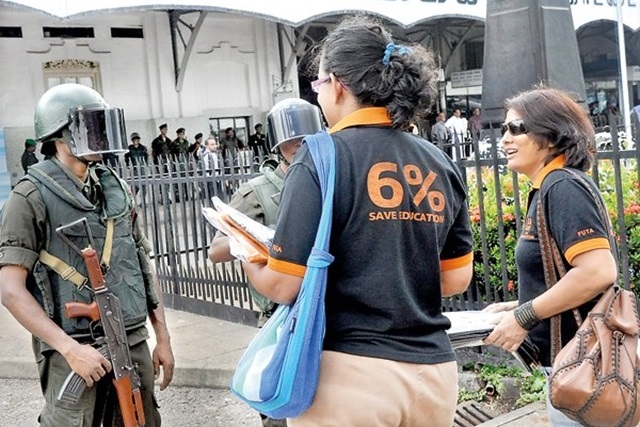
Amarasuriya insisted that her administration had made no such call, even as critics immediately pointed out that the 6% benchmark has been a central slogan of student movements, teacher unions, university academics, and civil society groups for more than a decade.
According to the Prime Minister, the government currently allocates 2.04% of GDP to education, while Rs. 7.04 billion has been set aside for the 2026 budget. She maintained that funding increases must be “gradual” and paired with structural reforms — a stance that many observers interpret as an attempt to downplay long-standing public pressure.
Political analysts and education activists expressed disbelief at her remarks, suggesting that the statement risks rewriting years of documented struggle. Critics argue that the government is attempting to distance itself from a demand that has become a symbol of public frustration with declining education standards.
Amarasuriya reiterated that “simply allocating money without reforms is useless,” but her comments have fueled accusations that the administration is attempting to redefine or dismiss the historical record of education advocacy in Sri Lanka.
Adding to the controversy, observers note that Harini Amarasuriya herself was once a member of the Federation of University Teachers’ Associations (FUTA) — the very organization that championed the 6% of GDP demand as its central platform.
Meanwhile, addressing Parliament today, opposition parliamentarian Chamara Sampath stated that former ministers Bandula Gunawardena and Akila Viraj Kariyawasam made significant contributions during their tenure, noting that it was under their terms that the largest budgets for education to date were allocated, strengthening schools, universities, and key educational initiatives.