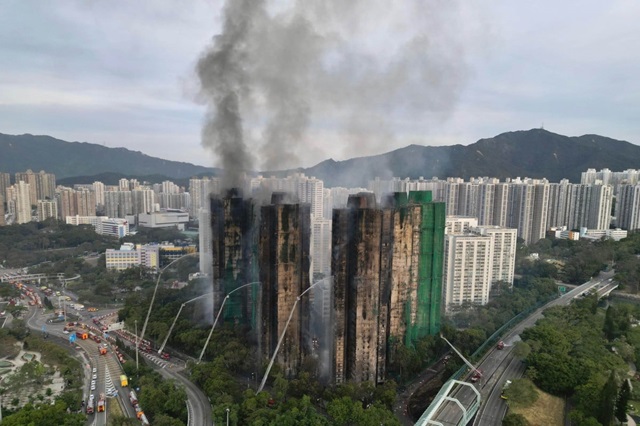
In Hong Kong’s northern district of Tai Po, the aftermath of the Wang Fuk Court residential fire has moved the search for missing residents into a local community hall, where distraught family members sift through photo albums of the dead. At least 128 people have been confirmed dead, while an estimated 150 remain unaccounted for. Fung, a man in his forties, told Times UK that after days of trying to contact his elderly mother-in-law, who lived in one of the towers consumed by the blaze, he had moved from hope to heartbreak. “The past three days have been agonising. I’ve lost hope of finding her,” he said.
The fire swept through seven of the eight towers, home to approximately 4,800 residents, leaving charred skeletons of buildings standing like blackened tombstones. Only 39 victims have been formally identified by police so far. Authorities have yet to determine the cause of the inferno, but attention has turned to potential failings in building safety. The management company had been notified that the fire-alarm system was non-operational, and renovation materials such as flammable foam insulation and green mesh sheeting are being investigated as factors that may have contributed to the fire’s rapid spread. Traditional bamboo scaffolding, widely used in Hong Kong, is also under scrutiny.
Eight people have been arrested, and a task force has been established to investigate possible corruption linked to the renovation project. Amid growing public anger, Hong Kong has launched three days of official mourning. Flags flew at half-mast at government buildings, and officials, including Chief Executive John Lee, observed moments of silence. Protesters and citizens, however, have voiced frustration at perceived negligence, with some questioning the presence of armed police at sites where residents sought answers.
Survivors’ accounts illustrate the sheer terror of the blaze. William Li, 40, recounted being trapped for hours as thick smoke and falling debris engulfed his flat. Using wet towels to block the gaps under doors, he guided neighbours to safety and signalled firefighters with a window light. Li and his family eventually escaped, with Li expressing gratitude to the rescue teams and urging the community to rebuild. Other survivors shared harrowing experiences, including a single mother unable to rescue her pet rabbits, and a woman whose son and father were trapped on the 18th floor, saved only after repeated attempts by emergency crews.
Volunteers have mobilized to support victims, distributing essential supplies ranging from food to diapers. Rescue teams have concluded the search for survivors, but efforts continue to recover the remains of victims. Thirty-five people remain hospitalized, and 110 are reported in stable condition. For many in Tai Po, the emotional toll is immense, with families struggling to reconcile the loss of loved ones and homes, even as some survivors begin the slow process of recovery.