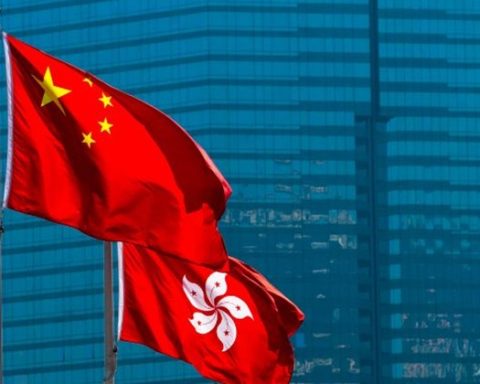
Hong Kong media tycoon and pro-democracy activist Jimmy Lai Chee-ying was found guilty on Monday of collusion with foreign forces and sedition in a closely watched national security trial that critics say symbolises the city’s dramatic political transformation. The verdict, delivered at the West Kowloon Law Courts Building, leaves the 78-year-old facing the possibility of life imprisonment, although no sentence has yet been imposed.
Judges Alex Lee, Esther Toh and Susana D’Almada Remedios ruled that Lai was guilty of two counts of conspiring to collude with foreign forces under the Beijing-imposed National Security Law, as well as a third count of sedition under colonial-era legislation. The court said a mitigation hearing would be held on January 12, after which sentencing will be determined.
Lai has been in custody since December 2020 and has spent more than 1,800 days in detention, much of it in solitary confinement. His legal battle has stretched over five years, making it one of the longest and most consequential national security cases since the law was imposed in 2020. Lai has consistently denied all charges, arguing that his actions amounted to journalism and political expression rather than criminal conduct.
Outside the courthouse on Monday morning, around 100 people gathered under heavy police presence. Among them was a woman in her 50s working in the financial sector, who identified herself only as Venus. She said she arrived at around 4 a.m. to show continued support for Lai and expressed hope that he would receive a lighter sentence, adding that her concern for him would not change despite the conviction.
The verdict drew significant international attention. Representatives from the United States, United Kingdom and Canada were present in court, according to local media. Human rights organisations and foreign governments have repeatedly condemned Lai’s prosecution, describing it as an attack on press freedom and political dissent. In the United States, a bipartisan group of lawmakers has moved to establish a “Jimmy Lai Day” in recognition of his role in promoting a free press, religious freedom and democracy in Hong Kong, while calling for his release and that of other political prisoners.
Hong Kong’s government has rejected accusations of political persecution. A government spokesperson said critics were “wantonly smearing” the city’s law enforcement, prosecution and judicial bodies, insisting that Lai has received adequate and comprehensive medical care while in custody. Officials maintain that the case demonstrates the equal application of the law and the necessity of safeguarding national security.
Legal scholars and former officials argue the trial reflects a fundamental shift in Hong Kong’s legal system. Eric Yan-ho Lai, a senior fellow at the Georgetown Center for Asian Law, said the proceedings were designed to demonstrate the supremacy of state power rather than limit it, contrasting the current approach with the city’s pre-1997 legal tradition, which emphasised checks on government authority.
Lai’s conviction follows his first arrest in August 2020, when more than 100 police officers raided the newsroom of Apple Daily, his outspoken newspaper. The paper was forced to shut down in June 2021 after its assets were frozen, a move widely seen as part of a broader crackdown on independent media. Since then, Hong Kong has fallen sharply in global press freedom rankings, while many journalists, activists and opposition figures have been arrested, silenced or driven into exile.
The verdict also comes amid broader political retrenchment in the city. Just a day earlier, Hong Kong’s Democratic Party, once the city’s largest opposition force, voted to disband after more than three decades of political activity. Combined with low voter turnout in recent elections and the overhaul of the electoral system to ensure “patriots only” govern, Lai’s conviction has reinforced perceptions that organised political opposition has effectively been dismantled.
As the city’s leadership prepares to brief Beijing on Hong Kong’s political and social situation, the outcome of Jimmy Lai’s case is widely seen as a bellwether for the future of dissent, media freedom and the rule of law. While the final sentence has yet to be decided, the guilty verdict alone has already sent a chilling signal through Hong Kong’s remaining civil society.