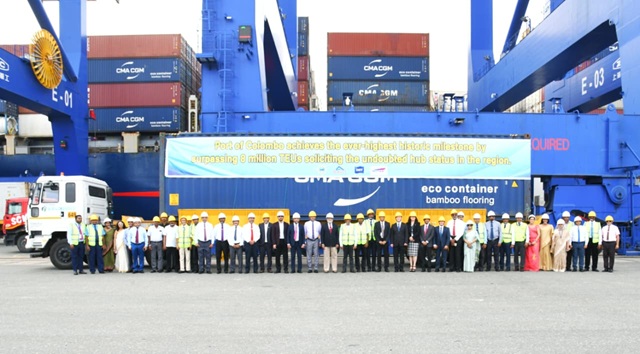
The Port of Colombo recorded its highest-ever annual container throughput in 2025, handling 8,291,178 TEUs and setting a new benchmark in its operational history. The achievement builds on a strong performance in 2024, when the port processed 7,792,069 TEUs, and reinforces Colombo’s position as the leading container hub in South Asia. The year-on-year growth reflects sustained investment, operational resilience and continued confidence from global shipping lines at a time when international trade flows remain uneven and freight networks are undergoing structural adjustments.
According to the Sri Lanka Ports Authority, the record performance was the result of coordinated operations across all container terminals within the port. SLPA-operated terminals continued to provide scale and operational stability, supporting both mainline and feeder services. Colombo International Container Terminals maintained its role as the port’s deep-water terminal for ultra-large container vessels, supported by strong berth productivity and efficient yard operations. South Asia Gateway Terminals contributed through reliable handling of regional and transhipment cargo, strengthening Colombo’s function as an intermediate hub within global shipping routes. The progress achieved at the Colombo West International Terminal, developed by the Adani Group in partnership with local stakeholders, added modern capacity and further reinforced Colombo’s long-term infrastructure base.
The 2025 outcome is significant not only for the volume recorded, but also for the conditions under which it was achieved. Global shipping continues to adjust to route realignments, expanding fleets and persistent cost pressures. Against this backdrop, the Port of Colombo’s ability to attract additional vessel calls, retain transhipment volumes and improve turnaround times reflects operational maturity and commercial reliability. The performance also highlights effective coordination among terminal operators, port service providers, regulators and logistics partners, ensuring consistent service delivery across the port.
The port’s current performance is underpinned by a long history of maritime engineering and structured development. During the late nineteenth century, under British colonial administration, the modern harbour took shape with the construction of the first permanent breakwater. The project was led by Sir John Coode, a prominent harbour engineer whose work transformed Colombo from an exposed anchorage into a sheltered deep-water port capable of year-round operations. The engineering principles established during that period laid the foundation for Colombo’s long-term growth and continue to influence port development planning.
With throughput exceeding 8.29 million TEUs, the Port of Colombo is positioned to further strengthen its role within global shipping networks while supporting Sri Lanka’s broader economic objectives. The Sri Lanka Ports Authority stated that continued focus on capacity expansion, digitalisation, workforce capability and service reliability will be key to sustaining growth. The 2025 milestone marks a significant chapter in the port’s development, reflecting its ability to operate at scale with consistency and confidence in an increasingly demanding global trade environment.