by Eric
“This is a violation of the given word and an act against the rights of man and international morality.”
“No ruler, no matter how exalted, stood above the will of the nation.”
“The people are the source of all authority.”
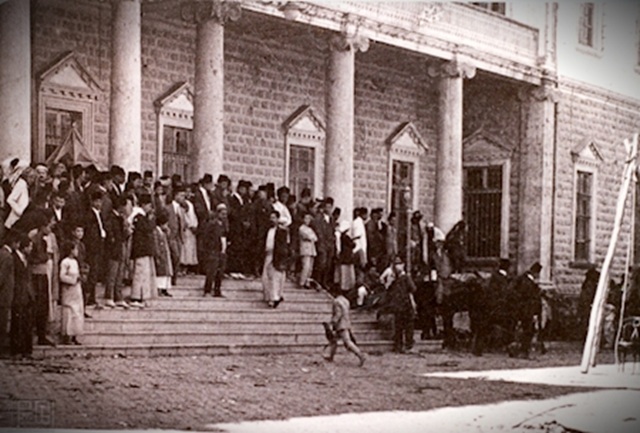
These are not the words of European revolutionaries, nor of post-war liberal philosophers in Paris or Washington. They are the words spoken, written, and enacted in Damascus in 1919–1920. They belong to Arab parliamentarians, Islamic reformers, and constitutionalists who believed—quite literally—that democracy was not a Western possession but a universal political right. Elizabeth F. Thompson’s How the West Stole Democracy from the Arabs forces the reader to confront a historical reality that has been systematically erased: Arabs did not reject democracy, nor were they incapable of sustaining it. They were punished for attempting it.
This is not a cautious book, nor is it written to reassure liberal sensibilities. Thompson does not ask whether the West meant well, nor does she frame empire as a tragic miscalculation. Instead, she presents a meticulous and deeply unsettling case built from parliamentary minutes, constitutional drafts, petitions, diplomatic correspondence, and eyewitness testimony. Her conclusion is blunt: Arab democracy was not an experiment that collapsed under its own weight. It was dismantled—intentionally and decisively—by Western powers that found its existence intolerable.
At the heart of the book lies a claim that feels almost forbidden in contemporary discourse: in the aftermath of the First World War, Arabs did not merely demand democracy—they institutionalised it. In Syria between 1918 and 1920, Thompson shows, a representative political system took shape that debated limits on executive power, defended parliamentary supremacy, guaranteed religious equality, and grounded political legitimacy in popular sovereignty. The Syrian Constitution of 1920 did not hedge its language. It declared unequivocally that authority flowed upward from the people, not downward from rulers. In doing so, it articulated a democratic vision that was neither tentative nor derivative.
The Syrian Arab Congress was not a symbolic assembly designed to impress European observers. It was contentious, fractured, and politically alive. Deputies challenged King Faisal openly, interrogated ministers, resisted foreign agreements, and rejected the notion that sovereignty could be bargained away in diplomatic salons. When Faisal attempted to assert personal authority over the legislature, Rashid Rida responded with a sentence that Thompson allows to stand without embellishment: “Syria was there before you were born.” This was not rhetorical flourish. It was constitutional doctrine expressed with moral clarity.
One of the book’s most destabilising interventions is its dismantling of the supposed incompatibility between Islam and democracy. Thompson reconstructs a forgotten alliance between Islamic reformers and liberal constitutionalists—an alliance that anchored democratic legitimacy not in secularism, but in moral accountability and collective consent. Rida, so often retrospectively recast as a precursor to authoritarian Islamist thought, emerges here as a defender of parliamentary sovereignty and a fierce opponent of tyranny. He argued that no ruler stood above the nation and that despotism violated both political reason and religious ethics. Democracy, in this account, was not imported in spite of Islam, but defended through it.
Thompson is careful not to romanticise the Congress. It was imperfect, unevenly representative, and operating under extraordinary pressure. But she refuses the lazy conclusion that imperfection equals incapacity. Many absences, she demonstrates, were the direct result of colonial obstruction: travel bans, intimidation, censorship, and deliberate sabotage by French and British authorities. Democracy did not collapse; it was choked. To describe its destruction as inevitable is, in Thompson’s telling, an act of historical bad faith.
Nowhere is this bad faith more exposed than in the conduct of the United States. Syrians invested enormous hope in Woodrow Wilson’s rhetoric of self-determination, reading it not as propaganda but as promise. Thompson recounts how Syrians described Wilson as a moral figure of world-historical importance, believing his principles applied universally or not at all. The King-Crane Commission confirmed their position overwhelmingly: Syrians rejected French rule and demanded independence. Yet the report was buried because it conflicted with imperial arrangements already agreed in secret. Self-determination, Thompson shows, functioned not as a right but as a performance—invoked when useful, discarded when inconvenient.
France, meanwhile, appears not as a failed guardian but as an executioner of democratic institutions. Thompson documents censorship, arrests, the dissolution of parliament, and the imposition of martial law, culminating in military invasion. When French forces advanced despite Faisal’s acceptance of their ultimatum, Faisal protested that France had violated both its word and international morality. Even French officers expressed unease. The advance continued regardless. What followed at Maysalun was not merely a military defeat, but the violent termination of constitutional order.
By restoring this history, Thompson does more than challenge conventional narratives; she overturns them. Sectarianism, she argues, was not the natural condition of Syrian society but the consequence of colonial rule. Before the mandate, Muslims, Christians, and Jews debated together, legislated together, and endorsed a constitution guaranteeing equality. Sectarian identities hardened only after democratic institutions were dismantled and communal divisions were exploited as tools of control.