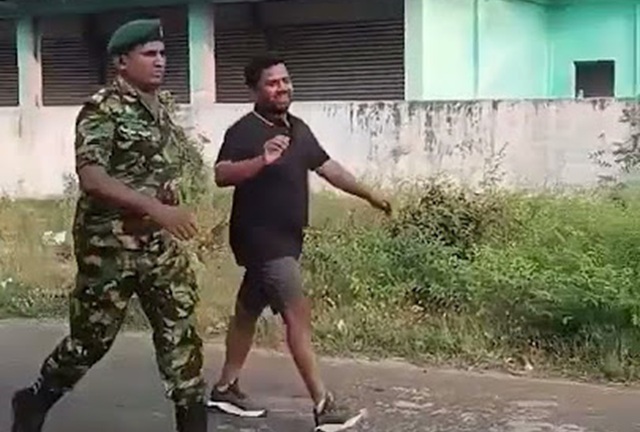
President Anura Kumara Dissanayake’s (AKD) recent visit to Jaffna received significant social media attention due to posting of a less than a minute-long video of him going for a walk there.
An unarmed soldier was captured walking beside AKD who is also the Commander-in-Chief of the armed forces in addition to being the Defence Minister. A soldier carrying an assault rifle was seen walking behind AKD. There was another soldier in a pair of shorts walking just behind the President. AKD’s Personal Security Officer (PSO) was not on that video. By January 26th morning that video received 378 K ‘hits’ and 9.8 K reactions.
AKD was in a pair of shorts and running shoes. There hadn’t been a previous occasion in which AKD was captured in a pair of shorts during his time as a lawmaker or the President. AKD was there on a two-day visit that coincided with Thai Pongal.
AKD’s latest visit to Jaffna for Thai Pongal caused a huge controversy when he declared that those who visited Buddhist shrines there influenced and encouraged hate. “Coming to Jaffna to observe sil on a Poya Day, while passing the Sri Maha Bodhi, is not virtue, but hatred,” AKD declared. The utterly uncalled for declaration received the wrath of the Buddhists. What made AKD, the leader of the JVP, a generally avowed agnostics, as well as NPP, to make such an unsubstantiated statement?
Opposition political parties did not waste much time to exploit AKD’s Jaffna visit to their advantage. They accused AKD of betraying the majority Buddhists in the country. Those who peruse social media know how much AKD’s Jaffna talk angered the vast majority of people aware of the sacrifices made by the armed forces and police to eradicate terrorism.
If not for the armed forces triumph over the LTTE in May 2009, AKD would never have ended up in the Office of the President. That is the undeniable truth. Whatever, various interested parties say, the vast majority of people remember the huge battlefield sacrifices made by the country’s armed forces that made the destruction of the LTTE’s conventional military power possible. Although some speculated that the LTTE may retain the capability to conduct hit and run attacks, years after the loss of its conventional capacity, the group couldn’t stage a comeback, thanks to eternal vigilance and the severity of its defeat.
AKD’s attention-grabbing Jaffna walk is nothing but a timely reminder that separatist Tamil terrorism had been defeated, conclusively. Of course, various interested parties may still propagate separatist views and propaganda but Eelam wouldn’t be a reality unless the government – whichever political party is in power – created an environment conducive for such an eventuality.
The JVP/NPP handsomely won both the presidential and parliamentary polls in Sept. and Nov. 2024, respectively. Their unprecedented triumph in the Northern and Eastern provinces emboldened their top leadership to further consolidate their position therein at any cost. However, an unexpected and strong comeback made by one-time LTTE ally, the TNA, appeared to have unnerved the ruling party. On the other hand, the TNA, too, seems to be alarmed over AKD’s political strategy meant to consolidate and enhance his political power in the North.
Perhaps, against the backdrop of AKD’s Jaffna walk, we should recollect the capture of Jaffna, the heart of the separatist campaign during President Chandrika Bandaranaike Kumaratunga’s time. Jaffna town was regained in the first week of December, 1995, 11 years before the outbreak of Eelam War IV (August 2006 to May 2009).
Operation Riviresa
In the run-up to the January 2015 presidential election, Kumaratunga, who served two terms as President (1994 to 1999 and 2001 to 2005), declared that her administration liberated 75% of the territory held by the LTTE. That claim was made in support of Maithripala Sirisena’s candidature at the then presidential election. Kumaratunga joined hands with the UNP’s Ranil Wickremesinghe, the JVP (NPP was formed in 2019), the SLMC and the TNA to ensure Sirisena’s victory.
Liberating 75% of territory held by the LTTE was nothing but a blatant lie. That claim was meant to dispute war-winning President Mahinda Rajapaksa’s bid for a third term. Ahead of the 2005 presidential election, Kumaratunga’s administration lost the capacity to conduct large-scale ground offensives in the Northern theatre of operations. In fact, the last major offensive, codenamed Agni Kheelsa in April 2001, had been undertaken in the Jaffna peninsula where the Army suffered debilitating losses, both in men and material. That was President Kumaratunga’s last attempt to flex military muscle. But, she should be credited for whole-heartedly supporting Operation Riviresa (Aug. to Dec. 1995) that brought back Jaffna under government control.
In spite of several major attempts by the LTTE to drive the Army out of Jaffna, the military held on. The largest ever combined security forces offensive, under President Mahinda Rajapaksa, with the Navy and Air Force initiating strategic action against the LTTE and the triumph over separatist terrorism in two months short of three years, should be examined taking into consideration the liberation of the Jaffna peninsula and the islands.
If President Kumaratunga failed to bring Jaffna under government control in 1995 and sustain the military presence there, regardless of enormous challenges, the war wouldn’t have lasted till 2006 and the outcome of the war could have gone the other way much earlier. Whatever the criticism of Kumaratunga’s rule, liberating the Jaffna peninsula is her greatest achievement. Regardless of financial constraints, Kumaratunga and her clever and intrepid Treasury Secretary, the late A.S. Jayawardena, provided the wherewithal for the armed forces to go on the offensive. After the successful capture of Jaffna, by the end of 1995, Kumaratunga ordered Kfirs and MiG 27s, and a range of other weapons, including Multi Barrel Rocket Launchers (MBRLs), to enhance the fire power, but the military couldn’t achieve the desired results. While she provided any amount of jaw, jaw, it was Amarananda Somasiri Jayawardena who ensured that the armed forces were provided with the necessary wherewithal, under difficult circumstances, especially in the aftermath of the later humiliating Wanni debacle, when he was the Central Bank Governor.
AKD is certainly privileged to engage in morning exercises in a terrain where some of the fiercest battles of the Eelam conflict were fought, involving the Indian Army, as well as other Tamil groups, sponsored by New Delhi, in the ’80s.
When the Army secured Jaffna, in 1995, and lost Elephant Pass in 2000, the forward defence lines had to be re-established and defended at great cost to both men and material. By then, the Vanni had become the LTTE stronghold and successful ground offensive seemed impossible but under President Mahinda Rajapaksa’s political leadership the combined armed forces achieved the unthinkable – the annihilation of the LTTE in a way it couldn’t make a comeback at any level. AKD’s post that went viral recently is evidence that peace has been restored and maintained for the Commander-in-Chief to take a walk on a Jaffna street.
Social media comments on AKD’s Jaffna walk reflected public thinking, especially against the backdrop of that unwarranted claim regarding Buddhists influencing hatred by visiting Jaffna on a Poya Day to observe sil, having passed the Sri Maha Bodhi.
UK anti-SL campaign
It would be pertinent to ask the Sri Lanka High Commission in the UK regarding action taken to counter the continuing propaganda campaign against the country. Sri Lankan HC in the UK Nimal Senadheera owed an explanation as UK politicians seemed to be engaged in a stepped-up Sri Lanka bashing with the NPP government not making any effort to counter such propaganda against our country.
Interestingly, the UK government is on a collision course with no less a person than President Donald Trump over his recent humiliating comments on NATO troops who fought alongside the Americans in Afghanistan.
British Prime Minister Keir Starmer is on record as having said that President Trump’s comments were “insulting and frankly appalling.” Starmer suggested the US President apologise for his remarks. Amidst strong protests by humiliated NATO countries, President Trump retracted his derogatory comments.
But the UK’s position with regard to Tamil terrorism that also claimed the lives of nearly 1,500 Indian officers and men seemed different. The UK continues to ignore crimes perpetrated by the LTTE, including rival Tamil groups, political parties and Tamil civilians.
The Labour Party that promoted and encouraged terrorism throughout the war here raised the post-war Sri Lanka situation again.
The Labour Party questioned the British government in the House of Commons recently on what action it was taking to support Tamils seeking justice for past and ongoing abuses in Sri Lanka.
Raising the issue on 20 January 2026, Peter Lamb, the Labour MP for Crawley, asked: “What action is the UK Government taking to support Tamils in seeking justice for past and current injustices?”
Responding on behalf of the government, Hamish Falconer, Parliamentary Under-Secretary of State at the Foreign, Commonwealth and Development Office, said the UK remained actively engaged in accountability for crimes committed against the Tamil people.
“The UK is active in seeking justice and accountability for Sri Lanka’s Tamil community,” Falconer told the House. He said Britain continues to play a leading role at the United Nations Human Rights Council on resolutions addressing Sri Lanka’s human rights record.
Falconer added that the UK had taken concrete steps in recent years, including imposing sanctions. “Last year, we sanctioned Sri Lankans for human rights violations in the civil war,” he said, referring to measures targeting individuals implicated in serious abuses.
He also stated that the UK had communicated its expectations directly to Colombo. “We have made clear to the Sri Lankan Government the importance of improved human rights for all in Sri Lanka, as well as reconciliation,” Falconer said.
Concluding his response, Falconer marked the Tamil harvest festival, adding, “Let me take the opportunity to wish the Tamil community a happy Thai Pongal.”
The UK cannot be unaware that quite a number of ex-terrorists today carry British passports.
David Lammy’s promise
Our High Commissioner in London Nimal Senadheera, in consultation with the Foreign Ministry in Colombo, should take up the Parliamentary Under-Secretary of State at the Foreign, Commonwealth and Development Office Hamish Falconer’s comment on sanctions imposed on Sri Lankans in March 2025. Falconer was referring to General (retd.) Shavendra Silva, Admiral of the Fleet Wasantha Karannagoda, General (retd), Jagath Jayasuriya and one-time LTTE commander Vinayagamoorthy Muralitharan, aka Karuna Amman.
The then Secretary of State for Foreign, Commonwealth and Development Affairs, David Lammy, declared in March 2025 that the above-mentioned Sri Lankans were sanctioned in line with election promises. A UK government statement quoted Lammy as having said: “I made a commitment during the election campaign to ensure those responsible are not allowed impunity. This decision ensures that those responsible for past human rights violations and abuses are held accountable.”
Since then David Lammy has received the appointment as Lord Chancellor, Secretary of State for Justice and Deputy Prime Minister.
Recent Thai Pongal celebrations held at 10 Downing Street for the second consecutive year, too, was used to disparage Sri Lanka with reference to genocide and Tamils fleeing the country. They have conveniently forgotten the origins of terrorism in Sri Lanka and how the UK, throughout the murderous campaign, backed terrorism by giving refuge to terrorists.
The British had no qualms in granting citizenship to Anton Balasingham, one-time translator at the British HC in Colombo and one of those who had direct access to LTTE leader Velupillai Prabhakaran. Balasingham’s second wife, Australian-born Adele, too, promoted terrorism and, after her husband’s demise in Dec 2006, she lives comfortably in the UK.
Adele had been captured in LTTE fatigues with LTTE women cadres. The possibility of her knowing the LTTE suicide attack on former Indian Prime Minister Rajiv Gandhi in May 1991 can never be ruled out.
With the British PM accommodating those campaigning against Sri Lanka at 10 Downing Street and the Deputy PM openly playing politics with the issues at hand, Sri Lanka is definitely on a difficult wicket.
Sri Lanka has chosen to appease all at the expense of the war-winning military. The NPP government never made a genuine effort to convince Britain to rescind sanctions imposed on three senior ex-military officers and Karuna. The British found fault with Karuna because he switched allegiance to the Sri Lankan military in 2004. The former eastern commander’s unexpected move weakened the LTTE, not only in the eastern theatre of operations but in Vanni as well. Therefore, the British in a bid to placate voters of Sri Lankan origin, sanctioned Karuna while accommodating Adele whose murderous relationship with the LTTE is known both in and outside the UK Parliament.
Some British lawmakers, in a shameless and disgraceful manner, propagated lies in the UK Parliament for obvious reasons. Successive governments failed to counter British propaganda over the years but such despicable efforts, on behalf of the LTTE, largely went unanswered. Our governments lacked the political will to defend the war-winning armed forces. Instead, the treacherous UNP and the SLFP got together, in 2015, to back a US-led accountability resolution that sought to haul Sri Lanka up before the Geneva-based United Nations Human Rights Council (UNHRC).
The possibility of those who propagated lies receiving monetary benefits from interested parties cannot be ruled out. Sri Lanka never bothered to counter unsubstantiated allegations. Sri Lanka actually facilitated such contemptible projects by turning a blind eye to what was going on.
The Canadian Parliament declaration that Sri Lanka perpetrated genocide during the conflict didn’t surprise anyone. The 2022 May announcement underscored Sri Lanka’s pathetic failure on the ‘human rights’ front. The Gotabaya Rajapaksa government struggling to cope with the massive protest campaign (Aragalaya) never really addressed that issue. Ranil Wickremesinghe, who succeeded Gotabaya Rajapaksa in July 2022, too, failed to take it up with Canada. The NPP obviously has no interest in fighting back western lies.
The Canada Parliament is the first national body to condemn Sri Lanka over genocide. It wouldn’t be the only parliament to take such a drastic step unless Sri Lanka, at least now, makes a genuine effort to set the record straight. Political parties, representing our Parliament, never reached a consensus regarding the need to defeat terrorism in the North or in the South. Of those elected representatives backed terrorism in the North as well as terroirism in the South. Perhaps, they have collectively forgotten the JVP terrorism that targeted President JRJ and the entire UNP Parliamentary group. The JVP attack on the UNP, in parliament, in August 1987, is a reminder of a period of terror that may not have materialised if not for the Indian intervention.