
by Durga
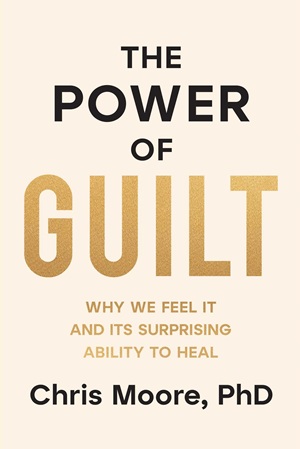
Chris Moore’s The Power of Guilt opens with a confession so extreme that it dares the reader to refuse him moral authority. “We had hit a group of fellow students cycling the same road back to town. Some of them had been injured and one had been killed.” The book does not ease us into theory; it drags us through blood, glass, and death. Guilt here is not abstract, not clinical, not metaphorical. It is anchored in a corpse. This opening move is already provocative because Moore implicitly claims that only someone who has killed—even indirectly—has earned the right to theorize guilt. The reader is trapped from the outset: to critique Moore’s conclusions is to risk appearing morally inferior to the man who has already confessed everything. Guilt, in this book, is not just the topic; it is the rhetorical weapon.
Moore insists that his guilt was total, overwhelming, and existential: “I fell into a morass of guilt, shame, remorse, and fear.” Yet almost immediately, the book introduces its most unsettling claim—not that guilt is crushing, but that it is curable, dissolvable, even negotiable. “With this visit, incredibly, the intense guilt I felt began to dissolve.” Guilt, Moore suggests, is not permanent, not proportional to harm, and not anchored to justice. It evaporates when the right people say the right words. This is the book’s first scandal: guilt is not tethered to the dead body in the road; it is tethered to social response. The victim’s forgiveness—or the idea of it—outweighs the victim’s existence.
The most morally destabilizing moment arrives when Moore recounts thinking, “Who are you to rebuke me in this way when the people who were harmed have already forgiven me?” This sentence should stop the reader cold. It is the book’s quiet heresy. Moore elevates forgiveness over law, reconciliation over justice, and interpersonal absolution over societal judgment. The police become morally irrelevant once forgiveness has been granted. The legal system is reduced to noise. Guilt, here, is no longer a moral reckoning—it is a social transaction. Once the transaction is complete, further condemnation becomes illegitimate.
Moore doubles down on this logic by admitting, astonishingly, “I did not really feel guilty about it.” This refers not to the killing, but to the crime itself. Legal guilt, he suggests, is emotionally hollow when relational guilt has already been resolved. The implication is deeply uncomfortable: a person can kill, be forgiven, and emerge psychologically intact—while the law lags behind as an outdated ritual of punishment. Moore does not explicitly say the law is wrong, but his narrative makes it emotionally redundant.
From here, The Power of Guilt launches its central thesis: “Guilt arises from doing something that has damaged a social relationship.” This is the book’s most radical claim, and Moore knows it. He explicitly rejects the dictionary, morality, and theology. “Rather than interpret guilt in terms of wrongdoing, we need to begin our understanding of guilt by considering its role in managing our social relationships.” Wrong is replaced by rupture. Sin is replaced by strain. Ethics collapses into sociology.
This move is intellectually seductive and morally dangerous. If guilt is about relationships rather than harm, then harm without relationship becomes ethically weightless. Moore tries to preempt this objection, but never fully escapes it. When he insists, “Guilt is the emotional signal that tells us we should attempt to repair this damage,” he implicitly defines morality as maintenance work. Ethics becomes customer service. The goal is not justice, but continuity.
The book’s sustained attack on moral universals becomes explicit when Moore critiques traditional definitions of guilt as a “moral emotion.” He notes approvingly that one can “jaywalk” without guilt and “feel guilty that I spend more time working than my wife would like me to.” The effect is corrosive: murder and marital disappointment now share the same emotional infrastructure. The scale of harm collapses. Guilt is flattened into a subjective barometer of relational discomfort.
Moore leans heavily on Freud, but only to discard him. He praises Freud’s insight that guilt originates in “fear of loss of love,” but rejects the idea that guilt restrains selfishness. Instead, Moore flips the script: “What if the urge to be social—to care for others—comes first?” This sounds humane, even optimistic, but it subtly removes moral responsibility from the individual and relocates it in the social field. One is no longer responsible for wrongdoing; one is responsible for relational failure. Evil becomes maladjustment.
This framework reaches its most controversial articulation when Moore insists that guilt is “not simply the result of doing something wrong.” That word—simply—does a remarkable amount of work. It suggests that wrongdoing is naïve, outdated, insufficient. The real crime is relational damage. The real repair is forgiveness. The dead, conspicuously, do not participate in this process.
Perhaps the most disturbing implication emerges when Moore reflects on how lucky he was. “I consider myself to be almost unbelievably fortunate.” Fortunate because the victims forgave him. Fortunate because his parents loved him. Fortunate because guilt did not “fester.” The book never seriously asks whether guilt should fester. Whether some acts deserve permanent moral contamination. Whether forgiveness can be premature, coercive, or morally obscene. Instead, forgiveness becomes the therapeutic endpoint, the gold standard of psychological health.
Moore’s insistence that guilt is “a positive force for healthy relationships” is the book’s final provocation. Guilt is no longer punishment, warning, or reckoning—it is infrastructure. It exists to keep social systems running smoothly. Even shame is reframed not as moral collapse but as a malfunctioning guilt mechanism. “Shame is feeling bad about oneself,” Moore explains, almost dismissively, as if self-condemnation were merely an inefficient emotional strategy.
The cumulative effect of The Power of Guilt is unsettling because it quietly empties guilt of transcendence. There is no cosmic ledger here, no moral remainder that survives forgiveness. Everything can be repaired. Everything can be metabolized. Even death becomes, psychologically speaking, manageable. Moore never celebrates this conclusion, but he also never resists it.
By the end, guilt has been stripped of its terror and its teeth. It has become a social algorithm. Feel guilt. Repair relationship. Move on. “We need to shed the image of guilt as a negative emotional scourge,” Moore urges. What replaces it is something far more chilling: a world in which morality is negotiable, absolution is interpersonal, and the dead are silent participants in the emotional recovery of the living.
This is a book that will comfort therapists, unsettle theologians, and quietly horrify anyone who believes that some acts should leave scars that forgiveness cannot erase. It does not deny evil—but it domesticates it. And that, perhaps, is its most controversial power of all.