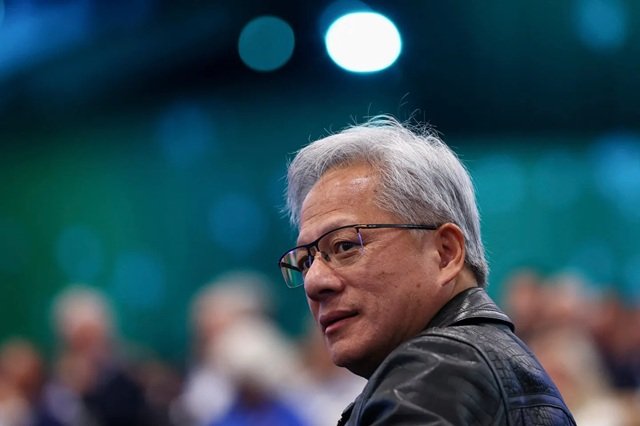
Nvidia chief executive Jensen Huang has warned that shortages of capital are holding back the rapid expansion of specialised cloud computing companies, despite soaring demand for the infrastructure needed to support artificial intelligence.
Speaking to CNBC’s Arjun Kharpal on the sidelines of Nvidia’s GTC conference in Berlin on Thursday, Huang said demand for so-called neocloud providers was “off the charts”, but that businesses were struggling to secure enough working capital to expand at the required pace.
“If you look at the fundamentals, the demand for the neo clouds is off the charts,” Huang said, describing their capabilities as “extraordinary”.
“What is missing in the middle is the working capital to fuel that growth… because there’s just so much demand across so many sectors of AI, there’s a scarcity of capital,” he said.
“The demand of the capital is much greater than the availability of the capital. That’s going to get solved,” he added.
Neocloud companies specialise in providing computing infrastructure for AI workloads. Their expansion has become increasingly important as businesses and developers seek the computing capacity required to build and operate AI systems.
However, the sector is facing growing investor concerns over the scale of spending required to build data centres and the time needed to generate returns. Shares in companies including CoreWeave and Nebius have recently fallen as investors reassess the costs and financing risks associated with the AI infrastructure boom.
Debt has also become a concern, particularly for CoreWeave, one of the sector’s largest providers, which has relied on borrowing to finance its data centre expansion.
Neocloud stocks remained under pressure in premarket trading on Thursday. Nebius fell 3.6% and CoreWeave declined 4%, while Iren and Applied Digital each lost nearly 4%.
Huang identified electricity availability as another major constraint on AI expansion, particularly in Europe, where energy is scarce and electricity prices are higher. He said allocating sufficient power to companies such as Nebius and French AI company Mistral would be crucial to developing the region’s computing infrastructure.
“You can bring investments into Europe, but you have to start with having your own infrastructure,” Huang said.
“If the neoclouds in Europe are able to establish an infrastructure here, then you can build the AI ecosystem, the AI economy on top of them, and then the flywheel of the AI economy will start in Europe. It will terminate in Europe.”
He added: “Across all of Europe, you’re going to need a lot more neoclouds.”
Huang’s comments come as Nvidia increases its investment in Europe’s AI sector. The chipmaker has committed nearly $10 billion to companies, universities and research institutions across the region as it seeks to accelerate the development of AI infrastructure and related businesses.
During a visit to London last week, Nvidia announced an investment stake worth more than $1 billion in five UK start-ups. The company is also investing in several French start-ups.
Huang said Nvidia’s efforts were intended to encourage the development of a broader European AI economy, drawing on the region’s existing scientific and industrial capabilities.
“We’re trying to kickstart the AI economy in Europe,” he told CNBC. “Europe has a tremendous amount of technology, tremendous amount of industrial know-how, incredible science and technology, and it’s ready to engage and build the AI economy here.”