


Editorial
There’s nothing subtle about the fact that Super Bowl LX on 8 February 2026 will be remembered not for the football but for the cultural and political earthquake detonated by the halftime show. Bad Bunny, born Benito Antonio Martínez Ocasio, walked onto the Levi’s Stadium turf in Santa Clara with a global audience measured in hundreds of millions and delivered a performance that was as much manifesto as music. By singing entirely in Spanish — a first in Super Bowl history — he challenged the unstated assumption that this American institution must be wrapped in English and narrow definitions of patriotism. That alone would have been enough to generate headlines; what followed exposed deeper fractures in society, media and the politics that have seeped into every corner of public life.
The backlash was immediate and shrill. Donald Trump, from his social media platform, called it “absolutely terrible” and “one of the worst ever,” claiming nobody understood a word and framing the decision as an affront to American values. This wasn’t a measured critique; it was a political broadside aimed not at performance quality but at identity and language. Every time Trump uses the word “terrible” it’s shorthand for “this challenges my cultural tribe,” and that’s precisely what happened here. He and his allies didn’t rate Bad Bunny on beat, staging or spectacle. They objected to the colour of his culture, the language he spoke and the implication that the United States might be something broader than an English‑only monoculture.
In the run-up to the game, right-wing commentators and influencers had already primed an audience to see this moment not as entertainment but as cultural warfare. Logan Paul’s blunt “No” when asked if he looked forward to the show was emblematic of that framing, as was Jake Paul’s open call to boycott the broadcast entirely. Even within the NFL’s own ranks, anonymous players waxed dismissive of the choice, couching their objections in clichés about “trying too hard” before inserting coded cultural resentment about a Spanish-language performance at the heart of the American sporting calendar.
This year’s protests didn’t stop at social media posts. Activist groups handed out more than fifteen thousand “ICE OUT” towels inside the stadium as a pointed critique of immigration enforcement — a direct echo of the political speeches Bad Bunny had made at the Grammy Awards earlier in the week when he called for humane policy and an end to ICE raids. Those towels weren’t embraced by the crowd the way Puerto Rican flags were, but their presence signals how deeply political this moment was, how public performances have become battlegrounds for policy grievances and counter-culture messaging.
Amid the flak, there were moments that flew under coverage radar. Bad Bunny reportedly handed one of his Grammy awards to a young boy on stage during the show, a gesture that went viral on social feeds but was largely drowned out by political noise. Mistaken rumours about a child actor’s identity — conflating him with a recent ICE detainee — spread before being fact-checked, illustrating how quickly misinformation campfires can ignite around highly charged spectacles like this.
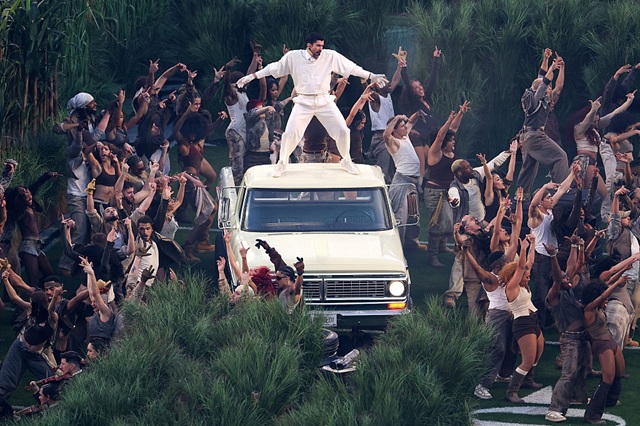
The performance itself was crafted to be joyous and unifying. Flags from across Latin America fluttered behind dancers, Lady Gaga appeared for an English-language cameo, and at the end Bad Bunny held up a football inscribed with “Together we are America” before spiking it in a gesture that was poetic, if lost on critics who refused to look beyond the soundtrack. Yet fact and intention matter less in modern outrage economies than the narratives that get traction among media tribes. Videos of imagined offences — including a misattributed clip of him sitting during “God Bless America” at a baseball game — were widely shared to stoke anger even though they had nothing to do with the Super Bowl itself.
What makes all this particularly striking is how it fits into a well-established pattern of Super Bowl controversies that predate this year. Americans have loudly debated halftime shows before. In 2004, the now-infamous Janet Jackson/Justin Timberlake performance produced an accidental “wardrobe malfunction” that dragged the FCC and the Bush administration into a moral panic and shattered MTV’s cultural hipster credibility. That episode rewired broadcast standards and ushered in a new era of caution and overreaction around live performances.
In 2016 and beyond, the NFL’s handling of Colin Kaepernick’s protests against police brutality spilled into halftime show politics when major artists refused to perform in solidarity, and when performers who did engage were criticised for crossing a supposed picket line. That drama — with Jay-Z, Cardi B, Rihanna and others at the centre of public statements — showed how the league’s biggest stage had become a venue for national culture wars.
Even the music of past shows drew fire; Super Bowl LIV in 2020 was decried by conservative and Christian commentators for supposed sexual content despite mainstream praise, underscoring how artists have always been faulted not on musical merit but on perceived offence to some audiences.
In that context, Bad Bunny’s performance should not be an anomaly but a predictable evolution: a world event where millions of viewers bring pre-existing political baggage to bear on what should be a celebration of sport and entertainment. Yet this year felt bigger. It felt like a cultural referendum. It felt like a moment when the NFL, perhaps unwittingly, invited not just a global pop star but a lightning rod capable of exposing the seams of national identity debates.
The defensive response — a counter “All-American Halftime Show” featuring Kid Rock and other conservative performers — didn’t just reflect differing tastes in music. It reflected a deeper anxiety about who gets to represent America, what language we speak when millions are watching, and what it means for an event so emblematic of American culture to embrace plurality.
Bad Bunny deleting his social media posts immediately after the show was the cherry on top: an intentional PR reset or a personal retreat, no one knows, but it suggests that even performers are now acutely aware that every public footprint can be weaponised in the culture wars.
Super Bowl LX will be remembered less for the final score and more as a marker of where America stands in 2026: divided, defensive, and ready to cast even a Spanish-language pop set as cultural treason. If pioneers in earlier Super Bowls pushed the boundaries of broadcast performance, Bad Bunny pushed the boundaries of national identity on one of the world’s largest stages. The question now is not what happens on the field, but how long the rumble from this halftime will echo through politics, entertainment and the uneasy definition of what it means to be American.










