


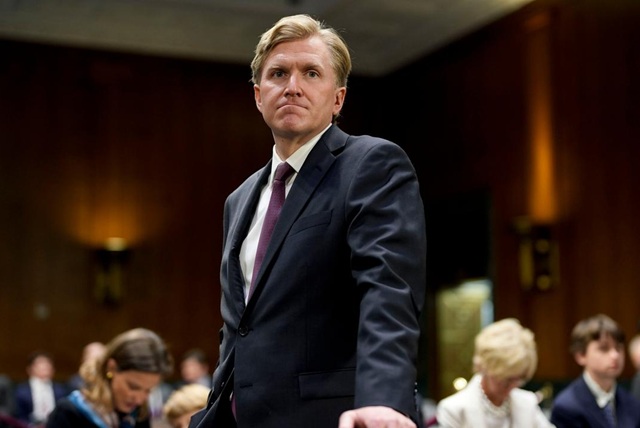
President Trump’s chief military strategist, Elbridge Colby, is calling for a radical shift in NATO’s approach, insisting the alliance should operate on “partnership, not dependency,” with European nations, Britain, and Canada increasing defence commitments. The Times UK reports that Colby, speaking ahead of a meeting of NATO defence ministers in Brussels, advocates a return to the alliance’s original Cold War-era principles rather than reliance on overwhelming US military power.
“In 2025, we saw a genuine commitment to have Europe lead the conventional defence of NATO,” Colby said. “Now it’s time to march out together… for a NATO based on partnership rather than dependency. Really, a return to what NATO originally was intended for.” Colby, 46, a former policy chief and key architect of the Trump administration’s National Defence Strategy, will attend the Brussels talks in place of US Defence Secretary Pete Hegseth, who is skipping the meeting. His presence signals Washington’s focus on urging Europe to increase military spending and operational capability more swiftly than the current timeline toward the 2035 target of 5 per cent of GDP.
Colby, a Harvard and Yale Law School graduate with a background in US intelligence and defense policy, has long been a China hawk and critic of Europe’s reliance on American support, particularly in relation to Ukraine. He advocates for European members to take primary responsibility for their conventional defence, while the US maintains its extended nuclear deterrent and select conventional capabilities. His stance is part of a broader Trump-era strategic faction dubbed the “prioritisers,” who seek to pivot US focus toward China while remaining pragmatic about the necessity of NATO.
Despite his hardline reputation, Colby has moderated some of his views after observing Europe’s operational role in supporting US missions, notably the B-2 bombing raid on Iran last summer. European officials told the Times UK that there are no immediate plans for a major US troop drawdown in Germany, Italy, or along NATO’s eastern flank, with the current 80,000–90,000 troops largely remaining in place. Colby is seen by European diplomats as a strategic thinker and a more cooperative interlocutor than Hegseth, whose criticism of European spending caused friction at last year’s NATO meetings.
Colby is expected to press European allies on the pace of real military capability spending rather than long-term, backloaded projections, warning against the so-called “hockey stick” approach of delaying significant expenditure until 2035. European diplomats say Colby’s message will be uncompromising: NATO must return to “factory settings,” a more lethal alliance committed to collective defence, and avoid strategies that undermine US readiness for power competition in Asia.
His influence on US policy has been substantial, shaping debates over the American role in Ukraine and the Middle East. During his tenure as Under Secretary of Defence for Policy, Colby argued against extensive arms transfers to Ukraine and advocated reorienting US forces toward the Indo-Pacific. “Our allies must take primary responsibility for Europe’s conventional defence, relying on the United States mainly for its extended nuclear deterrent and select conventional capabilities that do not detract from our ability to deter China,” he said.
Colby’s stance reflects a broader realignment within the Trump administration, which divides into three foreign policy camps: “primacists” who demand global US primacy, “restrainers” who oppose prolonged overseas commitments, and “prioritisers” like Colby, who balance strategic realism with targeted US engagement. While restrainers might pull back from NATO entirely, Colby advocates maintaining the alliance but forcing European nations to assume greater responsibility, particularly on conventional defence.
The Times UK noted that Colby’s approach has been shaped by practical realities. During the 2025 air operation against Iran, US B-2 bombers relied on European NATO air bases for mid-air refueling, demonstrating the continued operational value of allied support. Diplomats describe Colby as pragmatic and personable, a negotiator capable of pressing for increased defence expenditure while maintaining alliance cohesion.
Colby’s message will be reinforced at the upcoming Munich Security Conference, where he and other US officials, including Senator Marco Rubio, are expected to underscore the changing global security landscape. Reports suggest that the post-Cold War order, largely upheld by American power, is now under pressure, requiring European allies to integrate hard power more decisively into regional security planning. “For decades, Europe thrived under an American security umbrella that allowed it to prioritise integration and prosperity over hard power. That era has ended,” the conference report states.
As NATO ministers gather in Brussels, the question is whether Europe will heed Colby’s call to move beyond dependency and rapidly bolster defence capabilities. His vision of “NATO 3.0” emphasizes shared responsibility, operational readiness, and a return to the alliance’s core mission, setting the stage for a potential showdown over the speed and scope of European military investment in the years ahead.










