The sentencing of two men for plotting what investigators described as a mass-casualty attack against Jewish communities has sent a chilling reminder of the persistence of extremist violence in Europe and the fragile line between prevention and catastrophe. The case, detailed in reporting by The Times, revealed how an elaborate, Islamic State-inspired conspiracy unfolded across multiple cities before being dismantled by one of the most complex counterterrorism operations mounted in recent years.
Walid Saadaoui, 38, and Amar Hussein, 52, were handed life sentences with minimum terms of 37 and 26 years after a court found they had planned a coordinated shooting spree targeting Jewish gatherings in Manchester. Authorities said the attack, if carried out, could have become one of the deadliest acts of terrorism in modern British history, surpassing even past atrocities in scale and intent.
The investigation was led by Greater Manchester Police, whose chief constable, Stephen Watson, delivered a stark assessment after the sentencing. He said Jewish communities had been forced to live with extraordinary security concerns that others rarely experience, warning that hatred directed at one group ultimately threatens society as a whole. His remarks reflected growing concern among European security officials about the normalization of antisemitic threats amid global political tensions.
The plot began to unravel through intelligence gathered by MI5, which had been monitoring Saadaoui’s online activity. Investigators discovered that he was attempting to recruit collaborators, acquire military-grade weapons, and model an attack on atrocities carried out by Islamic State and its sympathizers. Among those he reportedly idolized was Abdelhamid Abaaoud, one of the key figures behind the 2015 terrorist attacks in Paris.
What followed was a high-risk undercover operation involving an officer known only by the pseudonym Farouk. According to investigators, Farouk engaged Saadaoui online before meeting him repeatedly in person, gaining the trust of the conspirators while covertly relaying critical intelligence to authorities. Assistant Chief Constable Rob Potts later said the operative placed himself in “significant danger” each time contact was made, as discovery would likely have meant immediate violence.
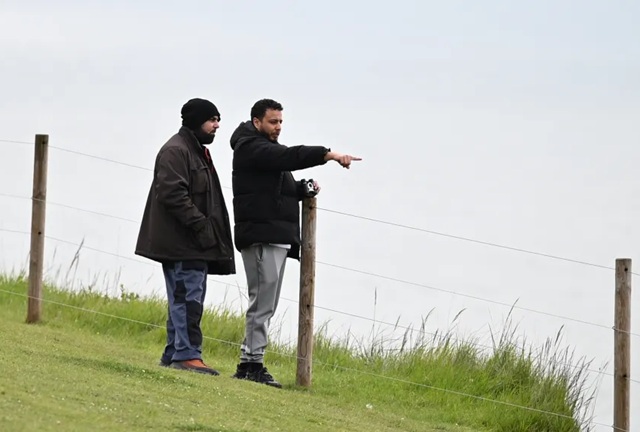
The suspects’ preparations were methodical. They conducted reconnaissance trips from Manchester to Dover, posing as tourists while studying security arrangements near the port where they intended to smuggle weapons into the country. Surveillance teams tracked them as they visited the nearby White Cliffs of Dover, blending into the steady flow of visitors while finalizing logistics for importing assault rifles, handguns, and hundreds of rounds of ammunition sourced from contacts in France.
Evidence presented in court revealed the pair used coded language drawn from Saadaoui’s hobby of keeping birds. Firearms were referred to as “goldfinches,” while ammunition was described as “bird seed.” Investigators said the coded exchanges were designed to evade digital detection, though they ultimately provided additional proof of intent once deciphered.
Saadaoui’s personal history added layers of complexity to the case. Originally from Tunisia, he had worked as a hotel entertainer before moving to England after marrying a British woman. He later ran a small restaurant business, which eventually failed. Prosecutors showed that proceeds from the sale of his home were redirected toward purchasing weapons, including an initial payment of €5,000 for a cache that was to include four AK-47 rifles and more than a thousand rounds of ammunition. Hussein, a former soldier who had settled in England years earlier, became a key accomplice, helping coordinate logistics and surveillance.
The men allegedly planned to disguise themselves in traditional Jewish attire to gain access to religious spaces and then carry out a roaming attack targeting worshippers, police officers, and emergency responders. Authorities believe they chose symbolic dates and locations to maximize casualties and psychological impact.
The conspiracy was brought to an end in May last year when Saadaoui was arrested while taking delivery of what he believed was the first shipment of weapons. The firearms had in fact been supplied in a controlled operation and rendered inoperable by police. The arrest marked the culmination of months of surveillance, intelligence gathering, and covert engagement described by officials as the largest and most complex undercover counterterrorism investigation ever undertaken in northwest England.
During sentencing, the presiding judge praised the undercover officer’s courage, noting that his actions had “potentially saved many lives” and underscored the often unseen human risks behind intelligence-led policing. The court also heard that Saadaoui’s younger brother, though not directly involved in the attack planning, had prior knowledge of elements of the scheme and failed to alert authorities, resulting in his own conviction on related charges.
The case has reverberated beyond the courtroom, fueling renewed debate about domestic radicalization, online extremism, and the evolving tactics of so-called “lone cell” terrorism. Analysts say such plots increasingly rely on small networks or even individuals inspired by global propaganda rather than direct command structures, making them harder to detect until late stages.
Prime Minister Keir Starmer welcomed the convictions, declaring that the government would “never relent” in confronting antisemitism and politically motivated violence. His statement reflected a broader European security posture that treats attacks against minority communities as threats to democratic stability itself.
Security experts note that while the disruption of this plot demonstrates the effectiveness of intelligence coordination, it also highlights how quickly extremist ideologies can translate into operational plans. The combination of encrypted communication, cross-border procurement, and symbolic targeting mirrors patterns seen in previous international attacks, underscoring the transnational dimension of modern terrorism.
For Jewish communities in Manchester and beyond, the revelations have been both sobering and affirming. Community leaders expressed gratitude for the intervention while acknowledging the emotional toll of living under persistent threat. Increased security at synagogues, schools, and cultural centers has become routine, a visible reminder of dangers that authorities say are unlikely to disappear entirely.
Officials insist the case should not only be seen as a narrowly averted tragedy but also as evidence of what sustained intelligence work can achieve. Yet they warn that prevention depends heavily on early detection, community cooperation, and the willingness of undercover operatives to assume extraordinary risks.
As Europe confronts a shifting landscape of radicalization shaped by geopolitical conflict, digital propaganda, and social fragmentation, the foiled Manchester plot stands as both a success story and a cautionary tale. It illustrates how acts of mass violence can gestate quietly within ordinary surroundings—and how, in this instance, vigilance, infiltration, and timing prevented a devastating attack from becoming reality.