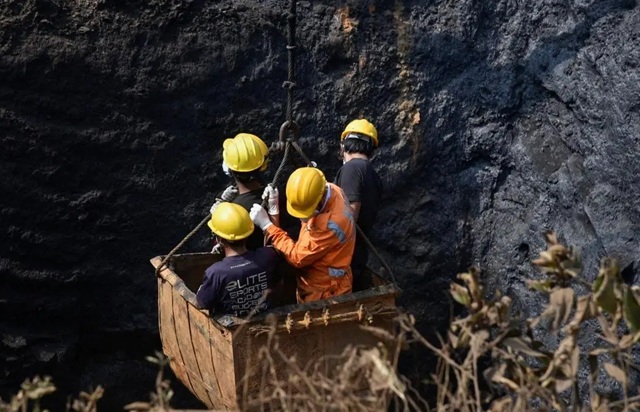
A devastating explosion at an illegal coal mine in the Thangsko area of East Jaintia Hills district on February 5, 2026, killed 33 workers and laid bare the failure of enforcement agencies to curb rat-hole mining in Meghalaya. Coverage by Front Line India highlights how the accident underscores not just regulatory lapses, but the persistence of a deeply entrenched mining ecosystem that remains largely unmapped and unmonitored. Rescue personnel from the National and State Disaster Response Forces recovered 28 bodies at the site, while five more succumbed to injuries in hospitals, with authorities halting operations on February 9 once officials were convinced no further casualties remained.
Investigations revealed that the miners were using dynamite for extraction—an alarming development in a practice historically reliant on manual tools such as shovels and pickaxes. Superintendent of Police Vikash Kumar stated that officials are probing the source of the explosives, recovering over 35 kilograms of illegal dynamite in raids across the district, and questioning individuals involved in operating the mine. This marks the first reported use of dynamite in rat-hole mining in the region, adding a new layer of risk to an already dangerous occupation that primarily employs migrant labourers from Assam and even Nepal.
The political response has been tense. Chief Minister Conrad Sangma reported the seizure of more than 15,000 tonnes of illegally mined coal and the registration of 64 FIRs across the State for illegal mining, coal transportation, and unlicensed use of explosives. Meanwhile, the State Assembly witnessed friction when Speaker Thomas A Sangma refused to allow a debate on the incident, citing ongoing court proceedings, a move criticised by opposition legislators as an attempt to evade scrutiny over administrative failings. The national government, led by Prime Minister Narendra Modi, announced ex-gratia payments of Rs. 2 lakh for the kin of each deceased worker and Rs. 50,000 for each injured individual, while compensation for migrant workers from Assam and Nepal reached up to Rs. 5 lakh per family.
Illegal rat-hole mining in Meghalaya is not a new phenomenon. The National Green Tribunal banned the practice in 2014, and the Supreme Court later allowed only legally sanctioned, scientific mining on privately owned land, subject to strict environmental and safety protocols. Yet the illegal operations have persisted. A committee appointed by the Meghalaya High Court in 2022 identified over 22,000 rat-hole mines in East Jaintia Hills alone, a district covering more than 2,100 square kilometres. The panel’s 36th interim report revealed that tens of thousands of tonnes of coal had vanished from government surveillance, with discrepancies in the accounting of legally mined versus illicitly extracted coal suggesting collusion between the coal mafia, transporters, and possibly officials.
Justice Brojendra Prasad Katakey, retired judge of the Gauhati High Court and head of the judicial monitoring panel, noted that the February 5 explosion likely occurred due to methane accumulation ignited by dynamite blasts in clustered vertical pits. He highlighted how the procurement and use of explosives in these illegal operations was entirely unregulated and beyond the oversight of certified professionals. Prior investigations by the panel had exposed discrepancies in coal transported to Bangladesh, showing that state authorities consistently failed to track illegal exports. The committee also documented significant environmental damage, including deforestation, soil degradation, and pollution of rivers and streams.
Civil society activists warn that the illegal mining ecosystem extends beyond miners to encompass businessmen from neighbouring states, collusive government officials, and elements of the coal mafia. Cherian Momin from Tura noted that truckloads of coal are often transported under a single challan, obscuring the true scale of the operations and facilitating large-scale money laundering. He called for a thorough investigation to map the entire chain of illegal activities, from extraction to transport and sale, to expose the network profiting from this hazardous trade.
Despite efforts to legalise and regulate coal mining in Meghalaya, including the establishment of scientific mines and issuance of leases for landowner-operated mining, illegal rat-hole operations continue to flourish. The peculiar land ownership system in Meghalaya, classified as a Schedule VI area under the Constitution, adds further complexity, as mineral rights belong to individual landowners rather than the State, complicating enforcement and monitoring. Activists such as Agnes Kharshiing have documented cases of land grabbing and intimidation by the coal mafia, illustrating the systemic challenges facing authorities attempting to implement regulatory oversight.
The February 5 incident is the latest in a string of disasters that have repeatedly exposed the human cost of illegal rat-hole mining. Past accidents in East Jaintia Hills and neighbouring Nagaland have resulted in dozens of deaths, highlighting the persistent hazards faced by poor migrant workers who operate in narrow, unstable tunnels without basic safety equipment. The introduction of explosives represents an escalation in risk, with authorities struggling to track and control these operations.
The Meghalaya High Court has demanded detailed reports from police and district administration on the accident and continues to emphasise accountability, warning that independent investigations may be required to ensure justice. Meanwhile, the coal mafia and illegal operators remain largely insulated by the remoteness of the mining sites, lack of surveillance personnel, and collusion with elements of the local administration. The persistence of these operations raises urgent questions about governance, regulatory enforcement, and the protection of vulnerable labourers in India’s mineral-rich northeast.