After the inconclusive 12-day war in June, Israeli forces under Prime Minister Binyamin Netanyahu are recalibrating their strategy, while the US accelerates a military buildup that could see the largest warship ever built, the USS Gerald R. Ford, deployed near Israel by this weekend. Experts warn that the stage is set for a joint Israeli-American operation targeting Iran’s nuclear and missile capabilities, a scenario that could reshape the region’s security landscape.
The Times UK reports that Netanyahu has issued stark warnings: “If the ayatollahs make a mistake and attack us, they will receive a response they cannot even imagine.” Israeli military planners believe their lessons from last June—when preliminary US and Israeli strikes failed to fully neutralize Iran’s nuclear facilities—will give them a tactical advantage. Major General Amos Yadlin, a former fighter pilot and Israel Defense Force intelligence chief, said, “Israel can send in hundreds of bombs in a very precise manner. If the Americans ask, Israel will answer.”
President Trump has demanded that Iran abandon its nuclear programme and condemned the regime’s brutal suppression of recent protests. While no official decision to strike has been announced, the US military is reportedly prepared to launch operations imminently. The Geneva talks earlier this week failed to produce any meaningful compromise, particularly on Iran’s missile development and regional proxy activities. “Instead of negotiating, they are playing chicken and threatening the president of America,” Yadlin said. “The chances of an American attack are now higher than no attack.”
Israeli forces have remained on high alert, anticipating retaliation by Iran against American regional assets and its allies. Netanyahu reportedly discussed the situation directly with Trump during a White House meeting, signaling close coordination. “Iran already announced that Israel will be on their retaliation list. So it makes a lot of sense that Israel will be involved, whether in return for an Iranian attack, or if Israel perceives an imminent threat,” Yadlin explained. While Israel has not altered public preparedness levels, the government is reportedly weighing the potential psychological and economic impact of a pre-emptive warning.
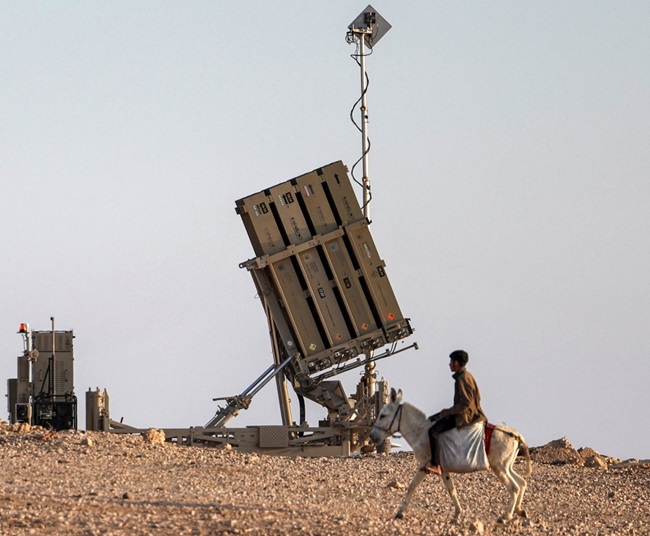
Security analysts emphasize the scale of the threat posed by Iran’s ballistic missile arsenal, now believed to include up to 2,000 missiles, capable of striking deep into Israeli territory. Israel’s Iron Dome and other missile defence systems have intercepted many incoming rockets during previous exchanges, but experts warn the current Iranian stockpile could overwhelm even sophisticated defences. Dan Diker of the Jerusalem Centre for Security and Foreign Affairs noted that Israel, together with the US and regional allies, has “substantially” upgraded anti-missile systems since last year.
The June conflict inflicted an estimated $3 billion in damage on Israel, highlighting the destructive potential of Iran’s arsenal. Israeli strikes last year targeted anti-aircraft batteries, nuclear scientists, and missile launchers. While damage was significant, it did not eliminate Iran’s missile capabilities. According to the Institute for the Study of War, Israel destroyed roughly a third of Iranian missile launchers, but Iran still possesses the largest stockpile of ballistic missiles in the Middle East, capable of reaching Israel and US assets across the region. Tehran may also leverage Hezbollah in Lebanon as a proxy, prompting Israeli airstrikes against weapons depots and launch sites there.
President Trump has reportedly considered a “fully fledged war” with Iran, assembling an enormous armada in the Middle East. The USS Gerald R. Ford will join the USS Abraham Lincoln and eight Arleigh Burke-class destroyers, along with over 120 aircraft that have crossed the Atlantic in recent days. Plans may involve launching attacks from Diego Garcia in the Indian Ocean and RAF Fairford in Gloucestershire, Britain. Analysts warn that while US airpower is formidable, a regime change in Iran cannot realistically be achieved by airstrikes alone. Dr Rosemary Kelanic, director of the Middle East programme at Defense Priorities, cautioned that “if Iran fights back and takes out American military targets, it creates an extremely unpredictable situation.”
Tehran’s likely response has been informed by last year’s engagements, where strikes on the Natanz and Fordow nuclear facilities were choreographed to minimize escalation. This time, however, experts predict the Iranian regime may act without restraint, potentially targeting US embassies in Iraq, closing the Strait of Hormuz, or launching missile attacks against American bases in Jordan, Bahrain, and Qatar. “The Iranians have said they will go all out. They are not bluffing,” Kelanic said, noting concerns within the Trump administration about depleted stocks of American air-defence missiles.
Despite the risks, Trump appears motivated by a combination of strategic calculation and legacy considerations. Having overthrown Venezuela’s Nicolás Maduro with a special forces operation earlier this year, he may see the reversal of Iran’s 1979 revolution as a defining historical achievement. US military planners anticipate hundreds of sorties a day, leveraging air superiority and Israeli collaboration. Matthew Savill of the Royal United Services Institute emphasized that, while air defences are robust, “people shouldn’t assume that THAAD, Arrow 2 and Arrow 3 are an impenetrable shield.”
The potential scale of a US-Israeli campaign contrasts sharply with the 12-day war of June, offering broader, more existential pressure on the Iranian regime. However, analysts caution that the United States faces serious political risks, particularly ahead of midterm elections. History shows that Americans are wary of protracted conflicts in the Middle East, and a drawn-out war could jeopardize domestic support. Trump’s advisers are reportedly weighing whether a rapid, high-intensity strike could compel regime concessions or merely provoke a wider regional conflagration.
As the USS Gerald R. Ford closes in on the Eastern Mediterranean, and Israeli forces remain poised for rapid action, the world watches with mounting concern. The Times UK reports that the next few days could define the Middle East’s strategic future, testing the limits of military coordination, deterrence, and the willingness of nations to confront one another in an age of unprecedented destruction. Both Israel and the United States appear determined to act if provoked, but the outcome remains uncertain, and the human and geopolitical costs could be enormous.