by Luxman Aravind
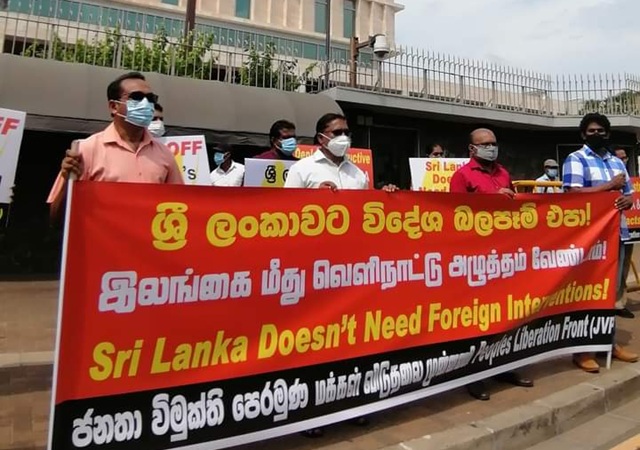
The most enduring currency in Sri Lankan politics is not ideology, principle, or even nationalism. It is survival. What we are witnessing today is not a policy correction or an evolution of thought, but the naked politics of betrayal repackaged as pragmatism. The transformation of the Janatha Vimukthi Peramuna from a movement that once roused thousands of rural Sinhala youth to resist Indian influence into an organisation now speaking warmly of partnership with India is not merely ironic; it is morally seismic. A political force that built its legitimacy upon resistance has quietly inverted its own historical meaning without pausing to account for the human cost of that earlier mobilisation.
In the late 1980s, young men and women were not told they were entering a temporary political theatre. They were told they were defending sovereignty, civilisation, and the dignity of Sri Lanka. They were indoctrinated to believe that external intervention was an existential threat and that compromise was treachery. Those ideas were not abstract seminar-room theories. They were instructions issued into villages, whispered into classrooms, printed in pamphlets, and enforced through fear. Today, the same political lineage speaks the language of cooperation, technology transfer, and regional partnership, as though history were an inconvenient draft that could simply be edited.
The founder, Rohana Wijeweera, constructed a movement that thrived on absolutism. There was clarity, however dangerous: the enemy was named, the struggle was defined, and sacrifice was demanded. Tens of thousands answered that call. Many never returned. Their families were left not with ideology, but with absence — empty chairs, unmarked graves, lives permanently suspended between grief and unanswered questions. If today’s leadership believes circumstances have changed, the country is entitled to ask a brutally simple question: who will be held accountable for those who died under the previous certainties? Political reinterpretation does not exhume bodies, nor does it console mothers who buried sons for a cause that has now been diplomatically abandoned.
The current leadership, including Anura Kumara Dissanayake and party secretary Tilvin Silva, presents this shift as realism demanded by economic collapse and geopolitical necessity. Yet realism arrived suspiciously aligned with electoral victory and the burdens of governing. Before assuming power, the rhetoric was unambiguous. Agreements with India were denounced as dangerous concessions. Strategic projects, particularly around Trincomalee, were portrayed as threats to national control. The language then was not nuanced scrutiny but emotional mobilisation. Now the language has softened into technocratic reassurance. The ideology that once inflamed resistance has been replaced with managerial vocabulary, as if the past were an embarrassing youthful indiscretion rather than a campaign that reshaped an entire generation.
This is not ideological maturation. Mature political movements confront their past honestly. They acknowledge misjudgements, accept responsibility, and create mechanisms of reconciliation. None of that has occurred. There has been no national reckoning for the estimated seventy thousand lives lost in the southern violence of 1987–89. No comprehensive truth process. No systematic reparations. No moral accounting by those whose words helped ignite that era. Instead, there is silence — a silence filled only by development statistics and diplomatic photographs. The dead have been politically outlived.
One cannot escape the impression that ideology, for all its grand language, has functioned as a disposable instrument. When confrontation mobilised support, confrontation was sacred. When cooperation became economically necessary, cooperation became enlightened. The doctrine bends, the narrative adjusts, and survival continues. The tragedy is not that political parties change — change is inevitable — but that in this case change has occurred without responsibility. The same political culture that once condemned compromise as betrayal now practises it without confession.
Sinhala politics has, over decades, normalised this elasticity of conviction. Principles are proclaimed in opposition and diluted in power. Nationalism becomes negotiable once the arithmetic of governance intervenes. What makes this instance especially stark is the scale of sacrifice that accompanied the earlier position. A movement that demanded total loyalty now offers selective amnesia. If such reversals can occur without consequence, they will occur again. Trust, once broken at this magnitude, does not regenerate simply because circumstances require cooperation.
There is also a deeper danger. When politics repeatedly demonstrates that ideology is expendable, citizens eventually conclude that all political language is performance. That cynicism corrodes democratic culture far more effectively than any external influence ever could. People who believe they were once summoned to defend the nation now see the same slogans repurposed or discarded according to expediency. The lesson absorbed is not one of reconciliation but of futility: conviction is for followers, flexibility is for leaders.
No nation can indefinitely sustain a political tradition that refuses to confront its own consequences. Economic recovery may demand new alliances. Regional realities may compel engagement. But moral debts do not vanish because balance sheets improve. A state that can renegotiate agreements yet cannot address the grievances of families who lost everything reveals a hierarchy of priorities that is profoundly unsettling.
If the present leadership truly believes it has entered a new political era, it must answer the questions that linger from the old one. Who speaks for the disappeared? Who compensates those whose lives were shattered by ideological wars now deemed obsolete? Where is the institutional courage to admit that political absolutism helped destroy the very society it claimed to defend? Without such reckoning, today’s pragmatism appears less like wisdom and more like adaptation without conscience.
The politics of survival may secure governments, but it leaves nations psychologically fractured. Sri Lanka risks entering a future in which every declaration is met with suspicion, every mobilisation interpreted as temporary theatre, and every promise assumed to be reversible. That is not stability. It is a slow erosion of collective belief.
History is not demanding perfection. It is demanding honesty. Until that honesty emerges, the distance between what was once preached and what is now practised will remain one of the most troubling fault lines in the island’s political life — a reminder that survival achieved through forgetting carries consequences that no economic partnership can repair.