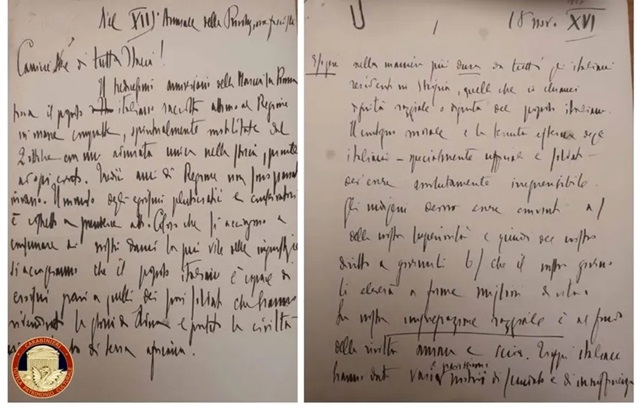
A recently recovered handwritten letter by Benito Mussolini exposes a rarely seen side of the Italian dictator: vulnerability. Seized by Italian police before it could be sold to a foreign collector, the document shows Mussolini begging Adolf Hitler for assistance in regaining prestige in a country where his authority had all but collapsed. Written in November 1944, the five-page letter details the former Duce’s growing frustration at German interference and his attempts to assert national dignity even while relying entirely on Nazi support.
The letter, verified by forensic experts, was intended for Hitler’s eyes only and reveals the depth of Mussolini’s dependence on the German Führer at a time when the tide of World War II was decisively turning against the Axis powers. Among Mussolini’s complaints were the imposition of German language in parts of northern Italy and the requirement that Italian troops be trained in Germany rather than at home—a move he saw as an affront to national sovereignty. His final, almost plaintive request: that Hitler help him restore his waning “prestige” among Italians.
Historians describe the letter as a rare insight into the power imbalance between two of the 20th century’s most infamous dictators. Christian Goeschel, a historian at the University of Manchester, explained that Hitler had already begun treating Mussolini as a “lame duck,” leaving him to navigate an Italian Social Republic that was increasingly under German occupation. “The document shows Mussolini on the defensive, desperate to limit German influence while still needing their protection,” Goeschel said.
The letter was written a year after Mussolini was deposed by King Victor Emmanuel III in July 1943, following the Allied invasion of Sicily. Rescued by German forces, Mussolini was installed as the head of the Italian Social Republic, a puppet regime in northern Italy. By April 1944, when he met Hitler at Klessheim Castle near Salzburg, Austria, Mussolini’s power was largely symbolic, and the meeting reflected his weakened bargaining position.
The document’s rediscovery came after an unnamed private owner in Italy sought an export permit to auction it abroad. Archivists in the Piedmont and Valle d’Aosta regions recognized the handwriting and alerted the Carabinieri, Italy’s national police force, who secured the letter for the state archive. Deneb Teresa Cesana, head of the regional archive, said, “This was a dark moment for Mussolini, and the list is an important testament to that.”
Experts believe the letter was likely lost when the archives of the Italian Social Republic were dispersed amid the chaos at the war’s end in 1945. It adds nuance to historical understanding of Mussolini’s final years, a period often portrayed as mere collaboration with Nazi Germany. Giovanni Fasanella, an Italian wartime archivist, noted that a copy may exist in the British National Archives in Kew, London, as Allied forces photographed many Italian documents in 1945 before they disappeared into private hands.
The letter also illuminates lesser-known aspects of Mussolini’s desperation and ego. For instance, Mussolini reportedly requested that Hitler reinstate Italian officers who had been sidelined by the Germans, arguing that their removal damaged Italy’s military reputation. In another handwritten note, he argued against the overt use of German military advisors in Italian territory, warning that it could create “resentment among Italian citizens” and undermine the fragile legitimacy of his government.
Historians have long debated the nature of Mussolini’s alliance with Hitler, often emphasizing ideological alignment over practical dependence. The newly surfaced letter, however, portrays a man forced into subservience by circumstance. The meticulous phrasing and careful appeals for respect suggest that Mussolini remained acutely aware of his image, even as he presided over a regime heavily controlled by a foreign power.
Little-known anecdotes from this period further highlight Mussolini’s precarious position. For example, contemporary reports suggest he instructed aides to maintain appearances of authority by holding public events with only carefully vetted audiences. In one instance, he ordered a parade of local militia to boost morale, only to learn that German officers had already replaced key Italian commanders—a fact he allegedly kept secret to avoid humiliation. These small details, while often overshadowed by the grand narrative of the war, underscore the everyday struggles of a dictator whose power was in rapid decline.
The letter also provides rare insight into Hitler’s attitude toward his Italian counterpart. According to Goeschel, Hitler’s allowance of dual approaches—some German officials collaborating with Mussolini, others seeking to dominate the Italian Social Republic—reveals a calculated strategy to keep Mussolini dependent and divided. “Hitler was happy to let them compete,” Goeschel said. “Mussolini clearly didn’t understand that going into the meeting, which explains the defensive tone of his notes.”
Italian authorities now face the delicate task of preserving and studying the document, ensuring that it is accessible to historians while safeguarding it from private sale. Cesana emphasized the broader importance of recovering such materials: “We believe there are many documents like this in private hands. Each one offers a unique lens into Italy’s wartime history and helps us reclaim the historical record for future generations.”
As the world reflects on the final years of the Axis powers, Mussolini’s desperate appeal to Hitler stands as a stark reminder that even the most authoritarian leaders are not immune to fear, insecurity, and dependence. Beyond propaganda and posturing, the letters humanize a figure often reduced to caricature, revealing a man navigating the collapse of his regime with an uneasy mix of defiance and pleading. In the meticulous lines of his handwriting, historians now have a new testament to the complex, often humiliating realities behind the headlines of World War II.