


The Sri Lanka Navy ship P 628 is undertaking its longest passage, sailing from Baltimore on the East Coast of the USA all the way to Sri Lanka. This great news, which appeared a few days ago, prompted me to write this article.
The four ex-US Coast Guard ships given to the Sri Lanka Navy are SLNS Samudura (P621), SLNS Gajabahu (P626), SLNS Vijayabahu (P627), and now the ex-USCG Decisive (P628). The last ship was officially handed over during a ceremony held on December 2, 2025. The Commander of the Navy, Vice Admiral Kanchana Banagoda, and the Sri Lankan Ambassador to the US, His Excellency Mahinda Samarasinghe, were present at this historic event. Upon completion of all training and testing equipment, the newly acquired SLN ship (P628, until commissioned with its new name) left her home port in Pensacola, Florida, on her long voyage to Sri Lanka (Colombo/Trincomalee) a few days ago. She is under the command of the brilliant Captain Gayan Wickramasooriya, assisted by his crew of 14 officers and 72 sailors, and will cover a passage of 14,775 nautical miles. As per the planned voyage, they are scheduled to cover this distance in 77 days, reaching Sri Lanka by the second week of May 2026.
She will be the first SLN ship to cross the Panama Canal from the Atlantic Ocean to the Pacific Ocean. She has an endurance of 6,000 nautical miles, meaning careful planning is required for refueling during her passage. We wish her “fair winds and following seas.”
I want to clarify three points for the general public who are not seafarers:
First – why is a ship called “she”? The simple answer is similar to your own lady: “It is not the initial acquisition that will cost you, but the maintenance!” (Ladies, please pardon me!)
Second – why is the SLN acquiring old ships? This ex-USCG cutter was built in 1967 and commissioned in 1968. These ships are constructed with the best marine-grade steel and undergo major overhauls every four years.
For example, do you know the USS Blue Ridge, the flagship of the US 7th Fleet (which covers the Indo-Pacific region)? It commands 50–60 ships, 150 aircraft, and 27,000 sailors and Marines, and it was built and launched on January 4, 1969. So, do not judge the capability of a warship by its launch date; evaluate the equipment and weaponry it carries. The USS Blue Ridge last visited Sri Lanka from March 26–31, 2016, when I was the Commander of the Navy. I had the privilege of taking our Commander-in-Chief and the then-President, Maithripala Sirisena, on board at Colombo Harbour.
My able Director General of Operations, Rear Admiral Dharmendra Wettewa, led the Sri Lanka Navy delegation on board for the first-ever SLN-US Navy staff talks. His skillful negotiation (he is an alumnus of the US Navy War College, Rhode Island, and later appointed Sri Lanka Defence Attaché in Washington, DC) paved the way for establishing the Sri Lanka Navy Marines Corps, training under US Marines, and acquiring more US Coast Guard ships. Bravo Zulu to Dharmendra.
As my late Foreign Service Guru, Hon. Lakshman Kadiragamar, advised: “Use officers who speak the same language when dealing with foreign forces—they will understand your requirements better.”
Third – what does “fair winds and following seas” mean? “Fair winds” is defined in the American Regional Dictionary as “safe journey and good fortune,” with early usage appearing in Herman Melville’s Moby Dick (1851). “Following seas” is defined in Bowditch’s Practical Navigation as “a sea moving generally in the direction you are heading,” helping you reach home safely and quickly.
Dear Captain Gayan Wickramasooriya, our blessings are with you! I take this opportunity to thank the US government for helping us become a partner in making the vast Indian Ocean safe.
Now, a story from our Navy’s “Far East Cruise” in 1960, which ended humorously as “Far East Booze.”
Mrs. Sirimavo R.D. Bandaranaike was the Prime Minister of Ceylon from July 21, 1960, to March 25, 1965. During this eventful period, the Navy, under Rear Admiral Gerald Royce De Mel, OBE—the first Ceylonese Navy Commander (then called Captain of the Navy)—requested government approval to proceed on a “Far East Cruise” to Japan, visiting Singapore, Malaysia, the Philippines, and Japan as a flag-showing mission.
As documented in We Should Have a Navy by legendary Navy historian Commander Somasiri Devendra, the mission was approved. The Navy’s flagship, RCyN Ship Parakrama (Algerian-class minesweeper, ex-HMS Pickle), and the newly commissioned River-class frigates brought from Israel were deployed. RCyN Ship Mahasen, a Canadian-built River-class frigate (ex-Israel Navy ship Mivtach), was commanded by Lieutenant Commander Rajan Proctor, while RCyN Ship Parakrama was commanded by Lieutenant Commander D.I. De Livera.
Rear Admiral De Mel flew his flag on board RCyNS Mahasen and planned to join Japan. Coincidentally, the Ceylon Ambassador in Japan was ex-Navy officer Sir Susantha De Fonseka. The planned passage included Singapore, Bangkok, Hong Kong, Tokyo, and a return journey via Port Swettenham (now Port Klang, Malaysia) and Penang.
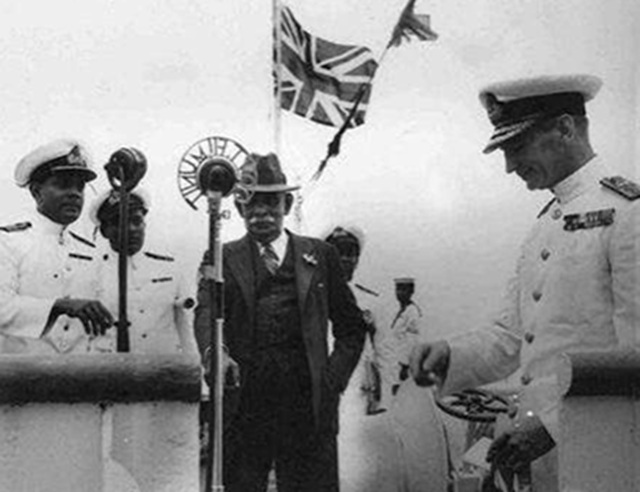
All went well until the ships reached Hong Kong, where Parakrama developed technical issues. Orders were given for Parakrama to remain in Hong Kong while Mahasen continued to Tokyo. The ship received a grand reception from the Japanese Self-Defense Forces, and Rear Admiral De Mel and his staff joined in Japan. The Navy’s flag-showing mission was a complete success. The return journey was initially uneventful.
Then misfortune struck both the Navy and the nation. On the return journey, RCyNS Mahasen was tasked with collecting weapons and ammunition from Singapore by the Ministry of Defence. At the same time, some officers had purchased large quantities of whiskey as a “side business,” intending to enjoy it upon returning home. When this whiskey purchase was discovered by an “interested party,” it was leaked to top leadership, falsely claiming the Navy was smuggling arms.
Upon arrival, the Inspector General of Police inspected Mahasen. Officers courteously guided the IGP and other police personnel, who found nothing suspicious, apart from the arms and ammunition brought as per Ministry instructions. Naval Headquarters then issued sailing orders to patrol south of Mannar, with secret instructions to “dump the whiskey at sea and return clean to harbor.”
The officers attempted an illegal transfer of the whiskey to a fishing trawler off Kalpitiya. Another trawler spotted the transfer and reported it to Kalpitiya Police. The trawler was raided, and the whiskey confiscated.
Consequently, nine Royal Ceylon Navy officers were withdrawn; eight were sent into compulsory retirement along with many sailors. Rear Admiral Royce De Mel, then serving as Captain of the Navy, was interdicted pending inquiry. The Navy’s involvement in the 1962 attempted coup made matters worse. No officers or sailors were recruited for the next decade.
Thus, the “Far East Cruise” became famously known as the “Far East Booze.” All large ships were eventually sold for scrap, and the Royal Ceylon Navy became primarily a patrol craft force.
All this happened before I was born in 1962. My narration here is based on available records and stories from our “old Navy” – the Okapi Navy.
Let me explain what the “Okapi Navy” is in my next article.
Those were the days!
For anyone interested in the genesis of our Navy, please read We Must Have a Navy by the late Instructor Commander Somasiri Devendra, freely available on the Ministry of Defence website.













