
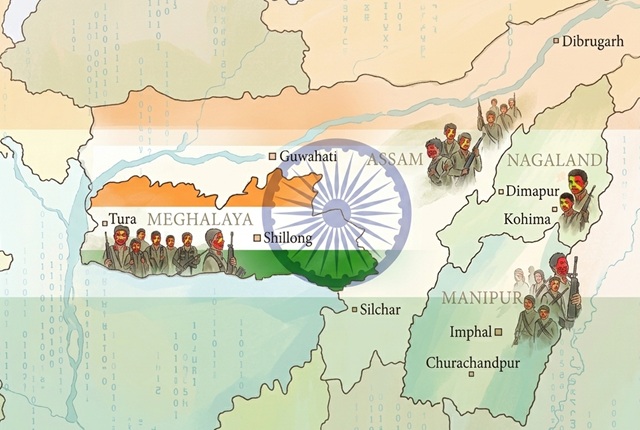
Meghalaya has remained one of the relatively stable states in India’s Northeast in terms of insurgency and internal security, particularly when compared with neighbouring states such as Manipur, Nagaland and Assam. Over the past decade, the security situation has improved considerably as militant groups have weakened due to sustained counter-insurgency operations, arrests, surrenders and the implementation of peace accords. Nevertheless, the state continues to experience residual insurgent activity, extortion networks, cross-border linkages and occasional law-and-order disturbances. These developments indicate that, while the insurgency has significantly declined, the security environment remains fragile and requires continued vigilance by state and central security agencies.
According to partial data compiled by the South Asia Terrorism Portal (SATP), Meghalaya has not recorded any insurgency-related fatalities since September 14, 2021, when an Over Ground Worker (OGW) associated with the United Achik Liberation Army (UALA) and A’chik Songna An’pachakgipa Kotok (ASAK) was killed near Tura in the West Garo Hills District. The last civilian fatality occurred on May 12-13, 2019, when a villager near the Indo-Bangladesh border in Lapalang village of East Khasi Hills District was killed by insurgents. The most recent Security Force (SF) fatality dates back to February 18, 2018, when a National Congress Party (NCP) candidate and two security personnel were killed in an Improvised Explosive Device (IED) attack at Samanda in the East Garo Hills District. These figures underline the sharp decline in insurgency-related violence in the state over the past decade.
Historically, Meghalaya experienced intense insurgent violence during the 1990s. The state recorded its peak insurgency in 1997, when a total of 495 fatalities were reported. Civilian fatalities reached their highest level in 1993 with 266 deaths, while SF fatalities peaked in 1997 with 111 personnel killed. Fatalities remained in triple digits between 1992 and 2000, reflecting intense militant activity during that period. However, since the early 2000s, violence gradually declined, as SFs intensified counter-insurgency operations and several militant groups weakened or entered into peace processes. Fatality levels dropped into double digits between 2001 and 2016, and declined further, since.
Over the past nine years, from 2017 to 2025, Meghalaya recorded a total of 18 insurgency-related fatalities. Eight deaths were recorded in 2017, seven in 2018, one in 2019 and two in 2021, while five years – 2020, 2022, 2023, 2024 and 2025 – recorded no such fatalities. Among militant groups active during this period, the now-defunct Garo National Liberation Army was linked to 13 of the 18 fatalities. The Hynniewtrep National Liberation Council (HNLC) and UALA were each linked to two fatalities, while one incident was attributed to the National Democratic Front of Bodoland-Saraigowra (NDFB-S).
Arrests and surrenders of militants played an important role in reducing insurgent capabilities. Meghalaya recorded two insurgent arrests in a single incident in 2026. In 2025, there were 11 such arrests in six separate incidents, while in 2024, 27 insurgents were arrested in 13 separate incidents. Since 2000, Meghalaya has recorded a total of 1,816 insurgent arrests across 836 incidents. In terms of surrenders, the state recorded two surrenders in a single incident in 2025, two surrenders in two incidents in 2024, and six surrenders in two incidents in 2023. Since 2001, Meghalaya has recorded a total of 610 insurgent surrenders in 244 incidents.
The principal insurgent organisation still operating in Meghalaya is HNLC, which claims to represent the interests of the Khasi-Jaintia communities. The group has historically advocated greater autonomy or self-determination for the Hynniewtrep region and has been involved in extortion, intimidation and occasional acts of sabotage. Although its operational strength has declined significantly, the outfit continues to maintain a limited network of cadres and sympathisers. Intelligence estimates suggest that the organisation currently has around 15 to 20 active cadres, with some senior cadres reportedly operating from bases in Bangladesh, particularly in the Maulvi Bazar region.
HNLC has been banned under the provisions of the Unlawful Activities (Prevention) Act (UAPA) since 2000, and the ban has been periodically extended by the Union Government. The organisation remains under scrutiny due to its involvement in extortion, recruitment and propaganda activities. Between November 2019 and June 2024, authorities registered 48 cases against HNLC and arrested 73 cadres and associates. Security agencies have also recovered arms and explosives during several operations targeting the group. The outfit has increasingly relied on digital communication platforms and messaging applications to threaten businessmen and collect extortion money.
In recent years, HNLC has also attempted to revive its ideological narrative through public statements and propaganda. In January 2025, the group released a new manifesto outlining its demands for recognition of a semi-sovereign status for the Hynniewtrep people. The document accused the Government of India (GoI) of violating historical agreements related to the region’s accession and called for direct dialogue to address issues relating to autonomy, land rights and cultural identity. While such statements indicate the persistence of separatist rhetoric, the organisation’s operational capacity remains limited.
Attempts to initiate peace negotiations between the government and HNLC have been made periodically. The Meghalaya government has repeatedly appealed to the group to engage in dialogue and abandon violence. However, peace talks collapsed in early 2024, due to disagreements over key demands and the framework of negotiations. Following the breakdown of talks, the outfit appears to have reverted to low-intensity activities such as extortion and propaganda, rather than large-scale militant attacks. Security agencies remain alert to the possibility of the group attempting to regroup or recruit new members.
Despite the overall decline in insurgent violence, isolated incidents linked to militant networks continue. On December 15, 2025, an IED exploded at the premises of a private company in East Jaintia Hills District. Although no casualties were reported, the incident triggered a security alert. On December 18, 2025, Meghalaya Police arrested two HNLC OGWs in connection with the explosion. The suspects reportedly confessed to planting the device, demonstrating that the organisation retains the capability to stage occasional disruptive actions.
Security agencies have also intercepted attempts by smaller militant factions to revive their activities. On November 2, 2025, SFs arrested five suspected cadres, including a minor, belonging to the regrouped faction of the Garo National Liberation Army (GNLA) in South West Khasi Hills District. The arrests followed an extortion complaint filed by a businessman who had reportedly received threats and demands for money. The swift action by SFs prevented the emergence of a new extortion network and highlighted the continuing efforts by authorities to prevent any resurgence of militancy.
Apart from insurgent activity, Meghalaya has also experienced occasional law-and-order disturbances linked to political tensions and local grievances. One such incident occurred between March 9-10, 2026, in West Garo Hills District, when violence erupted during the nomination process for elections to the Garo Hills Autonomous District Council. Tensions began escalating on March 9, after protests broke out over the eligibility of certain candidates contesting the council elections. The situation deteriorated further on March 10, when clashes erupted between protesters and SFs in the Chibinang area. Security personnel opened fire to disperse the violent crowd, resulting in the death of two persons. Following the incident, authorities imposed a curfew, suspended internet services and deployed additional SFs, including Army units conducting flag marches, to restore normalcy. The Meghalaya Government subsequently postponed the council elections due to the deteriorating security situation.
Another development that raised security concerns occurred on January 29, 2026, when a threat poster purportedly issued in the name of the Islamic State (IS) was discovered in Tura town. The poster ordered members of the Garo community in several areas of West Garo Hills to vacate their land before 2027, or face consequences. Authorities have not been able to verify the authenticity of the message, and investigations are underway to determine whether the use of the group’s name was intended to spread panic or provoke communal tensions.
Cross-border dynamics continue to play an important role in shaping the security landscape in Meghalaya. The state shares a 443 kilometre international border with Bangladesh, much of which remains porous and difficult to fence due to challenging terrain. The porous nature of the border has historically facilitated the movement of militants, arms and contraband goods. Smuggling of commodities such as betel nut, cattle and narcotics remains a persistent challenge for security agencies operating along the frontier. Thus, for instance, Border Security Force (BSF) data indicates frequent seizures of contraband along the Meghalaya-Bangladesh border. In 2025 alone, SFs confiscated over 750 heads of cattle and contraband worth about INR 117 million, including narcotics such as Yaba tablets and cannabis, during anti-smuggling operations. In addition, earlier enforcement actions recovered 11,435 Yaba tablets, more than 7,500 bottles of Phensedyl cough syrup and about 31 kilograms of cannabis from the border region, underscoring the continuing use of the corridor for narcotics trafficking. Moreover, militant leaders based in Bangladesh have occasionally used cross-border networks to coordinate activities inside Meghalaya. As a result, border management and intelligence cooperation continue to remain critical components of the state’s security strategy.
The Meghalaya government has also focused on consolidating peace processes involving former militant groups. A notable example is the implementation of the tripartite peace accord signed in 2014 with the Achik National Volunteer Council (ANVC) and its breakaway faction. In September 2025, the state government held a high-level review meeting with former leaders of these organisations to assess the progress of the agreement. Officials indicated that approximately 50 to 60 per cent of the commitments under the accord had been fulfilled, while the remaining provisions were under implementation. These include development projects, rehabilitation packages for surrendered militants and initiatives aimed at improving infrastructure and governance in the Garo Hills region.
Overall, the situation in Meghalaya in 2026 can be characterised as one of residual militancy within an otherwise stable security environment. The dramatic decline in fatalities over the past decade reflects the combined impact of sustained counter-insurgency operations, intelligence-led policing, arrests, surrenders and peace agreements. However, the presence of small militant networks, attempts by dormant outfits to regroup, and the continued influence of insurgent leaders operating from across the international border, indicate that the possibility of limited militant activity cannot be entirely ruled out. Sporadic incidents such as extortion attempts, small-scale explosions or propaganda campaigns may continue, even in the absence of large-scale violence. Continued coordination between SFs, effective implementation of peace accords and sustained socio-economic development will therefore remain essential to ensuring that the state does not witness any resurgence of insurgency in the coming years.