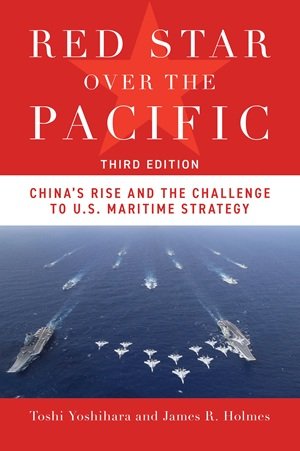
Toshi Yoshihara and James R. Holmes’s Red Star Over the Pacific: China’s Rise and the Challenge to U.S. Maritime Strategy presents itself as a work of strategic diagnosis, yet it is as much an intervention in the intellectual contest over how to interpret China’s maritime ascent. From its opening chapters, the book stakes a claim for both analytical clarity and ideological urgency, asserting that China’s seaward turn “constitutes a permanent complicating factor in Asian and global affairs” (p. 14). The statement encapsulates the book’s dual character: it is at once an empirical survey of Chinese capabilities and a normative warning designed to influence American strategic thought. This tension between descriptive rigor and strategic advocacy is the work’s defining feature, producing a text that is simultaneously compelling, provocative, and open to critique.
Central to the book is the concept of the “China Dream,” which the authors present as more than rhetorical flourish, framing it as a guiding principle linking domestic rejuvenation to maritime power. They assert that Xi Jinping “made ‘Chinese Dream’ his credo…fulfilling this ‘great renewal’ constitutes ‘the greatest dream for the Chinese nation in modern history’” (p. 7). This framing is analytically powerful, suggesting that ideological aspiration is inseparable from strategic orientation. Yet it risks conflating elite discourse with operational intent, treating public proclamations as transparent evidence of coherent policy. While the authors note that such rhetoric may be “grandiose” and “self-interested” (p. 9), they do not fully interrogate the performative and contingent character of political language, leaving open the question of how much of the China Dream reflects tactical positioning versus genuine strategic resolve.
Yoshihara and Holmes anchor their analysis firmly in a Mahanian conception of maritime strategy, arguing that Chinese strategists have embraced a Mahanian “logic” while adapting a distinct “grammar” suited to their operational environment (p. 35). This duality allows the authors to reconcile continuity in strategic purpose with innovative doctrine, but it also introduces a subtle circularity: China behaves in Mahanian ways because it is read through Mahan, and it is read through Mahan because it appears to behave accordingly. The claim that “maritime strategy is a type of grand strategy” (p. 33) risks becoming less a neutral observation than a conceptual imposition, privileging a Western interpretive lens over potentially indigenous strategic traditions. At the same time, the authors demonstrate sophistication in linking economic and strategic geography to capability development, noting that China’s dependence on maritime commerce “has compelled Beijing to develop durable commercial and military means” (p. 15), while threats at sea “demand credible, long-lasting instruments of national power” (p. 15). Yet the coexistence of structural determinism and voluntarist agency—leaders “tapped into a deep—and preexisting—reserve of national willpower” (p. 16)—remains unresolved, producing a tension between inevitability and choice.
The book is also deeply attentive to the psychological and cultural dimensions of Chinese strategy, at times provocatively so. The leadership is described as a “contradictory mix of hypersensitivity and swagger” (p. 16), a formulation that captures both the insecurity and assertiveness observable in Chinese behaviour. Yet this approach risks cultural essentialism, attributing strategic outcomes to a national psyche shaped by historical grievance and rising power. Assertions such as China’s need to respond to “even minor slights at sea” (p. 15) amplify a sense of inevitable confrontation, even as empirical evidence for such sensitivity is often circumstantial. These psychological claims intersect with operational analysis, as when the authors note that “Beijing can hope to drive up the costs of entry into waters and skies it cares about, deterring or hindering U.S. involvement in Asian conflicts” (p. 231), blending cautionary interpretation with anticipatory strategic reasoning.
A key strength of the book is its methodological commitment to Chinese-language sources, including “policymakers, senior military officers, strategists, and scholars” (p. 17). By allowing Chinese commentators to “speak for themselves” (p. 17), Yoshihara and Holmes provide depth and nuance often missing in analyses dominated by secondary reporting. Nevertheless, this approach carries inherent risks: representativeness is uneven, and some sources are speculative or pseudonymous, raising questions about the line between informed insight and institutional signalling (p. 20). The authors defend this choice by highlighting the “savvy, learning, candor, and independence” of these writers (p. 20), yet the tension between authenticity and bias is never fully resolved.
Operational analysis is another notable dimension of the book. Yoshihara and Holmes provide vivid accounts of fleet modernisation, missile development, and doctrinal evolution, emphasising a holistic strategy that integrates naval, paramilitary, and civilian capabilities (p. 23). The authors argue that “tactics involving dispersed, multifaceted attacks thus promise the PLA a handsome return on a modest investment” (p. 232) and that “if the PLA drives U.S. forces to fixate on any single physical domain—surface, subsurface, or aerial—Chinese forces can then pose new challenges from those being neglected” (p. 229). Such insights are both granular and operationally significant, highlighting the sophistication of the People’s Liberation Army Navy (PLAN) without succumbing to hyperbole. Yet the interpretive lens remains shaped by strategic competition: Chinese developments are primarily read as threats rather than as defensive measures or regionally calibrated responses.
Throughout, the book maintains an implicit normative stance, functioning as a strategic warning to the United States. The authors frame the text as a “red team” exercise to help America “adapt its strategy and forces” (p. 33), portraying China’s rise as a problem to be managed rather than a neutral object of study. This orientation shapes interpretations, privileging accounts of latent revisionism over cooperative possibilities: while Beijing asserts “win-win cooperation” (p. 15) and denies hegemonic ambition as “pure nonsense” (p. 10), these claims are treated sceptically, reinforcing a narrative of inevitable challenge. Even historical analogies are strategically framed, as when lessons from the Falklands conflict illustrate the potency of asymmetric tactics: “The successful Argentine counterpunch awakened the British public to the gravity of the crisis while buoying Argentina’s confidence” (p. 250).
At its best, the book’s analytical clarity and theoretical rigor allow readers to interrogate both the logic and the limits of Chinese strategy. Yoshihara and Holmes assert that “China’s turn to the sea is rooted in a coherent and compelling logic” (p. 17), and they consistently link operational detail to strategic reasoning, demonstrating how a “savvy Chinese home team can parley its innate advantages into distinct strategic and operational advantages over the United States, the visitor, imposing costs Washington might find politically unacceptable” (p. 214). Yet this coherence is always provisional, contingent on both interpretation and the unpredictable dynamics of maritime competition.
The book’s provocations extend to resource allocation and force structure, where the authors caution against overemphasis on low-end craft: “Large numbers of low-end craft are more suitable for police duty…large-scale construction of patrol craft diverts resources from building combatants needed to win maritime command” (p. 297). Such insights highlight the trade-offs inherent in maritime modernisation and reveal a nuanced understanding of capability development. Similarly, the authors underscore the strategic significance of chokepoints, noting that “China must quickly build up its navy and strengthen its maritime deterrent power to safeguard the passage of Chinese shipping through the Korea Strait” (p. 104), situating local geography within global strategic calculus.
In conclusion, Red Star Over the Pacific is a study that oscillates between rigorous empirical analysis and normative caution. Its strengths—detailed operational accounts, use of primary Chinese sources, and theoretical framing rooted in Mahanian logic—make it an indispensable text for understanding contemporary maritime strategy. Yet the book’s weaknesses—cultural essentialism, selective sourcing, and an implicit alignment with U.S. strategic anxieties—temper its claims and invite critical engagement. Yoshihara and Holmes succeed in producing a work that is analytically rich, intellectually provocative, and strategically significant, even as they leave open the questions of inevitability, coherence, and threat perception. As the authors emphasise, China’s maritime rise is not simply an object of observation but a subject of interpretation and contestation, and it is precisely this tension that makes the book a valuable starting point for debate in both scholarly and policy-oriented circles.