On a warm Saturday evening in central Tel Aviv, the sound of whistles and jeers carried across Habima Square as hundreds gathered to protest Israel’s ongoing war with Iran. Placards reading “Stop the bombing” and “End the war, end Bibi” — referring to Prime Minister Benjamin Netanyahu — were raised defiantly. Yet even as dissent grows louder, so too does the resistance it faces. According to reporting originally published in Die Zeit, what might have marked the emergence of a renewed anti-war movement instead became a confrontation with state authority, public hostility, and the ever-present threat of violence.
More than a month has passed since Israel, in coordination with the United States, launched strikes against the Iranian regime. Iran’s retaliation has come in the form of regular ballistic missile attacks, many targeting Tel Aviv and often carrying cluster munitions. The toll so far stands at 15 dead, hundreds injured, and widespread property damage. While experts describe the physical damage as limited, the psychological and political impact appears to be growing. Increasingly, Israelis are questioning whether the war is unfolding as expected, and whether its costs are justified.
Recent polling by the Israel Democracy Institute suggests a notable shift. Support for the war among Jewish Israelis, which stood at 90 percent in its first week, has steadily declined. Among those identifying as politically left-wing, the drop has been particularly sharp. Nearly 40 percent of Jewish respondents now believe Netanyahu is pursuing the war for personal reasons, a figure that rises above 50 percent among Arab Israelis. These figures reflect a society beginning to fracture along familiar political and ethnic lines, even as it faces an external threat.
At the heart of the protest movement is a struggle not only over policy but over the right to dissent itself. Tal Hassin, a veteran human rights lawyer representing the Association for Civil Rights in Israel, stood among the demonstrators, documenting the growing police presence. Just a day earlier, she had appeared before the Supreme Court in Jerusalem, arguing for the right to protest during wartime. Israel has no formal constitution, but citizens can petition the court directly against government actions, including recent police decisions to disperse demonstrations citing the risk of missile attacks.
The legal battle has taken on urgent significance. The protest at Habima Square was held above one of the city’s largest underground car parks, designated as a public bomb shelter. Hassin’s organisation argued that this made it a suitable and relatively safe venue for a larger demonstration, proposing a limit of 1,000 participants. The police, following Home Front Command guidelines, insisted on a cap of 150. As the protest began, the Supreme Court had yet to issue its ruling, leaving both organisers and officers in a state of uncertainty.
“This is unbelievable,” Hassin said, scanning the square as police vehicles with flashing lights encircled the crowd. “We still don’t know how many people are allowed to be here.” The delay underscored a broader challenge: organising dissent in a country where security concerns can override civil liberties at any moment. For many, the fear of police violence has become as immediate as the fear of incoming rockets.
That fear is not unfounded. The previous week’s protest ended in clashes that left several demonstrators injured, prompting the legal challenge now before the court. As the evening wore on, tension mounted. Mounted police units, trained for crowd control in East Jerusalem, took up positions nearby. Officers in riot gear formed lines behind them. The atmosphere grew more volatile as counter-protesters appeared, shouting accusations of treason. “Anarchists!” one young man yelled, beer in hand, as he spat on the ground.
The demographic profile of the protesters reflects the movement’s limitations. Many are older, middle-class, and politically left-leaning — a shrinking minority in Israeli society. “It’s not very Israeli to be against war,” said Amit Rechter, a 67-year-old Tel Aviv resident wearing a jacket emblazoned with an anti-war slogan. His observation points to a longstanding national ethos: in times of external threat, unity is expected. Yet that consensus has been eroding, particularly since the Hamas attacks of October 7, 2023, and the government’s subsequent handling of the crisis.
Public trust in Netanyahu has declined significantly. A recent study by the Institute for National Security Studies found that more than 56 percent of Jewish Israelis no longer trust the prime minister. Still, political fragmentation may work in his favour. A divided opposition struggles to coalesce into a viable alternative, and the pressures of war tend to consolidate power rather than disperse it.
As dusk fell over Habima Square, the long-awaited court decision finally arrived. A compromise: 600 protesters would be permitted, not the 1,000 requested. But the announcement came amid confusion. An unidentified lawyer in cycling gear circulated a copy of the ruling on his phone, showing it to police, protesters, and journalists alike. “I don’t agree with most of these people,” he said, gesturing to the crowd. “But I support their right to protest.”
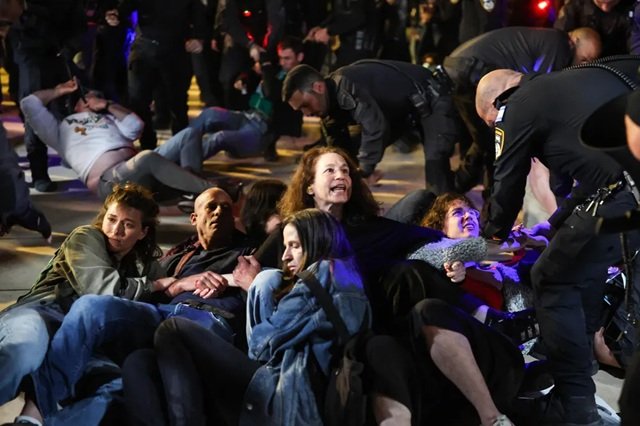
Moments later, the situation escalated. Police issued a warning: five minutes to disperse. Hassin, still on the phone, insisted she had not received official confirmation of the ruling. Then the mounted units advanced. Horses pushed into the crowd, scattering demonstrators in all directions. A young man limped away, claiming he had been kicked in the knee by an officer. Nearby, an older man lay on the ground, his condition unclear as police struggled to control the scene.
Amid the chaos, a new alarm sounded — the shrill alert of an incoming missile. Within minutes, the dynamics shifted entirely. Protesters and police alike moved towards the underground car park, descending escalators into the shelter below. The confrontation gave way to a shared instinct for survival. Above ground, the sound of intercepted rockets echoed across the sky.
By the end of the evening, 14 people had been arrested. Despite the turmoil, organisers announced plans for another protest the following week. Whether the movement will grow remains uncertain. What is clear is that opposition to the war is no longer confined to the margins. It is visible, vocal, and increasingly contested — not only by the state, but by a society grappling with fear, fatigue, and the unresolved question of how to dissent in a time of war.