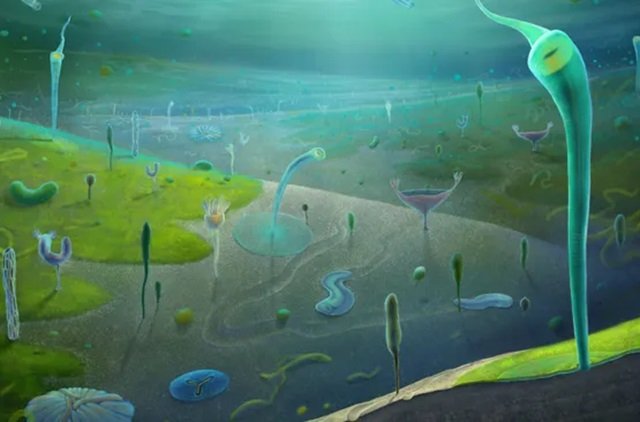
A newly discovered fossil site in southwestern China is rewriting the history of early animal life, revealing a surprising diversity of complex creatures that thrived before the famed Cambrian explosion. Previously, scientists believed that most modern animal groups appeared during the Cambrian period, which began around 539 million years ago. However, the fossils suggest that some animals had already evolved remarkable complexity by the end of the Ediacaran period, roughly 554 to 539 million years ago.
The collection, part of the Jiangchuan Biota, contains over 700 specimens, including bilateral worm-like animals that may have anchored themselves to the seafloor, early comb jellies, and relatives of starfish and sea cucumbers that likely used tentacles on their heads to capture food. Several other fossils display forms unlike any known modern or ancient species. One specimen, described by co-author Frankie Dunn of the Oxford University Museum of Natural History, bears a striking resemblance to the iconic sandworm from the science fiction classic Dune.
Unlike the durable shells or bones that preserve easily, most of these fossils were captured as carbonaceous films, flat imprints that preserve soft tissues such as guts and mouthparts. This rare preservation method could explain why these complex Ediacaran animals were previously overlooked, according to study co-author Ross Anderson, also of Oxford. “Our results indicate that the apparent absence of these complex animal groups from other Ediacaran sites may reflect differences in preservation rather than true biological absence,” he said.
The findings, reported in the journal Science and covered by Live Science, suggest that the emergence of complex life began earlier than previously thought. This discovery not only expands the timeline for animal evolution but also highlights the potential for further surprises in ancient fossil beds that preserve soft-bodied organisms.