El Salvador has launched one of the largest criminal trials in its modern history, placing 486 alleged members of the Mara Salvatrucha (MS-13) on trial in a sweeping case that underscores the country’s hardline security strategy. Among the defendants are senior leaders of the gang’s national hierarchy, known as the “ranfla nacional,” whom authorities accuse of orchestrating decades of violence, including a mass killing of 86 people in March 2022. That massacre, according to the government, became the catalyst for President Nayib Bukele’s state of emergency, a controversial measure that has now been renewed dozens of times and remains at the center of El Salvador’s security policy.
The Prosecutor’s Office alleges that the accused are responsible for more than 47,000 crimes committed between 2012 and 2022, including murder, extortion, drug trafficking, enforced disappearances, and arms smuggling. Officials say the case targets the leadership structure of MS-13, which they describe as operating like a coordinated criminal enterprise with national reach. The trial, held under the country’s expanded emergency legal framework, brings together hundreds of defendants in a single judicial process, a format that has drawn international scrutiny for its scale and procedural implications.
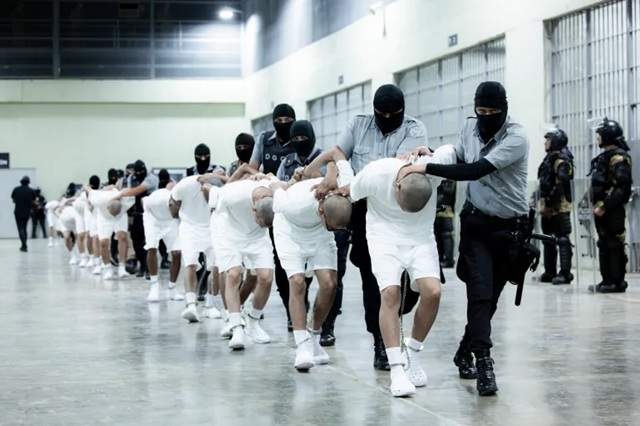
The proceedings began in a highly controlled environment, with many of the accused appearing remotely from maximum-security prisons, including the Terrorism Confinement Center known as CECOT. Authorities released images showing rows of detainees seated in plastic chairs, shackled at the hands and feet, attending hearings via videoconference under heavy armed guard. The images also revealed several senior gang figures whose whereabouts had been unknown for years, including some of the most prominent leaders of MS-13’s national structure. Officials said many appeared visibly weakened, a detail that quickly circulated in national and international media.
Among those identified were individuals accused of holding top leadership roles within the organization, including figures alleged to have coordinated operations both inside and outside El Salvador. Prosecutors claim that these leaders directed violent campaigns across the country and maintained influence over prison networks and street-level cells. The government has also linked some defendants to extradition requests from the United States, reflecting the transnational scope of the gang’s alleged activities. The inclusion of such high-profile defendants in a single mass trial marks a significant escalation in the state’s approach to organized crime prosecution.
At the center of this legal process is the state of exception introduced in 2022 after a wave of killings shocked the country. The government has since renewed the measure nearly 50 times, arguing that it remains necessary to dismantle criminal structures. Under this framework, constitutional protections such as limits on detention, privacy of communications, and aspects of due process have been suspended or significantly weakened. Authorities say the policy has enabled mass arrests and rapid dismantling of gang networks, while critics argue it has concentrated extraordinary power in the hands of the executive.
Since the beginning of the emergency regime, more than 91,000 people have been arrested, representing a significant proportion of the country’s adult population. The judicial system has been reorganized to process cases in bulk, including the use of grouped hearings in which hundreds of defendants are tried simultaneously. Judges involved in these proceedings often operate under conditions of anonymity, a measure the government says is intended to protect them from retaliation. In the current trial alone, officials say more than 400 defendants are already in custody, while dozens remain at large.
Human rights organizations and international observers have raised concerns about the scale and structure of the legal process. The Inter-American Commission on Human Rights has warned that the prolonged state of emergency poses serious risks to fundamental rights and has urged the government to reconsider its continuation. Amnesty International has similarly cautioned that many arrests may have been based on weak or unverified evidence, including anonymous tips and mass detention quotas. These criticisms highlight tensions between the government’s security achievements and questions about legal safeguards.
Experts in security policy describe El Salvador’s approach as a departure from traditional criminal justice models. Rather than individualized investigations, authorities have adopted what some analysts compare to a “mass capture” strategy, where entire groups are detained and prosecuted collectively based on alleged affiliation. Supporters of the policy argue that this approach is necessary to dismantle deeply embedded criminal organizations, while critics warn that it risks undermining the principle of individual responsibility in criminal law.
Alongside the judicial crackdown, the government has expanded its technological ambitions in law enforcement. Prosecutors recently announced plans to integrate artificial intelligence into their investigative systems, a move presented as a modernization of the justice apparatus. The new platform is expected to assist in processing citizen complaints and structuring case data, with officials suggesting it could become one of the most advanced systems of its kind globally. The announcement was made during a technology conference in San Salvador, where authorities framed the initiative as part of a broader transformation of the justice system.
President Bukele’s administration has increasingly tied security policy to technological innovation, promoting digital tools in governance and public services. Previous initiatives have included attempts to integrate cryptocurrency into the national economy, a policy that drew international attention but faced implementation challenges. The current push toward artificial intelligence reflects a continuation of this strategy, extending technological integration into law enforcement and judicial processes.
As the mass trial unfolds, El Salvador stands at a critical intersection between security policy, legal reform, and institutional transformation. The government presents the proceedings as a decisive step against organized crime, while critics view them as part of a broader consolidation of state power under emergency rule. With hundreds of defendants, sweeping charges, and unprecedented judicial methods, the case is set to become a defining moment in the country’s recent political and legal history.