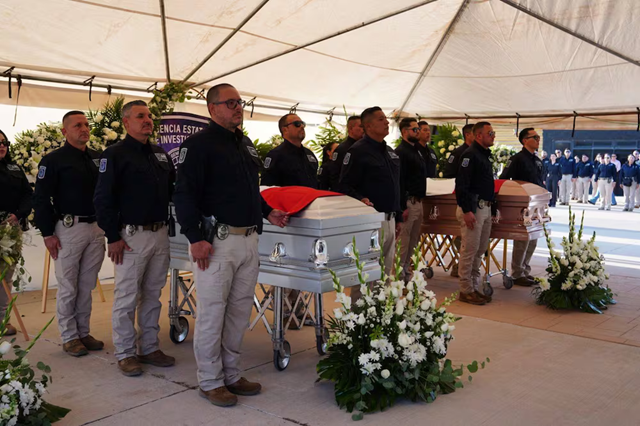
The death of two U.S. government officials in a road accident in a remote area of Mexico’s Sierra Madre Occidental has rapidly evolved from a tragic highway incident into a politically charged international controversy. According to reporting by El País, the crash occurred in the early hours of Sunday in the rugged mountainous region of the state of Chihuahua, an area defined by steep ravines and difficult terrain. Two Mexican agents also died in the same accident, initially framing the episode as another fatal but not unusual event in a region long marked by violence and insecurity.
The situation changed dramatically when it emerged that the American victims were not ordinary officials but operatives of the Central Intelligence Agency. That detail transformed the incident into a diplomatic flashpoint. In recent days, Mexico’s president Claudia Sheinbaum confirmed that all four individuals had been “working jointly” on an operation that, according to her government, had not been formally communicated to federal authorities. The revelation has triggered demands for clarification and intensified scrutiny over how far cooperation between Mexican states and U.S. security agencies extends beyond federal oversight.
Sheinbaum has since sent a formal request for explanations to the U.S. embassy and specifically to authorities in Chihuahua, a border state governed by the opposition National Action Party (PAN). Her concern centers on whether constitutional boundaries were breached, since Mexican law restricts foreign agents from conducting operations on national territory without federal authorization. The president has been emphatic in her public remarks, stating that no foreign security personnel are permitted to operate in the field independently, as such actions directly implicate national sovereignty and security.
What exactly the CIA officers were doing in Chihuahua remains unclear even at the highest levels of the Mexican government. Sheinbaum has acknowledged the absence of complete information, a gap that has itself become politically sensitive. Chihuahua is a key state in bilateral security cooperation due to its proximity to the United States and its strategic role in counter-narcotics operations. The uncertainty over the mission’s nature has therefore raised questions not only about a single operation but about the broader architecture of intelligence collaboration along the border.
The controversy has quickly escalated into a diplomatic exchange. White House spokesperson Karoline Leavitt responded by emphasizing that President Donald Trump continues to seek deeper security cooperation with Mexico. Speaking on Fox News, she urged empathy from the Mexican government in light of the deaths of the two American officials, while also underscoring Washington’s expectation of continued collaboration. Her comments reflected a tone of frustration from the U.S. side, framing the issue as one of shared security interests rather than procedural violation.
The incident unfolds against a broader geopolitical backdrop in which Trump has intensified U.S. military and security engagement across Latin America. His administration has increasingly framed the region as within America’s strategic sphere of influence, reviving rhetoric associated with the Monroe Doctrine. In recent months, Trump has openly argued that drug cartels exert control over Mexico and has proposed direct U.S. military involvement to combat them, a proposal firmly rejected by Sheinbaum. The Mexican president has drawn a clear red line, insisting that cooperation must never compromise national sovereignty or involve foreign troops on Mexican soil.
Sheinbaum reiterated this position this week, stating that while Mexico maintains open channels of collaboration with Washington, any suggestion of U.S. military presence is unnecessary and would violate Mexican law. She stressed that bilateral cooperation is already strong but must remain strictly within legal frameworks established by Mexico. Her administration has positioned sovereignty as a defining pillar of its security policy, especially in response to rising U.S. pressure.
Yet analysts suggest that the reality on the ground is more complex. Carlos Pérez Ricart, a researcher at the Center for Economic Research and Teaching and author of a study on U.S. antinarcotics operations in Mexico, told El País that American intelligence presence in the country has existed for more than a century. According to him, agencies such as the CIA and DEA have long operated in Mexico through formal and informal networks, often with or without the knowledge of the federal government. He argues that these operations are a constant feature of bilateral relations rather than an exception.
Pérez Ricart also describes the relationship as structurally asymmetrical, shaped by U.S. leverage and persistent pressure tied to drug enforcement priorities. From this perspective, he suggests that Washington pursues its security objectives in Mexico through both legal cooperation and covert action, depending on circumstances. This long-standing dynamic complicates Mexico’s sovereignty claims, particularly when operations appear to involve coordination with local or state-level authorities without federal oversight.
Other experts, such as Teresa Martínez Trujillo of Tecnológico de Monterrey, highlight the internal contradictions exposed by the accident. She notes that if federal authorities were unaware of the operation in Chihuahua, this points to a significant gap in communication within Mexico’s own security apparatus. Such fragmentation, she argues, undermines the country’s broader security strategy, which relies on coordinated action between federal and state institutions regardless of political affiliation.
Martínez Trujillo also warns that Sheinbaum’s admission of limited knowledge about activities in a key border state exposes a “blind spot” in governance that could be exploited by foreign actors. The lack of clarity not only fuels speculation about U.S. involvement but also weakens Mexico’s ability to assert full control over its territory in practice, even while doing so rhetorically.
Adding to the controversy is the opaque nature of intelligence operations involving the CIA, which has long been a source of suspicion in Latin America. Martínez Trujillo noted that without the accident, the operation might never have come to light at all. Mexican officials have since provided shifting explanations about the purpose of the mission, ranging from laboratory destruction operations to drone training exercises involving Mexican agents. The inconsistencies have only deepened public skepticism.