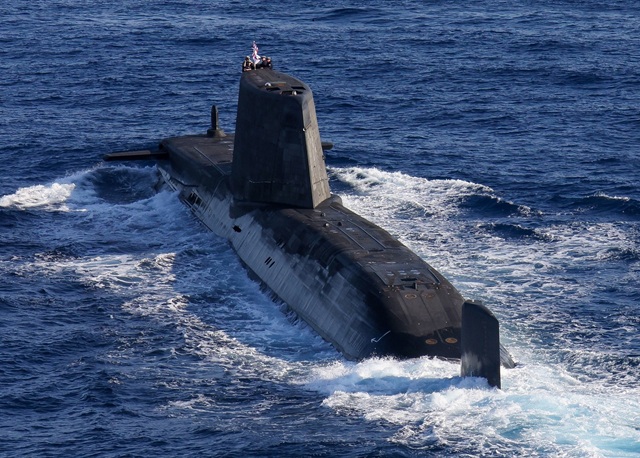
For more than six months, 160 sailors aboard a British nuclear submarine disappeared from the surface of the Earth. No sunlight touched their skin, no fresh air filled their lungs, and no message was sent to reassure loved ones that they were still alive. Their mission, as reported by Times UK, was not combat in the traditional sense but something far more unsettling: to remain hidden, silent, and ready to unleash nuclear devastation if ordered.
At the heart of this mission lies a small but extraordinary object. Deep inside the submarine sits a blue safe, guarded constantly. Within it is a handwritten letter from the British prime minister, often referred to as the “response from the grave.” Its instructions are simple and catastrophic, outlining what should be done if the United Kingdom is destroyed and communication with command is lost. For the crew, the existence of this letter is both a reassurance of purpose and a chilling reminder of the stakes.
The submarine, one of Britain’s Vanguard-class vessels, had just completed a record-breaking 206-day patrol beneath the ocean when it resurfaced in the Firth of Clyde. The moment is known in naval terms as “day zero,” when sailors finally emerge into daylight and are allowed to contact their families. It marks the end of a journey defined by isolation and discipline, where every hour is governed by the demands of maintaining the country’s continuous at-sea nuclear deterrent.
This deterrent requires that at least one submarine is always on patrol, ready to respond instantly to any existential threat. The burden falls on crews who descend through a narrow hatch into a confined, steel world where space is scarce and privacy nonexistent. Living quarters are cramped, routines are relentless, and the rhythm of life is dictated by six-hour shifts that repeat endlessly for months.
Silence is not just a condition but a necessity. The submarine moves slowly through the water, carefully avoiding detection. Even minor sounds are controlled, with reminders posted throughout the vessel warning that “mines have ears too.” Communication is strictly one-way. The crew receives updates from the outside world, including carefully edited news summaries and short family messages limited to 120 words, but they cannot respond.
These “familygrams” are heavily censored, not only by military protocol but by the families themselves. Bad news is often withheld to protect morale. Only the captain is informed of serious developments, such as deaths or personal tragedies, and he carries the burden of that knowledge alone until the mission ends. Upon return, he must deliver these messages face-to-face, a task described by commanders as one of the most difficult aspects of their role.
Life aboard the submarine is shaped by the challenge of sustaining both equipment and morale. The air is continuously recycled, generated through a process that extracts oxygen from seawater. The result is breathable but far from fresh, creating a distinct atmosphere that lingers on everything and everyone. Hygiene becomes a priority upon return, with some sailors reportedly showering multiple times a day to rid themselves of the smell.
Food, in contrast, becomes a central pillar of daily life. Feeding the crew is a monumental task, requiring the preparation of hundreds of meals each day under demanding conditions. Fresh supplies run out after about three months, leaving the crew reliant on frozen and preserved food. Despite these limitations, the galley staff play a critical role in maintaining morale, with themed meals and occasional standout dishes providing moments of comfort.
Recreation is equally important, though limited by space and resources. Sailors devise creative ways to pass the time, from makeshift mini golf to organized betting games based on recorded horse races. Exercise equipment is scattered throughout the vessel, even in unlikely locations near missile tubes, though it is not always reliable over such long missions.
The submarine itself is a study in contrasts. While it carries some of the most advanced weaponry in the world, much of its internal technology is deliberately simple. Systems are designed to be repairable by the crew, who must handle any malfunction without external assistance. This self-reliance is essential, as the submarine cannot surface except in extreme emergencies and must remain operational under all circumstances.
At the core of the vessel is its nuclear reactor, a compact but powerful system that allows it to operate for months without refueling. The energy generated drives every aspect of the submarine’s function, from propulsion to life support. The efficiency of this system is such that the total fuel used during the entire 206-day mission can be represented by a small metal rod, easily held in one hand.
Despite the harsh conditions, the submarine service retains a surprisingly high level of commitment from its personnel. Many sailors choose to undertake multiple missions, drawn by a combination of professional pride, technical fascination, and the unique nature of the work. For some, the appeal is as simple as the sense of operating in a hidden world few will ever experience.
The cost of maintaining this capability, however, is immense. The United Kingdom’s nuclear deterrent consumes a significant portion of the defense budget, and the aging Vanguard fleet is becoming increasingly expensive to maintain. Plans are already underway to replace it with a new generation of submarines, reflecting the long-term commitment to this strategy despite its financial and ethical complexities.
When the submarine finally returns to port, the human dimension of the mission becomes visible. Families gather in large numbers, waiting for the moment when their loved ones step back onto land. For many, the overwhelming emotion is relief. In a world marked by geopolitical tension and uncertainty, the safe return of the crew represents a personal victory amid global risk.
Yet the shadow of their mission lingers. The letter in the blue safe remains unopened, its instructions untested. It symbolizes a chain of command that stretches from political leadership to the silent depths of the ocean, where decisions of unimaginable consequence could be carried out without hesitation.
As the sailors disperse and the submarine prepares for its next patrol, the cycle continues. Hidden beneath the waves, beyond the reach of ordinary life, the machinery of deterrence remains in motion, sustained by individuals who endure isolation so that their country never has to face the unthinkable.