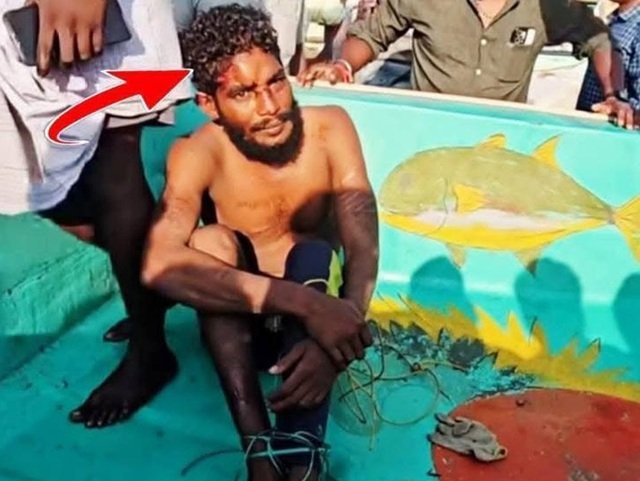
A violent confrontation in the Palk Strait has once again intensified tensions between Sri Lankan and Indian fishing communities after a 29-year-old Tamil fisherman from Jaffna was allegedly detained at sea and severely assaulted by a group of Indian fishermen. The incident, confirmed in part by Indian police authorities and supported by circulating video footage, has triggered renewed diplomatic unease and strong reactions from fishing associations on both sides of the maritime boundary.
The victim, identified as a fisherman from Vallai in Sri Lanka’s Jaffna District, is currently receiving treatment at Nagapattinam Government Medical College Hospital in Tamil Nadu. Medical officials reported that he required 15 stitches for injuries sustained to his head, nose, limbs, and ankles. While Indian authorities have acknowledged the incident, they have not publicly disclosed his identity. Police in Vedaranyam stated that the confrontation occurred late Sunday off the Nagapattinam coast after Indian fishermen alleged that two Sri Lankan men had boarded their vessel during fishing operations in the area.
According to accounts from members of the Indian fishing crew, the Sri Lankan fisherman was labelled a “pirate” during the confrontation, a claim that has been strongly rejected by Sri Lankan fishing organisations and community representatives. Fishermen’s cooperatives in northern Sri Lanka argue that there is no evidence of organised piracy in the Palk Strait and that such characterisations obscure deeper and long-standing disputes over maritime resources, particularly the repeated issue of illegal bottom trawling by Indian vessels in waters claimed by Sri Lanka.
Community leaders in Jaffna have described the incident as part of a broader pattern of escalating confrontations at sea. Francis Ithayaraja, a veteran fisherman and president of the Annai Velankanni fishing village in Mayiliddy, said that Sri Lankan Tamil fishermen have never historically engaged in piracy and accused sections of the Indian fishing community of misrepresenting incidents to justify their own activities. He further stated that Sri Lankan fishermen sometimes drift across maritime boundaries due to traditional navigation patterns influenced by ocean currents or due to mechanical failures at sea, rather than any organised intent to trespass or engage in criminal acts.
At the centre of the long-running dispute is the issue of bottom trawling, a practice widely used by Indian trawlers but banned in Sri Lankan waters due to its destructive impact on marine ecosystems. Sri Lankan fishing communities in the north argue that repeated incursions by trawlers from Tamil Nadu not only damage coral beds and breeding grounds but also destroy fishing nets and equipment, threatening the livelihoods of small-scale fishermen who are still recovering from the aftermath of Sri Lanka’s civil conflict.
While tensions have historically been framed as a fisheries dispute, local representatives say the situation has increasingly taken on the character of a maritime boundary conflict, with both sides accusing the other of illegal entry into territorial waters. A senior source from the northern fishing community acknowledged that isolated incidents involving Sri Lankan fishermen have occurred but stressed that these do not reflect any organised criminal activity and should not be conflated with piracy allegations.
The latest assault has provoked widespread anger in northern Sri Lanka, with fishing communities calling for stronger protection measures and clearer enforcement of maritime boundaries. Political reactions within Sri Lanka have been mixed, with many Tamil nationalist figures remaining publicly silent. However, opposition lawmaker Namal Rajapaksa condemned the incident, calling it deeply concerning and urging authorities to ensure the victim’s safety and safe return. He also criticised what he described as selective political solidarity, arguing that Tamil Nadu political voices often raise human rights concerns regarding Sri Lankan Tamils while remaining silent when violence occurs against Sri Lankan Tamil fishermen in Indian waters.
Neither the Indian nor Sri Lankan governments have issued detailed official statements on the incident so far. The episode adds to a long history of unresolved fisheries disputes between the two countries, despite repeated diplomatic engagements and bilateral talks that have yet to produce a lasting solution to the recurring cycle of arrests, confrontations, and allegations in the Palk Strait.