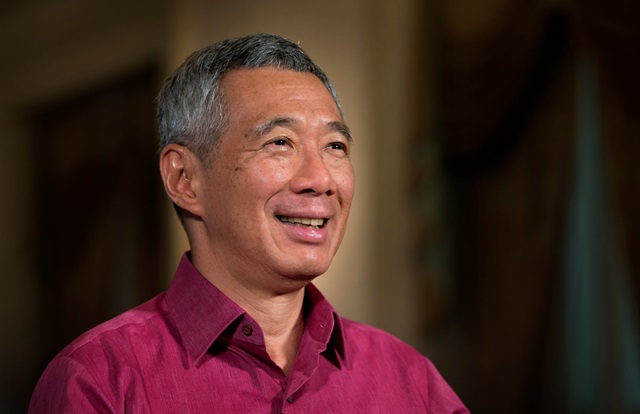
Senior Minister Lee Hsien Loong has warned that global trade can no longer be assumed to deliver mutual “win-win” outcomes, arguing that rising geopolitical tensions, security concerns and economic rivalry have fundamentally changed how countries approach cross-border commerce. Speaking in Nanning during a five-day visit to China, he said the world is currently experiencing “many uncertainties, many conflicts and contradictions,” which are reshaping long-standing assumptions about trade and cooperation.
Lee noted that trade, once widely viewed as a straightforward engine of mutual economic benefit, is now increasingly intertwined with national security, resilience planning and concerns over supply chain vulnerability. In this new environment, he said countries must actively work to ensure trade agreements and partnerships remain mutually beneficial rather than assuming that such outcomes will occur naturally. Despite these challenges, he stressed that significant potential still exists for cooperation between Singapore, China and ASEAN across trade, investment and broader economic engagement.
A key example highlighted by Lee was the New International Land-Sea Trade Corridor, launched in 2017 to connect western China with Singapore and Southeast Asia. He described it as a strong foundation for deeper cooperation, calling it a “very good foundation on which we can do a lot more.” The corridor has already contributed to a “considerable boost” in Guangxi’s development and its connectivity with regional markets, particularly through Singapore-linked logistics and trade networks.
Chinese officials also pointed to ongoing infrastructure developments that could further strengthen the corridor’s role. The upcoming Pinglu Canal is expected to provide a more direct maritime route from southwestern China to the sea, improving cargo efficiency and reducing reliance on longer detours through coastal provinces. This development is seen as enhancing Guangxi’s position as a logistics hub linking China with ASEAN markets.
The remarks were made during meetings with Guangxi Communist Party Secretary Chen Gang, who emphasized the corridor’s growing importance in western China’s logistics system and its potential to benefit both regional Chinese development and ASEAN connectivity. He also underscored the broader strategic role of improved transport infrastructure in deepening economic ties.
During his visit, Lee also toured major logistics facilities, including the China-Singapore Nanning International Logistics Park, a large-scale joint venture involving Singaporean and Chinese stakeholders. The facility, which integrates storage, transport, trade and financial services, has become a key node in regional supply chains and reflects growing bilateral investment ties.
Business leaders at the site noted that trade between China and ASEAN has continued to expand despite geopolitical tensions, with Singapore-Guangxi trade rising significantly in recent years. They also highlighted Singapore’s position as a relatively stable and preferred trading partner in an increasingly fragmented global environment, while pointing to new opportunities in sectors such as high-tech goods, pharmaceuticals and diversified regional shipping routes.