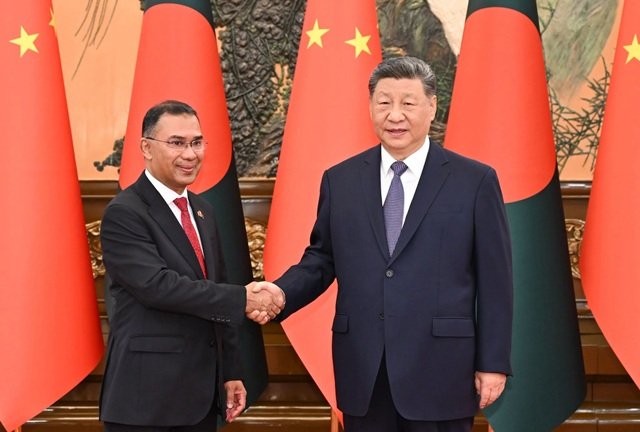
Bangladesh Prime Minister Tarique Rahman’s visit to China from June 24 to 26 has drawn significant attention as Bangladesh joined the Global Development Initiative (GDI) and sought an agreement to strengthen cooperation on the Teesta and other river management projects. The relationship has been elevated from the “Comprehensive Strategic Cooperative Partnership” to “China-Bangladesh Community with a Shared Future”, the highest level of bilateral relationship for China.
China has proposed the development of the China-Myanmar-Bangladesh Economic Corridor for greater regional connectivity. The proposal was made during a meeting between Bangladesh Prime Minister Tarique Rahman and Chinese President Xi Jinping.
There is also consensus in expansion of relations with China with the Bangladesh parliament unanimously thanking Rehman for a successful visit to Beijing.
Main Proposals
For the record Bangladesh and China signed at least 13 MoUs following bilateral talks between Prime Minister Rahman and Chinese Premier Li Qiang at the Great Hall of the People in Beijing on June 25. The agreements covered political, economic, and strategic cooperation, including trade, investment, infrastructure development, healthcare, education, and human resource development.
One of the MoUs brought Bangladesh into China’s Global Development Initiative (GDI), proposed by President Xi Jinping in 2021 to accelerate progress toward the UN’s 2030 Sustainable Development Goals.
Although China had long encouraged Bangladesh to join, Dhaka had previously remained cautious. Officials indicated that Bangladesh’s growing need for socio-economic investment made participation increasingly attractive.
The concept of China–Myanmar–Bangladesh Economic Corridor (CMBC) builds on the active China–Myanmar Economic Corridor (CMEC), centred on the Kyaukphyu deep sea port and SEZ, which gives China direct access to the Indian Ocean. China increasingly views Bangladesh as a natural extension of CMEC.
However, CMBC remains a geopolitical possibility rather than a formal corridor, contingent on stability in Myanmar and Dhaka’s strategic choices.
Bangladesh and China reached an agreement to establish a Chinese Industrial Park on around 150 acres adjacent to the Mongla Port modernisation project. Chinese investors expressed interest in several sectors, including renewable energy, textiles and garments, electronics, healthcare, medical devices, automobiles, recycling, and oil and gas. India was allocated the industrial park but could not make progress and Dhaka has now allocated the same to the Chinese who are likely to expand their industrial footprint.
Bangladesh is also planning to buy the J-10 CE multirole fighter jet from China. Discussions are underway to buy 20 to 24 fighter jets under a possible deal, which could be worth several billion dollars.
Key Risk Factors
While the Bangladesh National Party [BNP] has claimed that the foreign policy is “Bangladesh First”, the emerging pro‑China tilt appears to be populist that ignores the reality of Chinese failures in the region.
Thus, as the Prime Minister was lauded in the parliament for new proposals as Community of Shared Future, exploratory ideas around a China–Myanmar–Bangladesh corridor, and even talk of J‑10 acquisition, these developments overlook the long record of Chinese underperformance in South Asia, which should give Dhaka concerns.
Historically, China has struggled to deliver economic prosperity through grandiose projects.
Sri Lanka’s debt default due to unrestricted dependence on Chinese investments including the flagship Hambantota Port are well known.
In Pakistan’s China Pakistan Economic Corridor [CPEC] faces the geopolitical challenge of traversing through the Indian territory of Pakistan Occupied Kashmir including Gilgit Baltistan. Delays, delays, security blowback, and unmet industrial promises have marked CPEC going into Phase 2.
Pakistan managed to escape a debt default and is presently going through an International Monetary Fund Extended Fund Facility relief.
Nepal has wisely spurned Chinese offers under the Belt and Road Initiative and has thus escaped the Dragons claws so to say.
Myanmar through which the CMBC is to pass through is in a state of civil war with no early end in sight leaving little scope of fructification of the project in the near term.
For BNP, leaning heavily on China risks going the way of this pattern of strategic and economic drift.
At the same time, this will place Dhaka amid global competition for influence between the USA and China – having signed an exclusive trade agreement with Washington in February this year.
India is also unlikely to take some of the decisions particularly opting for J 10 fighters or the Teesta project lightly.
It is unclear if the BNP government opted for the Chinese projects succumbing to China’s pressures. Lack of adequate evaluation of the same in the short time that it has been in office that too coming in government after a long gap of a decade and a half is evident. While as a sovereign state, Bangladesh has the right to make alignments, how the regional and geostrategic space now shapes up for Dhaka after the Chinese tilt remains to be seen.