For centuries, Afghanistan’s educational institutions stood at the crossroads of faith, scholarship, and intellectual inquiry, producing generations of jurists, poets, philosophers, scientists, and religious scholars whose influence reached far beyond the country’s borders. Historical records describe a system in which Islamic learning was intertwined with literature, logic, mathematics, medicine, ethics, and the sciences of the age, creating a broad educational tradition rooted in both religious and rational disciplines.
That historical legacy has become the focus of renewed attention as the Taliban continue to present their education policies as a restoration of Afghanistan’s authentic Islamic tradition. Historical evidence and academic research referenced in recent scholarship, however, describe a markedly different educational heritage—one that was considerably broader than a curriculum centered primarily on religious memorization and legal instruction.
Afghanistan’s educational history stretches back even before the arrival of Islam, with traditions of religious, moral, and scholarly learning already established across the region. Following the spread of Islam, mosque schools, madrasas, and Sufi lodges emerged as the principal centers of education. Children learned to read the Qur’an and acquire basic literacy, while advanced students pursued studies in jurisprudence, hadith, Qur’anic interpretation, literature, logic, philosophy, mathematics, medicine, astronomy, ethics, and other branches of knowledge.
The country’s leading cities became internationally recognized centers of learning during successive Islamic dynasties. Balkh, Ghazni, and Herat were not only political capitals but also hubs of scholarship that nurtured figures including Al-Biruni, Ibn Sina, also known as Avicenna, Khwaja Abdullah Ansari, Sanai, Rumi, and Jami. Their work reflected an intellectual tradition in which religious scholarship existed alongside philosophy, literature, science, and reason.
According to historical accounts, Afghanistan’s classical madrasa was designed as a multidisciplinary institution rather than a narrowly defined religious school. Alongside studies of the Qur’an, jurisprudence, hadith, and exegesis, students engaged with theology, philosophy, Persian language and literature, mathematics, medicine, astronomy, and logic. The objective was to educate individuals who combined intellectual ability with moral development and social responsibility.
This tradition expanded during the Ghaznavid and Ghurid eras before reaching another period of prominence under the Timurids. Herat, in particular, became home to major educational institutions including the Nizamiyya, Fasihiyya, Ikhlasiyya, Ghiyathiyya, and Sultaniyya. The Ikhlasiyya Madrasa formed part of the historic Musalla complex, an extensive religious, educational, and cultural center where students studied both religious obligations and a wide range of scholarly disciplines.
The Musalla complex itself later became part of Afghanistan’s changing political landscape. During the late nineteenth century, under the rule of Amir Abdur Rahman Khan, much of the complex was demolished amid military considerations and British strategic pressure during the Panjdeh Crisis. Historians have described the destruction as the loss of one of Afghanistan’s most significant architectural and educational landmarks.
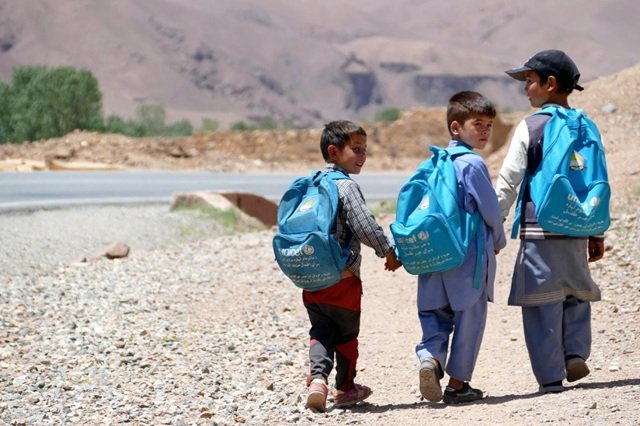
Education also extended into village communities through mosque schools, known as maktab-khanas, which introduced children to literacy and religious learning. Instruction typically began with Persian and Arabic alphabets, the Qaida primer, and Qur’anic reading before expanding to classical Persian texts such as Saadi’s Golestan and Bustan, the Panj Kitab, and the poetry of Hafez. Calligraphy, handwriting, arithmetic, ethics, and language formed important elements of early education, creating links between literacy and religious instruction.
Modern research has added further detail to the historical picture. A field study conducted by Dana Burde, Joel Middleton, and Rachel Wahl in remote villages of Ghor Province examined the role of traditional mosque schools in rural Afghanistan. Tracking 819 children between the ages of six and eleven, the researchers found that approximately 83.8 percent had attended mosque schools, while only about 0.5 percent had attended formal madrasas.
The study concluded that attendance at mosque schools was associated with stronger literacy, particularly in letter recognition, although it showed no significant relationship with mathematics achievement. Researchers attributed this outcome to the schools’ emphasis on Qur’anic recitation, memorization, literacy, and basic religious instruction rather than mathematical education. The findings also highlighted the broader educational and social role mosque schools played in communities where they often represented children’s first encounter with formal learning.
Against that historical backdrop, the source text argues that contemporary Taliban education policies represent a departure from Afghanistan’s established educational tradition rather than its continuation. It states that the issue is not the teaching of the Qur’an, jurisprudence, hadith, or theology, all of which have long been part of Afghan education, but the separation of those subjects from literature, ethics, reason, civic life, and wider intellectual inquiry.
Independent reports cited in the source indicate that the Taliban have expanded religious instruction while reducing or removing subjects including civic education, democracy, human rights, women’s rights, arts, and culture. The same reports describe revisions to school curricula intended to align educational content with the movement’s interpretation of Islam and Afghan society.
The closure of secondary schools and universities to girls is presented in the source as another significant break with Afghanistan’s historical educational practices. Rather than portraying education as a process of cultivating knowledge and moral development across society, the source argues that current policies have reshaped education into a system centered on exclusion and conformity.
The article identifies three dimensions to what it describes as a betrayal of Afghanistan’s classical educational tradition. It argues that history is misrepresented by portraying earlier madrasas as institutions devoted solely to memorization and obedience despite historical evidence of their broader curriculum. It further contends that Islamic scholarship in Afghanistan traditionally combined religious faith with ethics, justice, wisdom, and intellectual inquiry, elements it says have been separated from contemporary educational policy. Finally, it maintains that limiting critical thinking, civic education, history, arts, and equal educational access alters the role education has historically played in preparing future generations.
The source concludes that Afghanistan’s classical educational system sought to balance religion with reason, language, literature, ethics, and scientific knowledge. Mosque schools served as an entry point to literacy for generations of children, while madrasas functioned as centers of scholarship encompassing both religious and rational sciences. As debates over education continue under Taliban rule, Afghanistan’s long history of learning remains central to competing narratives about the country’s past and the direction of its educational future.