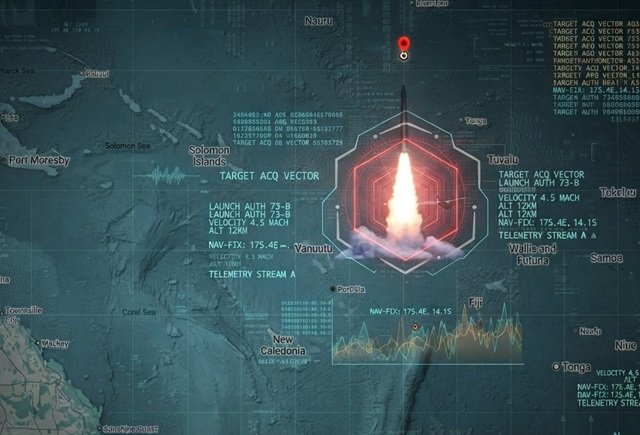
After displaying the powerful JL 3 Submarine Launched Ballistic Missile [SLBM] at the Victory Parade in Beijing in September last year, the PLA Navy conducted a test of an SLBM on July 6 in the Pacific Ocean between Nauru and Tonga many nautical miles away from Brisbane in Australia and Auckland in New Zealand. PNG [Papua New Guinea] to the West of the test site was possibly closer so were some of the Indonesia island territories.
So what was the Chinese intent and signaling here is a review.
The Test
China Military online quoting Xinhua stated with a photo taken on July 6, 2026, “of the moment of a strategic missile launched by a strategic nuclear submarine of the Chinese People’s Liberation Army (PLA) Navy bursting out of the water surface,” announced the test launch
The PLA Navy said that one strategic nuclear submarine of the navy successfully launched a strategic missile carrying a dummy warhead toward relevant high seas of the Pacific Ocean at 12:01 p.m., which landed precisely within the designated waters.
The test launch is a routine arrangement of the annual training of the PLA Navy, PLA navy said, adding that the Chinese side has already notified relevant countries in advance. The test launch complies with international law and international practice, and is not directed at any specific country or target, the navy added. No details of the test were released.
The authoritative Bulletin of Atomic Scientist Report states that the test launch is believed to be a JL-2 SLBM fired from one of its nuclear-powered ballistic missile submarines.
The missile impacted into the Pacific Ocean, more than 7,200 kilometers away from the launch point, testing the JL-2’s maximum range for the first time. This range is enough to reach Alaska, Guam, Hawaii, Russia, and India from waters near China, but not the continental United States as per the Report.
On the other hand, Reuters indicated that as state-controlled tabloid Global Times, citing a military expert, said it was likely to have been the JL-3, China’s most advanced submarine-launched missile.
Is the Chinese State media and experts attempting to overstate the capability, remains to be seen?
PLA Navy SLBM Capabilities
China currently fields a submarine force of six second-generation Jin-class (Type 094) nuclear-powered ballistic missile submarines (SSBNs), which are based at the Yalong naval base near Longpo on Hainan Island. The two newest SSBNs are believed to be improved variants of the original Type 094 design. Some Chinese journals refer to it as the Type 094A, but this has not been confirmed by either the Pentagon or the Chinese government.
As for ballistic missiles for submarines, China currently uses two types. These are the JL-2AG missiles for the Type 094 (Changzheng 9 and Changzheng 10) estimated range 7200 kms and the newer JL-3 missiles for the upgraded Type 094A (Changzheng 10, Changzheng 12, Changzheng 17, Changzheng 18) estimated range of 12,000 kms.
The new missile was unveiled on September 3, 2025, during a military parade marking the 80th anniversary of victory in the Second Sino-Japanese War and the end of World War II, where the JL-3 was officially declared the cornerstone of the naval component of nuclear deterrence.
The submarines have 12 vertical launch tubes for JL-2 submarine-launched ballistic missiles or upgraded JL-3s, as well as six 533 mm torpedo tubes in the bow for self-defence.
On November 19, 2022, Admiral Samuel Papparo, commander of the U.S. Pacific Fleet, stated that China had deployed JL-3 intercontinental ballistic missiles on six Type 094 strategic nuclear submarines.
The JL3 can carry either a single or multiple individually guided nuclear warheads.
The Pentagon recorded the first launch of the JL-3 in late November 2018, which the Chinese military conducted from aboard a Project 032 experimental submarine.
The next successful launch from the same test platform took place in June 2019.
China last fired a ballistic missile into the Pacific in September 2024, Beijing announced the launch of an intercontinental ballistic missile, which analysts identified as belonging to the DF-31 family, capable of striking targets on U.S. territory.
The SIPRI Year Book 2026 notes China’s continued expansion of dual-capable DF-26 missiles, growing MIRV deployment, expanding sea-based nuclear forces, and the modernization of its submarine fleet with Type-094A SSBNs and JL-3 submarine-launched ballistic missiles.
These developments significantly improve China’s survivable second-strike capability.
China’s No First Use Policy
The Bulletin of Atomic Scientists has stated that, “we estimate that China has produced a stockpile of approximately 620 nuclear warheads for delivery by land-based ballistic missiles, sea-based ballistic missiles, and bombers,” in a recent report.
Earlier in June, responding to Stockholm International Peace Research Institute report that China has significantly modernized nuclear capabilities over the past year, and continues to expand its nuclear arsenal Chinese Defense Spokesperson had said, “China’s nuclear policy has always been stable, consistent and predictable. Relevant parties should stop unfounded speculations and propaganda.”
Senior Colonel Chen Xi, in a press release said, “We always keep our nuclear capabilities at the minimum level required for national security, and never engage in any forms of nuclear arms race, playing a significant role in maintaining global strategic stability.”
China Russia Annual Naval Exercises
This test launch took place against the backdrop of the start of the joint Sino-Russian naval exercises Maritime Joint-2026, are being held near Qingdao from July 6 to 13.
There is no official confirmation of a link between the missile test and the exercises.
Global and Regional Reactions
The United States had indicated that information released by China fell considerably short of standards adopted by all other P5 nuclear weapon states.
“China’s notification to the United States came only a few hours before the launch and failed to provide sufficient detail, falling considerably short of standards adopted by all other P5 nuclear weapon states,” the official said as per a Reuters Report.
Responding to US reaction to the missile launch Chinese foreign ministry spokesperson Mao Ning called the US’ criticism on the missile test a typical example of double standards and hegemonism, urging it to view China’s national defense and military development in an objective and rational manner
China has repeatedly emphasized that the missile launch was a routine arrangement of the annual military training program. It was aimed at verifying the reliability, safety, and effectiveness of relevant weapon systems, Mao Ning, the spokesperson said three days after when asked about the US State Department claiming that China informed the US too late and failed to provide sufficient detail.
Hitting back at the United States as the only country in the world that has actually used nuclear weapons and the country with the world’s largest and most advanced nuclear arsenal, conducts strategic missile launches from nuclear submarines every year, yet it criticizes and interferes in China’s normal missile launch, she added, “This is a typical example of double standards and hegemonism,” and called for US to view China’s national defense and military development in an objective and rational manner and make genuine efforts to safeguard global strategic stability.
Joseph Wu, Secretary-General of Taiwan’s National Security Council shared on social media that the SLBM was a JL-2 and included a graphic showing the flight path of the SLBM. The SLBM was launched in the South China Sea and flew over the northern coastline of the Philippine main island of Luzon before landing in the Pacific Ocean between Nauru and Tonga.
“It’s a provocation that destabilizes the Indo-Pacific. China just proved itself again to be a bully on the block,” Wu said.
The Japan Coast Guard said having received information from the Chinese hydrographic authorities that the area south of Honshu’s Cape Shionomisaki could potentially see debris from the test launch. Part of the designated area included Japan’s Exclusive Economic Zone (EEZ) south of Cape Shionomisaki.
The Japanese Embassy in Beijing also received an explanation from the Chinese Ministry of National Defense that China would launch a ballistic missile and urged China to reconsider its ballistic missile launch training and to not pass over Japanese airspace, according to the embassy.
“At the same time Beijing criticizes Japan for investing in its defense to bring security and stability to the Indo-Pacific, it test-fires a ballistic missile in the same region,” U.S. Ambassador to Japan George Glass said in a social media post criticizing the launch.
China’s launch also drew criticism from both New Zealand and Australia. Public broadcast service RNZ reported that New Zealand Foreign Minister Winston Peters said New Zealand considered the firing as an unwelcome and concerning development.
“We, like our neighbors in other Pacific countries, have no interest in China using the South Pacific as a testing site for missile capability,” Peters said.
Like Taiwan and Japan, New Zealand was informed by China of the plans to launch a long-range ballistic missile into the South Pacific, but the test was conducted within hours of being informed, according to the RNZ report.
Australian Deputy Prime Minister and Defence Minister Richard Marles during a press conference in Nowra, Australia also said that, “We were informed by China today of its intention to do this test. This is a long-range missile test, and we are very concerned about any actions which undermine the stability, the peace and security of the Pacific,” Marles said, according to a transcript. He also brushed off claims that the launch was in response to an Australia-Fiji defense pact signed in Fiji on the same day.
India and Australia held the annual summit on July 09 days after China conducted the SLBM test on July 06 in the Pacific, thus there is likely to have been renewed momentum for upgrading ties between the Indo Pacific major powers. Whether the Chinese test was timed with the visit of Mr Modi to Indonesia, Australia and New Zeal will not be known or this could be only coincidental.
Nuclear Prognostications for the Pacific
The rapid expansion and modernisation of the Chinese nuclear arsenal had led to concerns since the past decade.
One outcome of which was said to be the AUKUS announced in September 2021 between Australia, the UK and the US. The agreement was to facilitate Australia to acquire new generation of nuclear powered submarines by 2040 and in the interim a US Navy Virginia class submarine in the 2030s.
With Chinese SLBM test and the AUKUS coming into play in the next half a decades concerns over a nuclear crisis are being played out astride South East Asia, where states have committed to the Treaty on the South East Asia Nuclear Weapon Free Zone [SEANWFZ Treaty] or the Bangkok Treaty. China as well as the four other nuclear weapons states – France, Russia, UK and the US have not signed and ratified the protocol for the Bangkok Treaty an exception as compared to other NWFZs.
While portending a nuclear crisis in the Pacific may be too early, preparing for the same by creating confidence building and crisis management institutions and mechanism would be in order.