The fringe has occupied many roles throughout history. It has been a symbol of royal authority, a marker of aristocratic fashion, a statement of modernity, and, more recently, the focus of cultural and political debate. While often viewed today as a simple hairstyle choice, historians and beauty experts argue that the section of hair falling across the forehead has long reflected broader ideas about identity, status, and self-expression. As reported by El Pais, the contemporary popularity of the fringe—and particularly the rise of ultra-short “micro bangs”—has renewed interest in the hairstyle’s remarkably long and complex history.
Modern hairstyling offers an extensive vocabulary of fringe variations, from curtain bangs and butterfly styles to Korean-inspired cuts, baby bangs, and the Japanese hime cut. That diversity reflects the hairstyle’s enduring appeal while also revealing how hair has become a subject of wider cultural conversations. Questions surrounding cultural appropriation, fashion trends, and even the perceived political meanings of certain fringe styles have increasingly entered public discussion.
For Rachael Gibson, a hair historian known online as “The Hair Historian,” hair has always been closely linked to status, identity, and personal expression. While a fringe alone may not constitute a dramatic statement today, she argues that it remains part of the visual language through which individuals communicate aspects of themselves and shape how they are perceived by others.
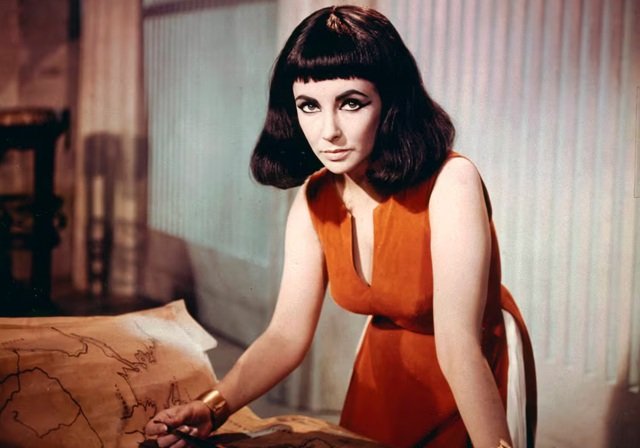
The earliest widely recognized examples of the fringe date back to Ancient Egypt, where wigs and carefully styled hair formed an important part of elite appearance. Among the most enduring images is that of Cleopatra, whose distinctive straight fringe has become one of history’s most recognizable hairstyles. According to historical accounts, however, the famous look was created with a wig rather than natural hair. Wigs served practical purposes by protecting wearers from the intense sun while simultaneously acting as powerful symbols of wealth and social status. The 1963 film Cleopatra, starring Elizabeth Taylor, cemented that image in popular culture with its elaborate black wig, jeweled adornments, and sharply cut fringe.
Evidence from Ancient Greece and Rome also points to the popularity of fringes among both men and women. Artistic depictions of figures such as Alexander the Great and Julius Caesar frequently show strands of hair falling across the forehead. Abigail Campos, a beauty journalist and director of the Beautycast Podcast, explains that in those societies the hairstyle reflected ideals of symmetry, order, and status rather than functioning as an independent element of personal identity.
Throughout the medieval period, portraits of European monarchs commonly featured male rulers wearing shoulder-length hair with prominent fringes, while women’s hairstyles generally avoided covering the forehead. Paintings preserved in institutions such as Madrid’s Royal Collections Gallery illustrate how widespread the style was among European elites. The association between the fringe and individual fashion choices, however, would emerge much later.
By the middle of the nineteenth century, the hairstyle increasingly became part of women’s fashion, although Campos notes that its origins were never exclusively feminine. Instead, the stronger association developed as European social conventions gradually limited aesthetic experimentation among men while allowing women’s hairstyles to become an important medium for fashion and personal distinction.
Artists associated with the Pre-Raphaelite movement helped elevate the fringe’s visual appeal through portraits of women with long flowing hair and soft fringes that projected mystery and independence. At roughly the same time, Alexandra of Denmark transformed the hairstyle into an identifiable fashion trend. After marrying the future King Edward VII, Alexandra’s short, curled fringe became widely imitated throughout British high society. According to Campos, it marked one of the first occasions on which a specific fringe style was publicly named, copied, and consciously adopted as a fashion statement.
The twentieth century dramatically expanded the fringe’s cultural significance. Gibson notes that as women increasingly began cutting rather than simply styling long hair, hairstyles evolved more rapidly than in previous generations. During the 1920s, the flapper movement introduced one of the era’s defining looks: a blunt fringe paired with a jaw-length bob. Although the style never became universal, actresses including Anna May Wong and Louise Brooks turned it into one of the most recognizable visual symbols of the decade, reflecting changing attitudes toward women’s independence and social freedom.
Hollywood’s growing influence after the Second World War further strengthened the fringe’s association with modernity and individuality. Audrey Hepburn’s self-cut fringe in the 1953 film Roman Holiday became one of cinema’s most enduring beauty moments, while Brigitte Bardot’s curtain bangs remained synonymous with her public image throughout her career. During the 1960s, Jane Birkin, Anita Pallenberg, and Marianne Faithfull popularized deliberately relaxed fringes that became hallmarks of the era’s fashion.
Men’s hairstyles underwent their own transformation when the Beatles adopted their now-iconic fringe haircut, created by stylist Leslie Cavendish. The look spread rapidly among young people, with some reportedly facing disciplinary action at work because the hairstyle was viewed by parts of society as untidy or inappropriate. The episode illustrated how hairstyles could become symbols of wider generational and cultural change.
Successive decades continued to produce signature fringe styles. Stevie Nicks’ curly fringe became closely associated with the 1970s, while the 1980s introduced more dramatic trends that later fell out of fashion. In the 1990s, Meg Ryan’s soft, open fringe inspired countless imitations, followed by the side-swept styles worn by Cameron Diaz and the Olsen twins in the early 2000s. The indie aesthetic of the 2010s brought renewed attention to the full fringe worn by actress Zooey Deschanel.
Celebrity influence remains central to contemporary hairstyling. José Sánchez, director of the Oramai hair salon, says a new fringe worn by a well-known public figure frequently inspires clients seeking similar transformations. Yet he notes that hairstyles seen on red carpets do not always translate successfully to everyday life, as factors including hair texture, face shape, daily routines, and maintenance requirements determine whether a particular style is suitable.
For some public figures, the fringe has become an enduring part of their identity. Spanish singer Aitana has repeatedly said she cannot imagine herself without one, while actress Dakota Johnson has worn a fringe since childhood and has spoken publicly about trimming it herself. British editor Anna Wintour’s blunt fringe and bob haircut have likewise remained virtually unchanged for decades, becoming one of the most recognizable personal styles in fashion.
Today, one of the most discussed variations is the micro fringe, or baby bangs. Gibson sees its growing popularity as representing a more defiant aesthetic that contrasts with recent beauty trends emphasizing polished appearances and restrained femininity. The intentionally uneven, ultra-short cut projects confidence and individuality rather than subtlety, she argues, placing the face fully on display instead of using hair as a form of concealment.
The hairstyle has also become unexpectedly entangled in online political discourse. According to El Pais, the phrase “bangs alert” has appeared in comments directed at women who produce feminist content or express views opposed by far-right online communities. Rather than referring simply to a haircut, the phrase has been used to mock women’s appearance in an effort to undermine their arguments. The development illustrates how even a seemingly minor element of personal style can become part of broader cultural conflicts.
From the ceremonial wigs of Ancient Egypt to the social media debates surrounding today’s micro fringe, the hairstyle has repeatedly evolved alongside changing ideas about power, beauty, gender, and identity. Across thousands of years, the fringe has remained far more than a fashion accessory, reflecting the societies that wear it and the shifting meanings attached to personal appearance.