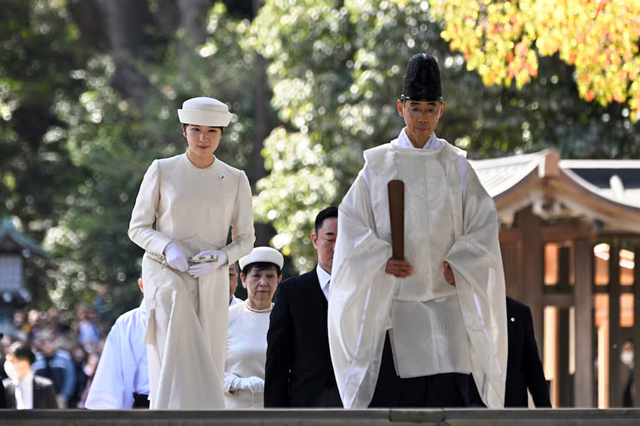
Japan’s parliament approved a landmark reform of the country’s Imperial House Law on Friday, preserving the long-standing system of male-only succession to the Chrysanthemum Throne while excluding Princess Aiko, the only child of Emperor Naruhito and Empress Masako, from the line of succession. The legislation also introduces a mechanism allowing the adoption of eligible men from former imperial branches in an effort to preserve the continuity of the world’s oldest reigning hereditary dynasty.
The measure marks the first revision of Japan’s imperial succession law since the end of the Second World War. It was introduced by the Liberal Democratic Party (LDP), led by Prime Minister Sanae Takaichi, who became Japan’s first female prime minister after taking office in October 2025.
The legislation passed the House of Councillors with 184 votes in favor and 57 against. In addition to the governing Liberal Democratic Party and its coalition partner, the Japan Innovation Party, several opposition parties supported the measure. The Japanese Communist Party voted unanimously against the bill, maintaining its position in favor of allowing a woman to ascend the throne, while progressive factions of the Constitutional Democratic Party also opposed the legislation.
Lawmakers simultaneously adopted a resolution calling for continued study of future succession arrangements in response to changes in the size of the imperial family, leaving open the possibility of further discussion as demographic pressures continue to affect the institution.
Before departing for an official visit to the Netherlands and Belgium on 11 June, Emperor Naruhito commented on the government’s proposal, saying he hoped it would be “something the people can understand.” Some observers interpreted the statement as an indirect reference to repeated public opinion surveys showing support for allowing a woman to become emperor at levels approaching 80 percent.
Japan’s imperial family currently consists of 16 members, but only three men remain eligible to inherit the throne under existing law. Crown Prince Akishino, the emperor’s 60-year-old brother, is first in the line of succession, followed by his 20-year-old son, Prince Hisahito. Prince Hitachi, the emperor’s 90-year-old uncle, is third in line. Under the current succession rules, the imperial line would come to an end if Prince Hisahito were not to have male descendants.
To address the shortage of male heirs, the amended law allows unmarried men aged 15 or older from former collateral branches of the imperial family, descended through the male line from past emperors, to return to the imperial household through adoption. The reform seeks to expand the pool of potential successors while maintaining the principle of patrilineal succession.
Eleven former imperial families, comprising 51 individuals, lost their noble status during the Allied occupation following the Second World War as part of democratic reforms that significantly reduced the size of the imperial household. Those measures limited membership in the imperial family to the immediate relatives of Emperor Hirohito, the grandfather of the current emperor. Although the occupation authorities introduced sweeping constitutional changes, they retained the patrilineal succession system that Japan had adopted during the Meiji Restoration in the nineteenth century.
The revised law also changes the status of female members of the imperial family. Under previous rules, princesses lost their imperial status upon marrying commoners. They will now retain their imperial status after marriage, although their spouses and children will remain private citizens and will not become members of the imperial family or enter the line of succession.
Public opinion appears more favorable toward restoring former male-line descendants to the imperial family than extending hereditary status to the families of female royals. According to a Jiji Press survey, 40 percent of respondents support granting succession rights to adopted male descendants from former imperial branches, while 34 percent favor extending noble status to the husbands and children of imperial women.
Tomohiro Kuni, a member of one of the former imperial families who lost its status after the war, expressed doubts about the adoption proposal in a recent interview with the Asahi Shimbun. Kuni, now 81, said that by the age of 15 a person has already spent a lifetime living outside the imperial household. He also noted that families such as his are separated from Emperor Naruhito by at least 36 generations through a common ancestor who lived approximately 600 years ago. While questioning the adoption plan, Kuni also said he would have no objection to Japan one day having a reigning empress, adding that Prime Minister Takaichi’s rise to office demonstrated that a woman can reach the country’s highest political position.