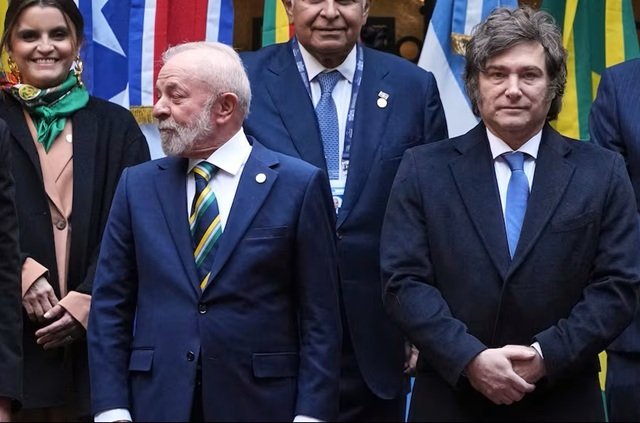
The increasingly bitter personal feud between Argentine President Javier Milei and Brazilian President Luiz Inácio Lula da Silva has escalated into the most serious diplomatic confrontation between Argentina and Brazil in recent years, after fresh insults from Milei prompted Brasília to recall its ambassador for consultations while underscoring the contrast between deteriorating political relations and enduring economic ties.
The latest crisis unfolded after Milei travelled to São Paulo on Saturday, bypassing diplomatic protocol by declining to meet Lula and instead appearing at an event supporting Flávio Bolsonaro’s presidential ambitions. During his address, the Argentine president referred to Lula as “corrupt” and a “convict”, remarks that triggered an immediate diplomatic response from Brazil.
Brazil recalled its ambassador to Argentina, Julio Bitelli, for consultations, with Foreign Minister Mauro Vieira describing Milei’s comments as “extremely serious and unacceptable”. Lula himself refrained from responding publicly, maintaining the restrained approach that has characterised Brazil’s handling of the increasingly strained relationship.
One of the few departures from that measured stance came from Brazil’s Economy Minister, Dario Durigan, who described Milei as a “clown” during a media interview and rejected the Argentine leader’s criticism of left-wing economic policies by pointing to Brazil’s stronger economic indicators. According to the report, the remarks were not well received within the Brazilian government, where officials preferred to contain the dispute rather than escalate it further.
The deterioration in relations predates Milei’s presidency. During Argentina’s 2023 presidential campaign, Lula warned during a visit to the United States that democracy in Argentina was at risk. Although he did not mention Milei by name, the then-candidate interpreted the remarks as directed at him. Tensions intensified further after advisers involved in Lula’s successful election campaign joined the campaign team of Sergio Massa ahead of Argentina’s presidential run-off, reinforcing Milei’s belief that Brazil had openly aligned itself with his political rival and continued its longstanding affinity with Kirchnerism.
Relations worsened further following Milei’s inauguration in December 2024. Former Brazilian president Jair Bolsonaro attended the ceremony as an honoured guest, while Lula remained in Brasília. Months later, during Milei’s first visit to Brazil as president, he again declined to meet Lula, instead attending a far-right political convention where he repeated his criticism of the Brazilian leader. Since then, the two presidents have encountered one another only briefly at international forums including the G20 and Mercosur, limiting their interactions to formal handshakes. On some occasions, the report states, Milei has avoided regional meetings altogether to prevent direct contact.
The personal hostility has been mirrored by profound policy differences, particularly over the future of Mercosur. Lula views the regional bloc as an essential vehicle for strengthening South America’s collective influence in global affairs, whereas Milei regards it as an obstacle that limits Argentina’s ability to negotiate independent trade agreements. Despite these differences, Mercosur recently concluded its long-awaited free trade agreement with the European Union after more than two decades of negotiations.
Economic relations, however, have remained remarkably resilient. Bilateral trade reached $31.2 billion last year, the highest level recorded in thirteen years. Brazil remains the principal destination for Argentine exports, while Argentina continues to purchase a substantial share of Brazil’s manufactured goods. Brazilian exports to Argentina grew by more than 30 per cent during the past year, driven largely by the automotive industry, illustrating the deep industrial integration between the two economies. The report notes that a vehicle assembled on the outskirts of São Paulo may contain an engine manufactured in Córdoba, highlighting the extent of cross-border production networks.
Institutional cooperation has also continued despite political tensions. Diplomatic channels between the two foreign ministries remain open, while customs cooperation and joint efforts to combat organised crime have persisted. Although Milei has expressed support for supporters of Jair Bolsonaro convicted over the attempted coup who fled to Argentina, judicial cooperation between the two countries has remained intact, with Argentina providing Brazil with requested information on fugitives.
Brazil has also previously assisted Argentina by managing the Argentine embassy in Caracas after Nicolás Maduro expelled Argentine diplomats. Milei publicly thanked Brazil for the gesture, although the arrangement ended in January 2026 when Brasília withdrew from the role, officially citing a technical reorganisation of its diplomatic mission. The decision coincided with another downturn in bilateral relations after Milei published a video on X celebrating Maduro’s fall and concluding with footage of Lula embracing the Venezuelan leader.
According to the report, Milei’s repeated personal attacks on Lula, describing him as a “communist”, “corrupt”, “thief” and “convict”, serve to energise his political supporters in both Argentina and Brazil. Lula, by contrast, has largely declined to engage directly, stating only that Milei owes an apology to Brazil and reserving his political criticism of foreign leaders primarily for US President Donald Trump.
Beyond official relations, public sentiment has also become more strained. The longstanding football rivalry between the neighbouring countries has intensified during the World Cup period, while several high-profile incidents involving racism by Argentine tourists have attracted widespread attention in Brazil. One widely reported case involved Agostina Páez, who insulted Black employees at a bar in Rio de Janeiro by calling them “monkeys” and imitating the animal. After spending two months in pre-trial detention under electronic monitoring, she returned to Argentina, where sections of the far right portrayed her as a symbol of what they called the “woke dictatorship”. Former Argentine Security Minister Patricia Bullrich publicly embraced her upon her return, while the Brazilian government chose not to politicise the incident.
Despite nearly three years of recurring disputes, the relationship between Argentina and Brazil appears to have settled into an uneasy equilibrium. Each new diplomatic confrontation has become more severe than the last, yet neither government has allowed the disputes to undermine a partnership rooted in decades of economic integration, industrial interdependence and strategic cooperation. While personal relations between Lula and Milei remain openly hostile, the breadth of shared interests continues to compel both governments to preserve essential channels of communication.