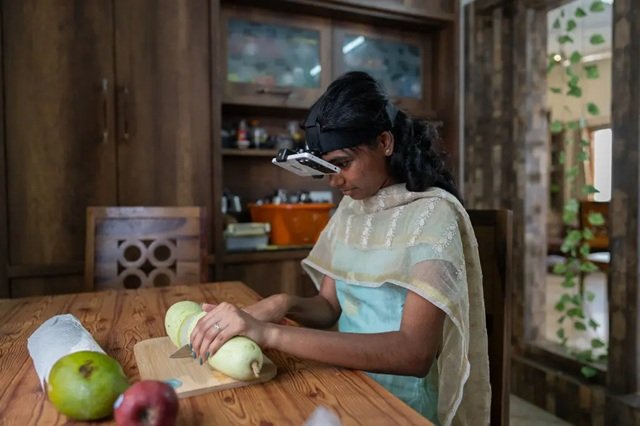
In Karur, near the southern tip of India, the rise of artificial intelligence is visible not only in technology but in the hundreds of young people who fill the city’s streets during breaks from work. Men and women in their 20s move between offices with corporate identification cards hanging from lanyards. Others work from home, recording themselves with smartphones strapped to their heads as they chop vegetables, make beds and perform other ordinary household tasks.
They are part of the rapidly expanding field of data annotation, a sector that still depends heavily on human labour. Data annotators examine information, identify errors and locate blind spots in artificial-intelligence systems, helping refine models used in self-driving cars, automated assembly lines, retail inventory systems and increasingly sophisticated robotic devices.
The work can be repetitive. Workers may spend hours examining video frame by frame, determining how effectively an artificial-intelligence model has performed a particular task. Yet the jobs illustrate an important contradiction in the technological transformation now under way: artificial intelligence can eliminate established forms of employment while simultaneously creating new forms of work whose purpose is to make the technology itself more capable.
Aiswarya Palaniswamy, 25, who holds a master’s degree in data analytics, joined the Karur-based Objectways Technologies last year. The company, whose clients are mainly American companies using artificial intelligence in their products, employs 2,600 people, including 300 hired in the last month.
Ms. Palaniswamy watches footage involving products in the rapidly expanding physical-A.I. sector, including self-driving cars and humanoid robots, and records how well the systems perform their assigned tasks. She believes the demand for such work will remain strong.
“There will always be data. There will always be information,” she said.
That confidence reflects a broader employment challenge in India. As artificial intelligence automates work such as payroll and data entry, opportunities for young graduates are becoming an increasingly important economic concern. Around 2 million Indians turn 18 each month, making the creation of steady employment a particularly pressing issue.
The problem has also become politically significant. The lack of opportunity for young people was an animating impulse behind the “cockroach” protests over education that erupted last month. Prime Minister Narendra Modi, who has promised to lead India into a golden era of prosperity and modernisation, replaced his education minister. Yet the deeper problem of providing skilled employment for graduates remains.
Data annotation offers one response, although its scale and durability remain uncertain.
Objectways’ skilled entry-level office positions pay around $210 to $260 a month, a comfortable salary in a small city like Karur, which has around 440,000 people. Less-skilled workers who record themselves performing household activities at home are paid $2.50 an hour for usable footage on a freelance basis.
The work is increasingly connected to machines that are intended eventually to perform those same activities. At Objectways’ laboratories in Karur, where two New York Times reporters visited in July, employees were annotating data for a humanoid robot designed to perform household chores. Other projects included a device intended to help blind people by describing their surroundings.
In a test kitchen, a worker recently operated robotic pincers fitted with cameras while they picked up plates, unscrewed the top of a water bottle, poured its contents into a cup and arranged food. Similar tasks were repeated in a test bathroom and bedroom.
“We are giving the robot the data and saying ‘learn from this,’” said Ravi Rajalingam, the founder and chief executive of Objectways.
Mr. Rajalingam established the company in his hometown in 2019 after working with a lending company to streamline its application process with artificial intelligence. His wife hired the company’s first 20 employees. He now sees data annotation as something different from the traditional role India has played in global outsourcing.
“India is the back office for the world, no longer,” Mr. Rajalingam said.
He acknowledged that many of the positions do not require engineering degrees, but argued that the work remains technical and can provide employees with knowledge of A.I. models. Many workers, he said, progress through the company.
Mohamed Afsar, 29, is one example. After growing up nearby and becoming the first person in his family to attend college, he was promoted and now oversees 600 employees working on projects at Objectways’ offices in Coimbatore, about two and a half hours west of Karur.
The scale of the work is considerable. Mr. Afsar said 200 people can process 70 hours of video a day showing robots or self-driving cars in operation. Yet the company receives 1,000 hours of video from clients every day, leaving a substantial volume still to be analysed.
For India, the economic attraction is clear. Analysts estimate that data annotation could contribute up to $10 billion to the country’s economy by the end of the decade. But the sector remains too small to persuade economists and policymakers that it will give India a meaningful advantage in the global A.I. race.
India’s government has also recognised the danger of creating another generation of jobs that technology could eventually remove. S. Krishnan, who leads the country’s information and technology ministry, said India should exploit the scale of its 1.4 billion people in areas where human knowledge remains necessary, including translating the country’s many languages and monitoring patients in intensive care wards.
“We have to look for higher-value-added jobs,” Mr. Krishnan said.
That concern is reinforced by a 2025 report from a government think tank, which estimated that as many as 1.5 million jobs in information and technology services could disappear because of disruption from artificial intelligence.
India’s challenge is therefore not simply to create A.I.-related employment, but to ensure that such employment survives technological change. The government would prefer homegrown A.I. companies developing their own applications, rather than relying primarily on data-annotation work for foreign clients.
Puneet Jindal, chief executive and founder of Labellerr, a data-annotation company in Punjab, said the expansion of artificial intelligence would create greater demand for data from diverse populations and in many languages.
“India is one of the most diverse countries on planet Earth, and people have so many different ways of working,” Mr. Jindal said. “The kind of scale you can get from India is phenomenal.”
Yet the country began its major A.I. push relatively late. One Morgan Stanley report described India as a “laggard”, and its first considerable A.I. development initiative did not arrive until 2024, when the government announced a $1.25 billion, five-year plan. That slow start left less room to absorb technology-related job losses.
For now, however, the young employees at Objectways appear willing to occupy the space between human labour and machine capability. They are training robots to perform tasks that humans currently perform themselves, while earning a living from the process.
Hari Prasad, 25, graduated with an engineering degree last year. He did not expect his career to involve work resembling science fiction.
“If someone had told me that 10 years down the road a robot would be bringing you coffee, I wouldn’t have believed them,” he said.
Today, his work is helping to make that possibility real.
“We need a man to train the robot,” he said with a smile.