President Donald Trump’s decision to order the Department of Defense to reduce joint military exercises with South Korea has unsettled one of Washington’s most important alliances in Asia, while his renewed engagement with North Korean leader Kim Jong Un has prompted wider concern among US partners about the dependability of American power in the Indo-Pacific.
The joint exercises with South Korea have taken place since 1955, making them a longstanding pillar of military cooperation between the two countries. Their reduction therefore carries significance beyond the immediate training schedule. Security cooperation and building partner capacity remain core components of US objectives in Asia, but scaling down the exercises is likely to affect the military readiness of both the United States and its allies.
The United States currently maintains approximately 28,500 troops in South Korea, stationed near the demilitarised zone (DMZ) separating the two Koreas. Conducted under the auspices of Ulchi Freedom Shield, previous exercises have included war games and simulations designed to provide lessons relevant to how a future conflict could unfold. Similar lessons from war games simulating an Iran war scenario appear to have been ignored in the lead-up to war with Tehran, according to The Soufan Center, whose analysis forms the basis of this account.
The decision has also exposed tensions between Washington and Seoul over the ongoing war with Iran. Trump appeared frustrated by South Korea’s unwillingness to provide more assistance to the United States in that conflict. Yet the public criticism of Seoul came at the same time as Trump heaped praise on North Korea and its leader, leaving many Asian allies concerned about Washington’s reliability both in the short term and over the longer term.
For some governments, the shift raises a more fundamental question: whether they should begin preparing for what they regard as the inevitability of a post-American world order. That concern is particularly acute as China continues its rise and pursues military modernisation. Since the start of the US and Israeli war with Iran in late February, Washington has repositioned critical military assets in the Middle East, moving them away from the Indo-Pacific, at least for now.
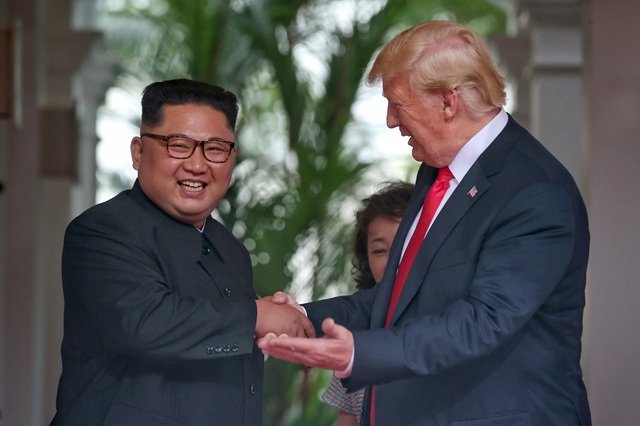
Against this backdrop, Trump’s renewed interest in Kim Jong Un is strikingly familiar. During his first term, the president openly praised what he called “love letters” between himself and the North Korean leader. Trump and Kim met in Singapore in 2018 and again in Vietnam in 2019. Yet those diplomatic efforts eventually collapsed after negotiations broke down over what Kim viewed as Trump’s maximalist demands for complete denuclearisation. The relationship later deteriorated, with Kim referring to Trump as a “mentally deranged U.S. dotard.”
What has changed sufficiently for Trump to seek rapprochement again remains unclear. North Korea has, if anything, developed closer relationships with several US strategic competitors and adversaries. During Russia’s ongoing war with Ukraine, Pyongyang has assisted Moscow with manpower and materiel, including munitions and ballistic missiles. North Korea has also strengthened its relationship with China and worked more closely with Iran, including on missile cooperation.
That record makes the prospect of another denuclearisation agreement appear highly unlikely to many observers. Yet, according to the Wall Street Journal, Trump has been pressing his aides to find a way to arrange another summit with Kim, with a strong preference for a meeting before the end of the year.
The timing has fuelled speculation about the political purpose of the renewed diplomacy. With the Iran war going poorly, some have suggested that Trump may be seeking a major foreign-policy achievement that could define his presidency. Reducing military exercises with South Korea could serve as an incentive for Kim — a gesture of goodwill and potentially a confidence-building measure intended to provide something tangible in exchange for a willingness to engage.
The nuclear dimension makes the calculation still more consequential. Trump recently said that he believes North Korea possesses 57 nuclear weapons, as well as multiple delivery vehicles. The disclosure was notable because it involved highly sensitive information from the President of the United States. Jeffrey Lewis, a leading authority on North Korea’s nuclear programme, has speculated that Pyongyang’s arsenal may instead be “in the low hundreds”, based on advances made over the past decade.
The debate over North Korea also reflects a much broader lesson drawn from the past 25 years. Countries without nuclear weapons programmes — Iraq, Libya and Iran — have proved more vulnerable to conventional military attacks. Countries that have broken the nuclear taboo, particularly North Korea, have been insulated from such attacks.
That pattern is now being examined against the consequences of the war with Iran. A growing concern is that countries, including Iran itself, could conclude that developing nuclear weapons is the only reliable means of ensuring regime survival. Such a conclusion could encourage further nuclear proliferation and fuel a worldwide arms race, creating profound risks for global security and regional stability.
The question facing Washington’s Asian allies is therefore larger than whether military exercises on the Korean Peninsula will be reduced. The issue is whether changes in US military priorities, combined with renewed diplomacy with North Korea and pressure on longstanding partners, signal a broader transformation in American strategic commitments.
The Soufan Center’s analysis places these developments within a rapidly changing international system in which alliances are fraying and longstanding norms are eroding. For allies from Tokyo to Manila, the concern is not simply what Washington does with North Korea today, but what its decisions reveal about the durability of American power and security commitments across the Indo-Pacific tomorrow.