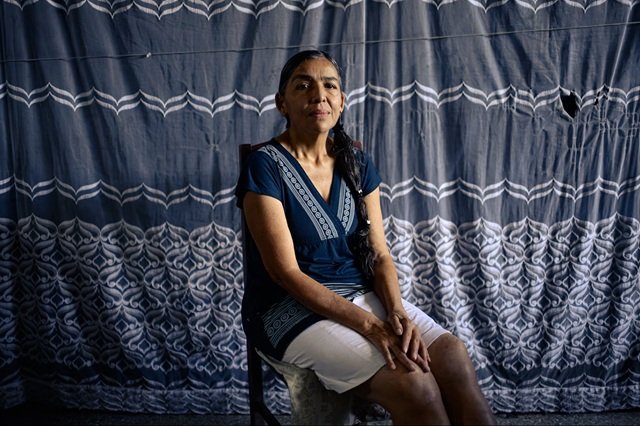
The double earthquake on June 24 and recent torrential rains in Caracas have reopened an old wound in Venezuela: the plight of families who have spent years waiting for state-provided housing while living in shelters, abandoned buildings and makeshift accommodation. A feature published by El País documents the lives of people whose temporary refuge has stretched across more than a decade, with some dying before ever receiving a home.
A few years ago, Magdalena bought a set of dishes she dreamed of using for the first time in the house the state would eventually provide after she lost her home in 2012. A landslide in Catia, west of Caracas, caused by heavy rains destroyed her house along with those of 60 other families. She moved into an abandoned building on José Ángel Lamas Avenue that was already sheltering displaced families.
Some residents eventually found housing, including in La Guaira, although some later lost those homes after the earthquake. Magdalena never left the shelter. In 2025, after 13 years, she died waiting. The dishes she had bought for her future home remained unused.
Her story forms part of a much longer history of displacement. Venezuela’s refugees awaiting state-provided housing have accumulated through several tragedies, the most prominent being the 1999 Vargas mudslide. That disaster triggered the occupation of abandoned buildings and was followed by further waves of displacement. Over the past 15 years, residents of unplanned constructions in working-class areas of western Caracas and La Guaira have lost homes to heavy rains, collapses or official declarations that their properties were uninhabitable. Hundreds of families were left without permanent housing solutions.
At the José Ángel Lamas shelter, Moraima, one of those still waiting, climbs four flights of stairs every day despite osteoarthritis, ligament instability and grade 4 cartilage deficiency that prevents her from bending her knees. She uses a cane and walks more slowly than she can manage. She lives with her son Abraham, who has severe autism, and her brother, who has heart and kidney disease.
After the June 24 double earthquake, the danger became more immediate. Engineers assessing the building’s columns warned her: “If there’s another earthquake, run down the stairs.” Moraima’s response was blunt: “But how can I run with my condition?”
Her accommodation is what she calls a “humanized space”. It is not an apartment but a kind of cubicle that she has gradually filled with mattresses, sheets used to divide the space and household appliances during 14 years of waiting.
At one point, Moraima received approval for an 8,000 bolivar loan, about $10, to buy a house. But the amount was insufficient for anything beyond shacks in favelas, which she says she cannot afford because of her disability. She has since waited for a larger loan or a more suitable home. After several devaluations, and with the money not arriving, securing a place through the “secondary market”, the housing loan programme for refugees, has become almost a lottery.
The problem extends well beyond families displaced directly by natural disasters. At the Pomarrosa Tower in Catia, 110 families have arrived over 16 years under circumstances ranging from victims of so-called security operations called OLP to state workers and families experiencing homelessness.
Among them is Yarcelis, a 41-year-old mother of six. One of her children has autism and microcephaly. She has lived in the tower for 10 years with her two youngest children and her mother, who suffers from prolapse.
Yarcelis does not work. She survives through assistance from her eldest daughter and her children’s stepmother, as well as alms. “I’d like to go wherever they’ll give me because, imagine. With so many things going on, sometimes you get depressed, because sometimes you don’t even have enough to eat, even if you have internet,” she says.
Yet she has not tried to leave independently. “I’ve always been waiting, because here they say that if you speak up or say anything… they scare you. There are so many things.”
Life inside Pomarrosa is tightly restricted. The entrance is locked after 10 p.m., residents cannot enter or leave, and 20 people share a bathroom. Water does not arrive every day, while residents are forbidden from opening their windows. “They treat us like cockroaches,” Yarcelis says.
The restrictions became particularly stark during the double earthquake. Families experienced the aftershocks inside the building. Marioxis Barrios, an official with the Presidential Commission for Dignified Shelters, explained that residents live in cubicles assigned to a state institution and require written authorisation to leave at night or receive visitors because they are not the owners.
The Capital District government currently houses 398 families in five shelters intended as temporary locations for disaster victims and four makeshift shelters. These are state-sanctioned occupations of abandoned buildings that once housed hotels, airlines, museums or banks and are now occupied by people described as having “social needs”.
The shelters are guarded by the Peace Defense Brigades, known as Cupaz, created by Nicolás Maduro in 2019 to impose social and political control on communities, according to the material published by El País.
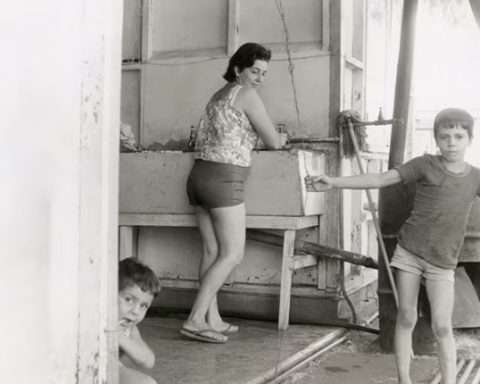
At La Posada de Catia, the passage of time is visible in the children who were born there. They play with a ball that no longer bounces, while water tanks serve as an improvised swimming pool. Nearby, a neighbour keeps pigs, chickens and ducks.
Raúl has lived there since his home in the Federico Quiroz sector of Catia collapsed in another flood in 2010. “When I finally get my own house, maybe I’ll kill them,” he says of the animals.
His neighbour José arrived under similar circumstances with his pregnant wife. He says many people have left, but that departures stopped on July 28 of 2024, which he associates with what he describes as the “election mess” and the subsequent repression.
The number of residents at the Catia shelter has fallen sharply. More than 100 families lived there in 2010; today, only 15 remain. The reduction has provided more space and somewhat better living conditions, but it has not resolved the central uncertainty: when will those still there receive permanent homes?
“I don’t know exactly when my turn will come, because you have to understand that this can’t happen overnight, and thank God, I’m not living under a bridge,” one resident says. “We’re waiting. The only action I’m going to take is when they tell me to look for my house.”
At Casa Taller in Catia, 21 families remain. Jessica, the shelter’s main spokesperson, says many residents have left the country, while only two were given housing, in the Valles del Tuy region. She wants to remain in Caracas because of her husband’s job and her daughter’s illness.
The shelter has been without water for a month, with bathrooms shared among 12 people. Jessica hopes housing can eventually be constructed on the site. She says residents have been told that a Self-Government Hall may be built there so that the Cupaz can operate, but believes there is room for housing as well.
The government’s response has included new housing deliveries. In July, Delcy Rodríguez’s government delivered 200 homes to victims of the double earthquake, just three weeks after the event. Those still living in places such as Pomarrosa and Casa Taller subsequently voiced complaints through TikTok. The response was another census of families and a warning that videos and acts of disobedience in shelters and refuges would not be accepted and could be addressed through legal action.
For residents of Caracas’s shelters, the recent earthquakes and rains have therefore revived not only fears about physical safety but also memories of years spent waiting. Most of these shelters are located in Libertador Municipality, historically dominated by Chavismo, and many of the buildings have significant leaks and post-earthquake damage that has not been addressed.
For people who have spent more than a decade waiting, the fear is no longer limited to whether the state will provide a home. There is also anxiety that demanding one could result in being sent somewhere even worse.
That uncertainty has produced a striking resignation among residents whose lives have been shaped by prolonged displacement. Their words continue to express hope, even as years of waiting have become part of daily life.
Jessica leaves the future to faith: “We have to be patient and pray so that we can benefit, because we don’t have the resources to buy a home. We have to trust in God: the opportunity will come.”