On a Monday evening in May, Japan’s Finance Minister Satsuki Katayama sat down for dinner with US Treasury Secretary Scott Bessent at a Japanese restaurant inside a 400-year-old garden in central Tokyo. Bessent was due to meet Prime Minister Sanae Takaichi the following day, but first he had concerns to raise with Katayama.
Over two hours, Bessent expressed frustration over the economic direction pursued by Takaichi’s government. The prime minister had expanded government spending while leaning on the Bank of Japan to maintain low interest rates. The policy was contributing to capital leaving Tokyo and pushing the yen to four-decade lows.
Bessent believed the yen had fallen too far. A weaker currency was worsening inflation in Japan while also creating difficulties for the administration of President Donald Trump, who has repeatedly argued that a weak yen disadvantages American exporters.
Bessent argued that Japan’s currency could be supported if the Bank of Japan raised interest rates. He questioned why the central bank was not being given greater autonomy and why some of Takaichi’s economic advisers continued to promote the benefits of a weak yen.
The tensions later culminated in an extraordinary joint intervention in currency markets by Katayama and Bessent in late July. The move temporarily strengthened the yen after it had fallen as low as ¥164 to the dollar.
The relationship between Japanese fiscal policy, monetary policy and Washington’s concerns was again on display this week. On Monday, Katayama met Bessent at a Group of 20 finance meeting in Asheville, North Carolina. Investor concerns over Japanese government spending subsequently helped push 10-year Japanese government bond yields to a 30-year high on Tuesday amid a broader global bond sell-off.
Katayama said she had explained to Bessent the Takaichi administration’s approach of increasing government spending while reducing debt relative to the size of the economy. She said Bessent “understood and appreciated” her explanation, while denying reports that he had urged her to press the Bank of Japan to raise interest rates.
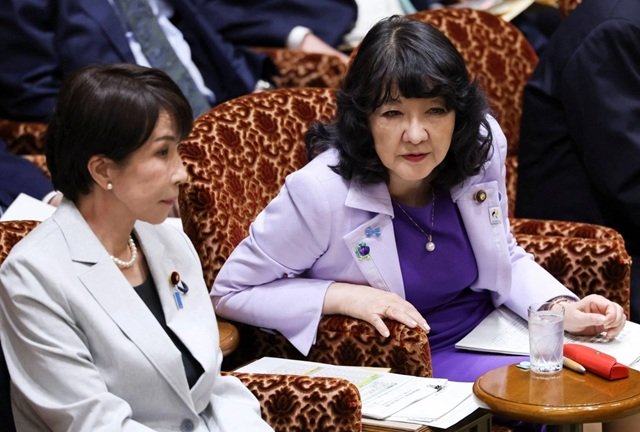
At 67, Katayama has emerged as a crucial intermediary between a Washington seeking a stronger Japanese currency and a prime minister whose expansionary fiscal agenda has weakened the yen and increased market concerns over Japan’s debt.
“People see her as a very important bridge between the Japanese monetary authorities and the U.S. side, and someone who’s seen as trying to pull back Prime Minister Takaichi’s aggressive instincts on fiscal policy,” said Izumi Devalier, chief Japan economist at Bank of America. “That’s not an easy job.”
Katayama spent more than two decades at Japan’s Ministry of Finance before entering politics and has publicly supported the independence of the Bank of Japan. Her position has become more difficult as the yen’s gains following the July intervention quickly faded, with the currency returning towards the politically sensitive level of ¥160 to the dollar.
Analysts and economists say a significant policy shift will be necessary to strengthen the yen more permanently. Katayama’s challenge is complicated by her close political relationship with Takaichi and their differing approaches to economic policy.
Takaichi has long advocated low interest rates and aggressive government spending to stimulate growth, once dismissing the prospect of higher Japanese interest rates as “stupid”. Katayama, shaped by her years in the Finance Ministry, has generally taken a more orthodox position, arguing that the yen was too weak and that Japan needed to live within its means.
Her career has been marked by a series of breakthroughs in a traditionally male-dominated political and bureaucratic system. In 1978, she was one of only 15 women among 630 students in a humanities class at the University of Tokyo. In 1982, she became the only woman in her entry cohort at the Ministry of Finance, where she sought a broad understanding of how national budgets shaped the country.
Katayama has recalled experiencing isolation during her early years in the ministry, where senior management treated her presence as an experiment. She nevertheless advanced through the bureaucracy and developed a reputation for being among its most feared officials.
In 2005, she entered Japan’s House of Representatives, becoming known for blunt remarks and distinctive pastel suits. In 2017, she publicly acknowledged ambitions to one day lead Japan. When Takaichi appointed her in October, Katayama returned to the ministry as Japan’s first female finance minister.
The appointment immediately exposed tensions between political loyalty and economic discipline. Officials at the Finance Ministry reportedly feared that Katayama’s relationship with Takaichi could limit her ability to restrain government spending.
“As a former Ministry of Finance official, Katayama clearly values fiscal discipline,” said Motohiro Sato, a professor of public finance at Hitotsubashi University in Tokyo. But he said she “lacks the level of clout to say ‘no’ to Ms. Takaichi” and has seemingly gone along with the prime minister’s direction.
In December, Japan approved its largest-ever annual budget proposal, worth more than $780 billion, with increased spending on technology investment and defence. When Takaichi promised tax cuts the following month, concerns over Japan’s debt burden pushed bond yields higher and the yen fell sharply.
Katayama and Bessent have held roughly a dozen discussions and are described by people familiar with their interactions as having a friendly rapport, despite their contrasting backgrounds. Bessent is a private-sector investor associated with free-market policies, while Katayama spent much of her career as a government bureaucrat accustomed to state-directed economic intervention.
Speculation following the currency intervention suggested Katayama could lose her position in a September Cabinet reshuffle. Later reports indicated she was likely to remain, partly because of her importance as a link between Japan and the United States and between Takaichi and Bessent.
Koichi Hamada, professor emeritus at Yale University and a former senior economic adviser to Prime Minister Shinzo Abe, knows both officials. He described Katayama and Bessent as reasonable figures who may hold differing views from their respective political leaders.
“If Mr. Bessent and Ms. Katayama keep talking, that will be a good thing,” Hamada said.