Wittenoom no longer appears on Australia’s road signs. It has been removed from official maps, abandoned and effectively erased. Nobody lives there, and visiting is prohibited. Yet for decades this remote settlement in Western Australia’s Pilbara region was a functioning mining town, complete with schools, a hospital, a church, a shop, a bar, an open-air cinema, sporting grounds and a police station.
Its existence depended on a single resource: blue asbestos.
For the Spanish families who arrived there in the 1960s, Wittenoom represented something very different at first. It was an opportunity. Like millions of Europeans who left poorer countries after the Second World War, they had travelled in search of work and a better future. Some Spaniards went to Germany, Switzerland, France or Belgium. Others crossed the Atlantic. A much smaller number travelled almost to the other side of the world.
Australia became one such destination under an agreement between the Franco regime and the Australian government that began in 1958. Nearly 8,000 Spaniards eventually travelled there under what became known as Operation Kangaroo. They worked in sugar cane, construction, tobacco, forestry and mining.
Wittenoom offered miners good wages in return for living in one of the most isolated places imaginable. Perth, the nearest major city, was about 1,400 kilometres away — roughly the distance between Madrid and Geneva. For migrants willing to endure the isolation for months or years, the financial rewards could appear worth the sacrifice.
But the mine around which Wittenoom was built contained enormous quantities of crocidolite, commonly known as blue asbestos, a mineral prized at the time for its resistance to heat and used in pipes, trains, ships, electrical installations and countless other products.
The company operating the mine, Australian Blue Asbestos, a subsidiary of Colonial Sugar Refining Company, had been extracting the mineral at Wittenoom since 1943. The company saw a major commercial opportunity.
What workers and their families were not told was that the material surrounding them could eventually kill them.
The story of Wittenoom, as recounted by EL PAÍS, is also the story of two Spanish families whose lives briefly intersected in the isolated settlement: the families of Daniel and María, and Milagros and Ramón. Their children were born in the same hospital, surrounded by red dust, reptiles and asbestos.
María Bernal met Daniel Écija at a dance at Madrid’s Círculo de Bellas Artes on 16 September 1961. She was 20; he had just turned 26. They married a year later. Four days afterwards, on 24 September 1962, they emigrated to Australia.
Neither spoke English.
María, now 84, remembers the journey as a mixture of fear, excitement and hope. It was her first time leaving Madrid and her first flight. She and her new husband carried only a small suitcase between them. Australia was impossibly distant, but she trusted the man she had married and believed in the future.
The family eventually reached Wittenoom. There they encountered a community of European migrants — Italians, Greeks, Poles, Irish and Spaniards — living in a settlement that seemed almost unreal to newcomers from Madrid.
Another Spanish couple, Milagros Barroso and Ramón de Juan, were already part of that world. Their families soon became close.
Víctor Calvo, now 72, arrived in Australia with his family when he was seven. His journey from Málaga took more than 20 days by ship. He remembers passing through the Suez Canal, the heat, the uncertainty and finally the small propeller aircraft that carried the family towards Wittenoom.
He remembers the red earth and the dust.
The settlement was made up largely of houses constructed from metal, wood and asbestos cement. There were snakes, tarantulas and enormous lizards. To a child accustomed to Spain, the place seemed like another world.
For the adults, however, the reality was harsher.
Daniel worked eight-hour shifts in the mine. Ramón sometimes worked 16-hour days. Accidents were common. On Daniel’s first day, his family later recalled, an explosion killed several people.
There were few safety measures. Ambulances appeared frequently enough that the settlement had its own hospital. Yet neither family understood that the danger extended far beyond the obvious risks of mining.
Asbestos was everywhere.
Children played with it. They handled the material and pulled it apart. Dust covered their surroundings. Nobody warned them.
In June 1963, María gave birth to Daniel Écija Jr in the Wittenoom hospital. Milagros had given birth to John Patrick only months earlier, in March. The two Spanish families had arrived thousands of kilometres from home and found themselves raising children in a mining settlement whose deadly legacy would emerge only decades later.
The Écija-Bernal family stayed for about 10 months. The De Juan-Barroso family remained for roughly two and a half years, from 1962 to 1964.
Both eventually left for Perth. They worked, saved money and built new lives. The Écija-Bernal family returned to Madrid in 1966. The De Juan-Barroso family followed in 1971, although Mercedes remained in Australia after marrying an Italian.
At the time, none of them understood that Wittenoom had already entered their lives in a way that could not simply be left behind.
In 1991, nearly three decades after Daniel Écija had left the mine, his family received devastating news: he had mesothelioma, an aggressive cancer strongly associated with asbestos exposure.
Nine months later, he was dead. He was 55.
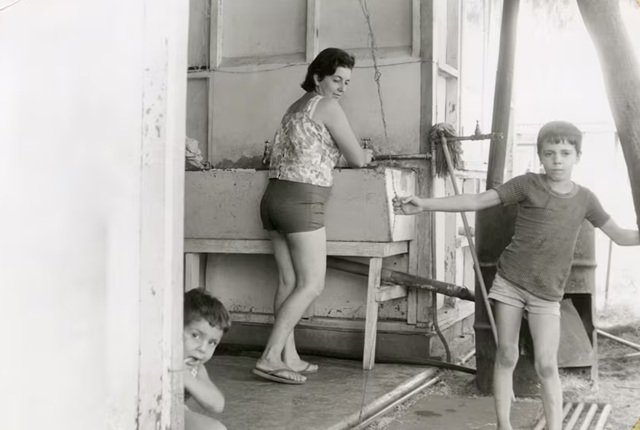
His death forced the family to reconstruct a past they had barely understood. They returned to old photographs and memories of Wittenoom and began to discover what had happened there.
More than 2,000 workers and residents had died from diseases linked to asbestos exposure, including mesothelioma, lung cancer and complications associated with asbestosis. Some deaths occurred decades after people had left the town.
The number may be considerably higher. Melita Markey, chief executive of the Asbestos Diseases Society of Australia, told EL PAÍS that the government stopped counting at 2,000, while current estimates could exceed 4,000. New cases continue to emerge, including among children of people who worked in the town as police officers and teachers.
The tragedy was made more disturbing by what was already known about the danger.
Warnings about asbestos dust had emerged as early as 1944. By 1946, a case of asbestosis had been diagnosed, while an inspector described working conditions as “terrorific”. In 1948, public health doctor Eric Saint warned in writing that dust levels were extremely dangerous. Further warnings followed.
In 1958, another inspector described the situation as a disgrace.
Three years later, Spanish migrants arrived without being warned about the danger.
The mine eventually closed in 1966, but the consequences continued. Legal battles followed, and in 1979 affected workers established the Asbestos Diseases Society of Australia. Documents that emerged through litigation showed that the company had known about the risks while failing to take adequate measures. In 1988, a judge found that the mining company had demonstrated “continuous, conscious and contumacious” disregard for the safety and health of its workers.
CSR reached a settlement with 200 affected people in 1989, paying A$18.3 million in compensation. Further litigation followed, with tens of millions of dollars eventually paid to former workers and their families.
Wittenoom itself slowly disappeared. Authorities began pushing for its closure in 1978. Electricity and services were cut in 2006. In 2007, its official status as a town was removed and its name disappeared from official maps. The last resident remained until 2022.
But erasing the name did not erase the contamination.
The former mining area remains polluted by microscopic blue-asbestos fibres, across an enormous area of about 46,840 hectares. The focus has now shifted towards cleaning the site. The Banjima people, the Aboriginal people whose traditional lands include the area, have this year lodged a A$1.5 billion claim against the Western Australian government over contamination of land and water.
For survivors and former residents, Wittenoom remains a personal threat as much as an environmental legacy. Mercedes de Juan and her brother John, who live in Australia, undergo annual medical examinations funded by the government, including scans and lung-function tests.
They are among the dwindling number of former residents who still carry memories of a town that officially no longer exists.
For Daniel Écija Jr, who was born there, Wittenoom is inseparable from the loss of his father.
His family had travelled to Australia because they had little in Spain and believed that the remote mining town offered a chance to build something better. His father was not seeking danger. He was an immigrant looking for work.
Decades later, the consequences of that decision remain.
The final irony came in 1985, when Daniel returned to Australia as an adult. At an airport checkpoint, a police officer looked at his passport, saw his place of birth and raised his eyes.
“So you’re from Wittenoom, are you? A terrifying place.”
The town had already begun to disappear from Australia’s maps.
But for the families who lived there, Wittenoom had never disappeared at all.