by Our Political Affairs Editor
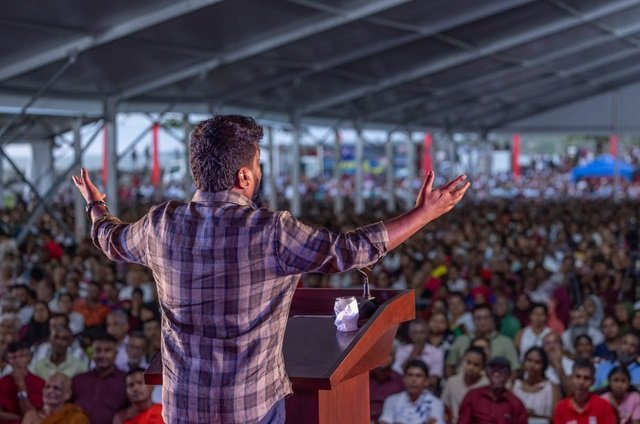
President Anura Kumara Dissanayake has discovered a remarkably simple prescription for two of Sri Lanka’s most serious public-policy problems. Build 50 more universities and tell sick people not to crowd hospitals. The first is grandiose. The second is deeply disturbing. Together, they reveal a government that appears increasingly comfortable announcing enormous solutions while avoiding the structural failures that actually require political courage.
Dissanayake’s promise to establish another 50 universities is difficult to take seriously when Sri Lanka’s existing university system remains burdened by decades of political interference, inadequate resources, delays and a culture in which students have repeatedly become collateral damage in political struggles. The JVP, which now dominates the government, cannot escape responsibility for the political culture it helped create around universities. It spent years treating campuses as political territory rather than institutions whose primary obligation was to educate young people. Thousands of students who wanted nothing more than a decent education were repeatedly caught between academic aspirations and political mobilisation. A government led by the JVP therefore has little credibility in presenting the multiplication of university institutions as though numbers alone will solve the country’s educational crisis.
There is also an uncomfortable precedent. The idea of expanding post-school education through institutions outside the traditional university system was not invented by Dissanayake. The Gotabaya Rajapaksa administration promoted the city university concept, envisaging institutions at provincial level that would provide vocational and practical education to young people who could not secure admission to conventional universities. Whatever one’s assessment of the Rajapaksa administration, the underlying problem was correctly identified. Sri Lanka does not need to pretend that every young person must follow the same academic route. It needs credible alternatives offering technical, vocational and professional skills linked to employment. Dissanayake’s proposed expansion may therefore resemble an attempt to revive or reproduce an idea that had already been placed on the political table. But promising 50 institutions is another matter entirely. Without teachers, laboratories, funding, accreditation, curricula, employment pathways and institutional independence, 50 new names on signboards will not constitute 50 new universities. They will constitute 50 new administrative burdens.
The President’s remarks on public health are far more consequential. A politician who once urged citizens to challenge governments in court over failures involving hospital treatment now appears to be telling citizens that they should not overwhelm hospitals and should first obtain recommendations at the primary-care level. That is a remarkable transformation in less than two years. The problem is not the principle of strengthening primary healthcare. Every sensible health system needs effective primary care, referral mechanisms and appropriate use of hospitals. The problem is the manner in which responsibility appears to be shifted from a failing or overstretched system onto the patient.
According to Dissanayake’s account, people are going to hospitals unnecessarily, asking for medicines despite not being sick, and should instead remain at home and drink koththamalli. If that is the President’s message, it represents an extraordinary descent in the political conversation about public healthcare. Poor people do not go to hospitals for entertainment. Patients do not ordinarily spend hours travelling, waiting and paying associated costs merely because they enjoy standing in queues. When citizens seek medical attention, the state should first ask why they believe they need it. It should not simply tell them to stay at home.
The danger is that such language can normalise the erosion of confidence in public healthcare. If hospitals are overcrowded, the government must fix the causes of overcrowding. If primary healthcare is inadequate, strengthen it. If unnecessary prescriptions are being issued, regulate prescribing. If medicines are being misused, improve clinical oversight. If patients are bypassing primary care because they do not trust it, repair that trust. None of these problems is solved by telling ordinary citizens to drink koththamalli.
There is an especially bitter irony here. The JVP spent years in opposition presenting itself as the defender of ordinary people against governments accused of failing them. Now, after gaining power, the same political movement faces the responsibility of governing the system it once attacked. Citizens who voted for change did not vote to be told that hospitals are overcrowded because they seek treatment too readily. They voted for a state capable of providing better services.
Dissanayake should be careful about what he normalises. Fifty universities without educational substance would be an expensive illusion. A healthcare system in which patients are discouraged from seeking hospital care without an appropriate referral would be something worse. It would place the burden of systemic failure on the very people who depend most heavily on the public system.
The President once spoke to citizens as though government failures were reasons to challenge the state. He now governs the state. That change carries a responsibility he cannot escape. Sri Lanka does not need another slogan, another political promise or another improvised remedy. And it certainly does not need a government telling the sick to stay at home with a cup of koththamalli while it congratulates itself on fixing the country.
Sri Lanka is still a democracy. But when political slogans and propaganda machinery begin to sound like echoes from a darker European past, the comparison becomes uncomfortable. “Heil Hitler”, “Sieg Heil”, “Ein Volk, ein Reich, ein Führer” — phrases once used to glorify absolute political power. Today, Sri Lanka has neither Hitler’s Germany nor a dictatorship. But when a government begins telling citizens what to believe, how to behave and even when to seek medical treatment, those historical echoes should not be dismissed lightly. Democracy can survive only when power remains accountable. Heil President “Koththamalli”.